
Editor's Note: This article is part of an ongoing RANE series on the shifting patterns of global trade. Previous installments have examined the Americas, the Strait of Hormuz, Japan and South Korea, India, Turkey, ASEAN countries, Mercosur, Congo and East Africa, as well as broader topics like data flows, maritime chokepoints (part one and part two) and digital trade.
Ongoing revisions to the European Union's supply-chain due diligence framework reflect a softening of ambitious sustainability goals as competitiveness, economic security and trade diversification take precedence, easing near-term compliance burdens for businesses but maintaining binding ESG obligations, regulatory fragmentation and long-term uncertainty for large companies and high-impact sectors such as energy, agriculture and manufacturing. The European Union is weakening its most ambitious supply-chain sustainability rules — the Corporate Sustainability Due Diligence Directive (CSDDD), the EU Deforestation Regulation (EUDR) and the Corporate Sustainability Reporting Directive (CSRD) — by delaying implementation, easing compliance and narrowing obligations. As part of the ''Omnibus'' simplification package presented in February, Brussels proposed giving companies more time and flexibility and softening due diligence, disclosure and liability requirements for all three initiatives. In April, the European Union also adopted the ''Stop-the-Clock'' Directive, pausing transposition and first-phase application of both the CSDDD and the CSRD to prevent immediate compliance deadlines from overwhelming companies while broader reforms move forward. After the European Council agreed on its negotiating mandate in June 2025, the European Parliament is set to vote on the proposal during a plenary session in November. European Parliament negotiators will then hold trilogue talks with the commission and council, aiming for final adoption by late 2025. Implementation of the CSDDD and CSRD has been pushed back to 2028, with a lighter reporting framework and reduced scope. Meanwhile, after weeks of speculation, the European Commission confirmed in October that the EUDR will still take effect on Dec. 30, 2025, for large and medium-sized companies. However, micro and small operators will have an additional year, with the regulation applying to them from Dec. 30 2026. The commission also introduced a six-month grace period before enforcement begins, and streamlined due diligence requirements by limiting mandatory submissions to the first importer and easing obligations for smaller and downstream operators.
- The CSDDD was proposed in 2022 and formally approved in 2024. It aims to harmonize national supply-chain laws and ensure companies account for human rights and environmental risks across their operations, subsidiaries and value chains and prepare credible climate transition strategies aligned with the 2015 Paris Agreement. Before the directive's adoption, European Parliament and European Council negotiators narrowed its reach by raising thresholds to cover only the largest firms and staggering implementation over several years. Applicability thresholds were raised to 1,000 employees and 450 million euros ($523 million) in turnover in 2024, exempting most mid-sized firms and phasing obligations over three to five years. The 2025 Omnibus package further lifted thresholds to 5,000 employees and 1.5 billion euro turnover while also limiting due diligence to direct partners, requiring deeper checks only with ''objective and verifiable'' risks, softening climate duties to ''reasonable efforts,'' extending reviews to five years and replacing the EU-wide liability regime with national rules.
- The CSRD was proposed in 2021 and formally approved the following year, with the purpose of harmonizing sustainability disclosures across the European Union and ensuring that companies report consistently on ESG impacts. The directive requires large firms and listed SMEs to disclose detailed information on sustainability risks, opportunities and transition strategies, aligned with the EU Taxonomy and global ESG frameworks. Over the years, revisions have significantly reduced its scope, raising applicability thresholds to 1,000 employees or 450 million euro turnover, excluding about 80% of originally covered companies and postponing first reporting from 2026 to 2028. The 2025 Omnibus package further eased compliance by granting data exemptions, reducing value-chain burdens on small suppliers, softening transition plan rules and scrapping stricter assurance standards.
- The EUDR was proposed in 2021 and adopted in 2023. It aims to curb global deforestation by banning imports of commodities such as soy, beef, palm oil, coffee, cocoa, rubber and timber unless companies can prove they are not linked to deforested land. Implementation has faced repeated delays because of political and technical challenges. Exporting countries such as Brazil, Indonesia and the United States argue the rules impose disproportionate costs on producers, especially smallholders. EU governments and industry groups have warned that the regulation will cause trade disruptions, compliance burdens and food security risks. In 2024, Brussels proposed exemptions for small producers, lighter duties for first importers and ''zero-risk'' status for some EU members. The European Commission's October 2025 proposal for another one-year extension for small businesses will now be discussed by the European Parliament and the European Council under ordinary procedure, aiming for approval by the end of 2025 (though this timeline appears ambitious).
- The ''Omnibus'' simplification package is a cross-cutting initiative designed to ease compliance burdens in sustainability reporting and due diligence, with the goal of strengthening competitiveness and attracting investment into the bloc.
These revisions to the European Union's supply-chain sustainability framework reflect a change of focus from ambitious environmental goals to a prioritization of competitiveness, energy security and industrial resilience in the bloc. The three supply-chain sustainability regulations were conceived during the first von der Leyen commission as part of the European Green Deal, Brussels' flagship plan to embed climate, sustainability and social standards across the bloc's economy and trade relations. Launched in 2019, the Green Deal reflected a moment when climate change ranked among the top public concerns in Europe, centrist parties dominated EU and national politics and support for ambitious sustainability targets was strong across the bloc. However, by the time von der Leyen began her second term in December 2024, political and economic conditions in the bloc had shifted sharply — and with them, priorities in Brussels. The COVID-19 pandemic's supply-chain disruptions and the energy and inflation crisis following Russia's 2022 invasion of Ukraine elevated competitiveness, industrial resilience and energy security above climate and sustainability concerns. Industry groups, exporters and member states all increasingly resisted measures seen as costly and disruptive, warning of excessive burdens on small and mid-sized firms, agricultural producers, industry and trade relations. The political balance also changed. Von der Leyen's second commission is far less united around the Green Deal, reflecting a turn to the right after the 2024 European Parliament elections, which strengthened conservative groups prioritizing shielding traditional industries, farmers and overall economic interests over decarbonization goals. Most national governments are now led by right-leaning parties skeptical of the green agenda or have been compelled to temper their support for it in a bid to compete with rising right-wing parties. Together, these pressures have driven a systematic push to dilute, delay or scale back measures.
- The commission's agenda - and thus initiatives like the Omnibus simplification package - is heavily informed by former European Central Bank President and Italian Prime Minister Mario Draghi's September 2024 report on European competitiveness. The report warned that persistently high energy costs, regulatory fragmentation and excessive red tape — including burdensome reporting obligations — are undermining the European Union's industrial base and global competitiveness. Draghi called, among other things, for streamlined and harmonized regulatory frameworks as well as a more ambitious trade strategy to reduce strategic dependencies and strengthen partnerships with resource-rich countries.
- Reflecting the recommendations of Draghi's report, the Omnibus simplification package aims to harmonize ESG reporting standards, cut red tape, reduce reporting obligations for SMEs and ease corporate liability for human rights and environmental violations across value chains while at the same time providing greater legal certainty and improving compliance. Proposed reforms seek to balance the drive for competitiveness with the preservation of an EU-wide sustainability framework that maintains core environmental and social commitments.
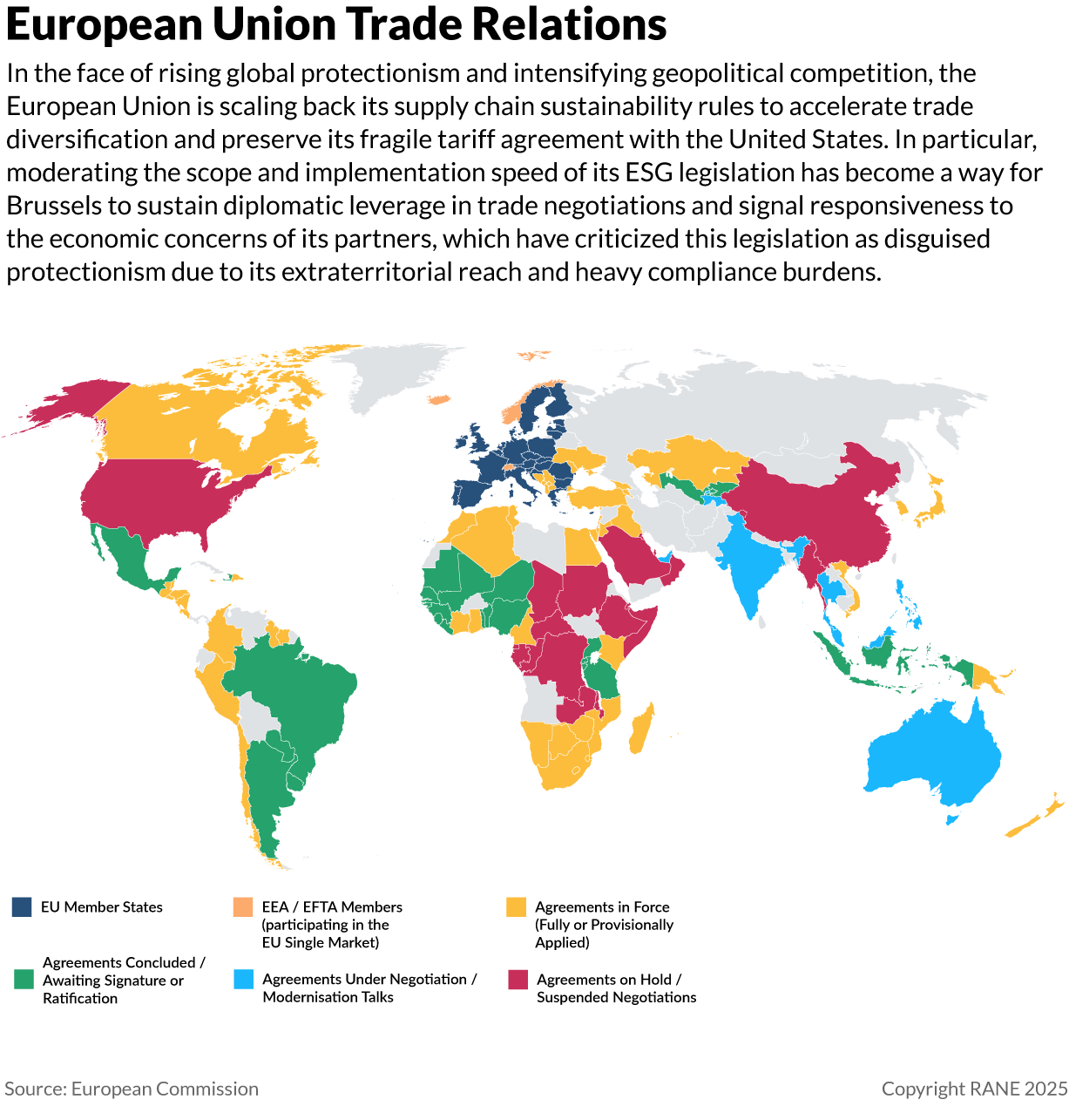
Rising global protectionism and intensifying geopolitical competition are also forcing Brussels to water down its supply-chain sustainability rules in order to accelerate trade diversification and preserve a fragile trade truce with Washington. Confronted with mounting protectionist pressures in Washington, slowing Chinese demand for European exports and growing concerns over dependency on Chinese supply chains for critical resources, technologies and manufacturing inputs, the European Commission has made trade diversification a central pillar of its economic security strategy. The drive to de-risk imports from China and secure access to new export markets has given renewed momentum to free trade negotiations with partners such as Mercosur, India, Indonesia, Mexico and Australia. These efforts have collided with the European Union's green regulatory agenda. Major trade partners have sharply criticized the CSDDD, the CSRD and the EUDR as forms of disguised protectionism due to their extraterritorial scope and heavy compliance burdens. The EUDR, for instance, has faced strong opposition from commodity exporters, which argue that the law unfairly penalizes producers and risks distorting global trade. Similarly, the CSDDD and the CSRD have triggered concerns among multinational firms about legal uncertainty, regulatory overlap and high compliance costs that may conflict with domestic frameworks. The United States has been especially vocal in opposing the European Union's supply-chain due diligence rules. The Trump administration has pressed EU policymakers to exempt U.S. companies from environmental and reporting obligations as part of a growing list of demands linked to the European Union's July pledge to address what it sees as unfair non-tariff trade barriers. For Brussels, moderating the scope and pace of implementation has become a pragmatic tool to sustain diplomatic leverage, avoid jeopardizing ongoing trade negotiations and signal responsiveness to partners' economic concerns.
- In the Aug. 21 EU-U.S. joint statement outlining the framework for a bilateral tariff agreement — building on the July political accord between von der Leyen and U.S. President Donald Trump to curb reciprocal tariffs — Brussels pledged to ensure that its ESG and sustainability regulations do not create ''undue'' barriers to transatlantic trade. To address Washington's concerns, the European Union agreed to engage on the implementation of the EUDR, recognizing negligible deforestation risk for U.S. producers and designating the United States as a low-risk sourcing partner while also committing to discuss administrative simplifications and overlapping obligations under the CSDDD and the CSRD. However, the European Commission clarified that these steps would remain limited to dialogue and exchanges of views, without granting preferential treatment to U.S. firms or revising existing EU legislation.
While the outright repeal of major sustainability rules remains unlikely, Brussels will use the Omnibus I simplification package to both appease member states seeking lighter regulation and present its deregulatory measures as concessions to Washington and other trade partners; further revisions are also possible amid mounting pressure from the European Union's key trade partners and energy suppliers. The European Commission will fold in requests from the Trump administration for exemptions and lighter compliance into the Omnibus simplification package by narrowing the scope of the CSDDD and the CSRD and classifying U.S. exporters as ''low-risk'' under EUDR. Feedback from partners, including Brazil, Indonesia and import-reliant EU member states like Austria and Poland, has also already shaped Brussels' decision to, once again, postpone the EUDR. It may lead to further revisions down the line, including carve-outs for small producers and limiting due diligence to first importers rather than entire supply chains. These adjustments reflect pragmatic efforts from the European Commission to reconcile competitiveness concerns and trade concessions with the European Union's broader sustainability commitments. However, recent joint calls from the United States and Qatar to scrap or significantly amend the CSDDD due to its potential impact on their liquefied natural gas (LNG) exports to Europe have intensified pressure on Brussels to further amend or delay the legislation, as the bloc phases out Russian gas and increases reliance on U.S. and Qatari LNG. This will, in turn, strengthen the position of those within the European Council and European Parliament advocating slower implementation or selective suspension. In recent months, France and Germany have even called for the CSDDD's full repeal, arguing that supply-chain due diligence rules stifle competitiveness and investment within the European Union. But despite mounting external and internal pressure for deeper revisions or even outright repeal, Brussels remains unlikely to push beyond dilution, delays and selective carve-outs in its recalibration of sustainability legislation, as strong political and institutional counterweights persist. Abolishing the directive would require fragile cross-party alliances in the European Parliament, potentially including far-right support. German Chancellor Friedrich Merz would also face pushback from coalition partners in the Social Democratic Party, while French President Emmanuel Macron, preoccupied with political instability at home, has little bandwidth to engage on the issue, and many member states remain committed to maintaining an EU-level due diligence framework. Similarly, Brussels has already made clear it will not yield to U.S. pressure to scrap its green standards entirely in exchange for tariff relief.
- A recent breakthrough on the Omnibus simplification package — sealed through an Oct. 8 compromise between the center-right European People's Party and the Socialists and Renew groups (after EPP had threatened to seek support from far-right lawmakers instead) — confirms that Brussels' pivot toward a more flexible, business-friendly sustainability regime is now politically entrenched. The new centrist consensus favors deregulation and lighter reporting burdens for companies, even at the expense of the Green Deal's original ambition. Still, any move toward outright repeal would likely see progressive, climate-focused groups withdraw their support.
- The Trump administration has recently intensified pressure on the European Union to revise its supply-chain legislation or grant exemptions to U.S. businesses, sending Brussels a position paper in October urging changes to the bloc's green legislative agenda. The document calls for the removal of requirements obliging non-EU firms to submit climate transition plans and for exemptions for U.S. companies and others from jurisdictions with comparable standards under the European Union's due diligence rules. The commission replied that any adjustments will proceed strictly within the terms of the Aug. 21 joint statement, which foresees no such concessions.
- On Oct. 22, the United States and Qatar jointly urged the European Union to withdraw or substantially amend the CSDDD, which they said would, in its current form, complicate their LNG exports to the bloc. In an open letter to Brussels, U.S. Energy Secretary Chris Wright and Qatari Energy Minister Saad Sherida al-Kaabi called for a reopening of talks with major exporters to revise provisions applying to non-EU companies, compliance penalties and climate transition obligations, arguing that the proposed amendments currently under negotiation by Brussels do not adequately address these concerns.
- In May, French President Emmanuel Macron and Merz jointly urged the full repeal of the CSDDD, arguing that the directive should be abolished outright rather than merely delayed or diluted. Their stance forms part of a broader Franco-German effort to ease regulatory burdens and strengthen the European Union's global competitiveness — a coordinated push since Merz's election in May that extends beyond supply-chain due diligence to include areas such as water pollution, chemical safety and circular-economy legislation. Both leaders contend that the CSDDD hampers investment, exposes export-oriented industries to legal risks and places European manufacturers at a disadvantage compared to the United States and China, particularly as they are already grappling with persistently high energy costs and mounting global trade barriers.
The recalibration of the European Union's sustainability framework will ease near-term compliance burdens and costs for businesses but preserve long-term uncertainty and structural complexity, as due diligence remains a permanent requirement and diverging national regimes, evolving standards and enduring climate commitments ensure sustained regulatory and reputational pressures across sectors. The easing of compliance requirements, narrower due diligence scope and delayed timelines will reduce administrative costs and legal exposure for businesses, shrinking the number of entities covered by the measures and lowering the frequency of costly mapping exercises. This will provide relief, particularly to SMEs and importers struggling with complex verification systems. Agricultural exporters and commodity traders will gain breathing space to adjust sourcing practices and avoid near-term supply disruptions or market exclusion. However, while reverting from the EU-wide liability framework to divergent national regimes may lessen pressure in some jurisdictions, it will also reintroduce a degree of legal fragmentation. Claimants will seek favorable courts amid uneven transposition across member states - most of which are likely to implement the directive narrowly, though a few more progressive-leaning countries and with stronger domestic due diligence frameworks may still adopt standards stricter than the European Union's. This will complicate compliance and compel multinationals to maintain flexible systems capable of adapting to different requirements across jurisdictions. If LNG exporters succeed in securing exemptions or narrower liability definitions amid recent U.S. and Qatari pressure, it will set a precedent for other third-country suppliers to demand similar treatment, further weakening the directive's extraterritorial scope and complicating its enforcement. While revisions explicitly aim to reduce compliance burdens by softening due diligence and climate obligations, for large firms developing detailed assessments of human-rights and environmental risks by country and commodity and setting clear internal criteria for when the ''objective information'' test requires deeper supply-chain due diligence revisions, which will be essential to mitigate litigation, regulatory and reputational risks, avoid financial penalties and preserve EU market access. Moreover, for larger corporations with complex global value chains, reforms may ease administrative burdens but not the reputational or financial exposure linked to breaches or activist scrutiny. Though deadlines have been extended, staged implementation still means due diligence will remain a permanent element of the European Union's sustainability framework. From a longer-term point of view, delays and dilution may blur investment signals and leave firms uncertain about future compliance expectations as the European Union's still ambitious long-term climate and sustainability commitments imply stricter standards could still re-emerge further down the line under more favorable political and economic circumstances. For companies integrated into global agricultural and commodity supply chains — especially in high-risk sectors like palm oil, soy and timber — and for other high-impact industries such as energy, manufacturing, technology and retail, this means sustained pressure to adapt sourcing practices, enhance supply-chain transparency and align operations with evolving EU sustainability and human-rights standards will persist.
- The overlap between the council's general approach adopted in late June and early European Parliament drafts suggests that a final compromise on the CSDDD will center on tier-1 supplier scoping with risk-based extensions, the removal of EU-level civil liability and higher entry thresholds than in the version adopted in 2024 — likely above 1,000 employees or 450 million euros in turnover and potentially reaching 5,000 employees or 1.5 billion euros, even if the Parliament argues for a lower ceiling. The directive will maintain reduced reporting frequency, national-level enforcement and phased implementation, with both the transposition deadline and the first application phase postponed to 2028. Final interinstitutional negotiations will thus likely revolve around three issues: the scope and thresholds, including whether non-EU firms will face equivalent criteria; the balance between tier-1 limitation and risk-based triggers for deeper-tier due diligence; and the remedy mechanism, as the European Parliament is likely to seek minimum access-to-justice provisions even without harmonized civil liability. However, mounting external and internal pressure might still result in further revisions beyond the scope of the Omnibus package.
- For CSRD, the reform will streamline reporting templates, remove redundant data points, extend deadlines to 2028 and introduce proportionate reporting for SMEs to cut compliance costs. Under EUDR, implementation will proceed in phased stages, with likely exemptions for micro and small enterprises, simplified traceability requirements and initial enforcement focused on high-risk commodities and regions such as palm oil, soy and beef.
