
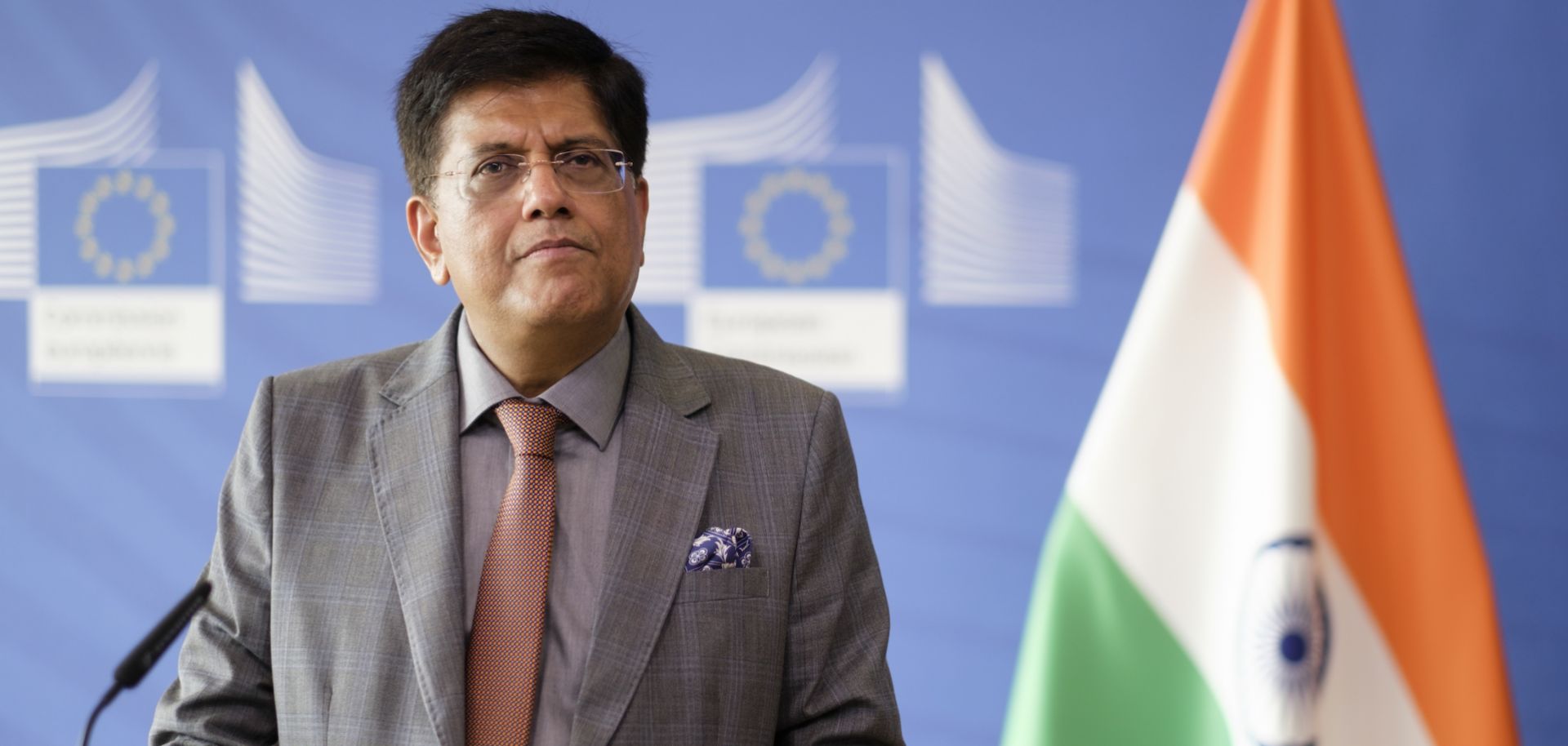
Indian Commerce Minister Piyush Goyal holds a press conference on EU-India trade relations at the European Commission’s headquarters in Brussels, Belgium on June 17, 2022.
Shared geopolitical interests will drive the European Union and India to continue their ongoing free trade negotiations, though outstanding obstacles mean that the process will be slow and complicated. On May 16, the European Union and India held the first ministerial meeting of their Trade and Technology Council (TTC) since launching the bilateral forum over a year ago. During the inaugural summit in Brussels, EU and Indian officials discussed issues spanning digital infrastructure, green technologies, supply chain resilience, quantum computing and semiconductors. Prior to the meeting, on May 15, Indian Commerce Minister Piyush Goyal and EU Trade Commissioner Valdis Dombrovskis also met to discuss the state of ongoing India-EU trade talks and agreed on further steps to accelerate negotiations. On the sidelines of the two meetings, however, bilateral tensions emerged — highlighting the challenges that still remain to closer India-EU cooperation. On May 16, EU foreign policy chief Josep Borrell called for Brussels to crack down on imports of Indian fuel made from refined Russian crude, which he claimed represented ''a circumvention of sanctions.'' Citing top Indian government and industry sources, Reuters also reported on May 16 that India was planning to file a complaint to the World Trade Organisation (WTO) over the European Union's Carbon Border Adjustment Mechanism, which threatens to impose tariffs of up to 35% on carbon-intensive imports from India.
- The EU-India TTC was launched in April 2022 as a high-level coordination platform to deepen bilateral cooperation in strategic areas such as trade, technology and security. Ministerial meetings are scheduled to take place at least once a year, while working groups meet regularly. The next TTC summit is planned for early 2024 in India.
- According to the EU press release issued on May 16, the inaugural TTC summit saw the European Union and India agree to collaborate on WTO reforms and intensify engagement on upcoming carbon border measures. When it came to trade, the two sides also pledged to ''deepen their common work on resilient value chains, work to resolve bilateral market access issues and exchange information on each other's mechanisms on foreign direct investment screening.'' On technology, EU and Indian officials agreed to cooperate on quantum computing and AI research and development projects, as well as coordinate policies and investments in their semiconductors industries through a dedicated Memorandum of Understanding. The two sides also agreed to promote the exchange of digital talent and work toward bridging the skills gap in the tech sector (which could translate into future labor migration programs) and agreed to coordinate on 5G, telecoms and Internet of Things standardization.
- On Feb. 5, the European Union began banning seaborne crude and refined oil products from Russia in response to Moscow's ongoing war in Ukraine. Amid the ban, India has been taking advantage of discounted Russian crude to turn into fuels and ship to Europe at higher margins, given tighter supply and demand balances.
The changing geopolitical landscape has renewed India and Europe's interest in strengthening their bilateral ties as a way to reduce their respective dependencies on China. Cooperation under the TTC is proceeding in parallel to Brussels and New Delhi's ongoing efforts to reach a comprehensive free trade agreement (FTA), though the TTC ministerial meetings offer an additional avenue for high-level discussions. While the two sides previously attempted to ink a trade deal in 2013, it ultimately collapsed due to insurmountable differences. However, the changing economic and geopolitical landscape — particularly following Russia's invasion of Ukraine and China's increasingly assertive behavior in the Indo-Pacific — brought India and the European Union back to the negotiating table in June 2022. New Delhi and Brussels' renewed push to ink a trade deal is driven largely by a shared desire to both reduce their dependency on China and curb Beijing's growing economic and geopolitical influence. For Europe, India's massive size and growth potential make it an attractive alternative to China for its exports, as well as manufacturing and investment. For India, Europe provides a huge export market, as well as an important alternative to China for the capital, technology and infrastructure development India needs to advance its economy. More broadly, a financially stronger and more independent India could create a counterweight to China's growing regional influence, which aligns with Europe's strategic interests as well.
- The European Union was India's third largest trading partner after the United States and China in 2021-22, accounting for almost 11% of total Indian trade. During the same time period, India was the European Union's 10th largest trading partner, accounting for 2% of the bloc's total trade in goods. Trade in goods between the European Union and India totaled 120 billion euros ($130 billion) in 2021-22, while trade in services between the two reached 40 billion euros ($43 billion), according to EU statistics. A free trade agreement would be expected to double trade volumes over a five-year period, according to estimates from the Economist Intelligence Unit.
- Political and diplomatic relations between the European Union and India have also deepened in recent years. In 2020, the two adopted a ''Roadmap 2025'' plan to further strengthen bilateral ties after elevating their relationship to a strategic partnership in 2004.
Despite their mutual interest in deepening bilateral relations, lingering issues will continue to complicate free trade negotiations. The TTC will help increase EU-India bilateral trade while also offering a strategic framework to foster cooperation in areas such as investment, technology and security, which will eventually help Brussels and New Delhi resolve the outstanding issues that still stand in the way of a trade deal. Unlike the previous round, the current negotiations are also divided into three separate strands for trade, investment protection and geographical indications, which should increase the likelihood of the European Union and India finalizing at least part of the comprehensive trade agreement, even if talks on other areas stall. But the FTA negotiations will likely still prove long and difficult, as overcoming the remaining technological and political roadblocks to a trade agreement will require a high degree of flexibility and willingness to compromise on both sides. The European Union and India first launched free trade negotiations in 2007, with high hopes of deepening economic ties between the two regions. However, talks were suspended in 2013 due to longstanding disagreements on issues like market access and tariff reductions — many of which remain unresolved. India, for example, will still be reticent to open up its sensitive manufacturing and agricultural sectors to international competition for fear of triggering social unrest and political backlash at home. Moreover, the European Union's strict sustainability requirements are considerably more demanding now than they were in 2013, which will further complicate negotiations.
- Influential industries in India — such as the dairy, beef, and poultry sectors — and small retailers are concerned about opening up their market to large European producers and retailers. Prime Minister Narendra Modi and his ruling Bharatiya Janata Party's supporters generally favor protectionist policies as well, which will further limit New Delhi's negotiating room with Brussels. To resolve its concerns about market access in a prospective EU trade deal, a compromise may be found by including asymmetric tariff liberalization with longer phase-in periods in sensitive Indian sectors or safeguard clauses in the event of significant jumps in imports (that could be offered to India, a developing country, on the basis of the special and differentiated treatment principle in the WTO system).
The European Union's new carbon tax and India's relations with Russia could also fuel tensions that further complicate negotiations between New Delhi and Brussels. On April 25, EU member states adopted a series of key pieces of climate legislation, including measures that establish a new Carbon Border Adjustment Mechanism (CBAM) for taxing imported goods based on their carbon footprint. Once the tariffs go into effect in 2016, the CBAM is expected to have a significant impact on India's exports of carbon-intensive products like steel, aluminum, cement, and fertilizers, which will likely face higher prices, reduced competitiveness, and lower demand in the European Union. With New Delhi planning to take the dispute to the WTO, the issue could strain relations and hinder FTA negotiations. India's continued relations with Russia amid the ongoing war in Ukraine could also emerge as a sticking point in trade talks. Since Russia launched its invasion in February 2022, New Delhi has refused to join Western sanctions against Moscow or scale back economic ties with the country. So far, this has not significantly dampened India's relations. However, the European Union is now stepping up efforts to close loopholes in sanctions that allow third countries to help Russia circumvent restrictions, which means India's exports of Russian crude-derived fuels to Europe could eventually fuel tensions with Brussels. Even so, the economic and geopolitical drivers for closer EU-India trade relations will likely continue to keep both sides interested in strengthening ties, despite these challenges.
- Under the CBAM, EU companies importing from outside the bloc will have to pay a tariff equivalent to the carbon price paid by European producers on the bloc's carbon emissions trading scheme. This measure has been criticized as an unfair trade practice by developing countries like India, which will face additional costs while taking longer to implement carbon-cutting policies.
- While taking steps to create its own carbon market, the Indian government published a draft for the institutional framework and operational mechanisms of an Indian Carbon Credits Trading Scheme (CCTS) in March 2023. New Delhi is also addressing concerns with the European Union's CBAM both multilaterally, including at the World Trade Organization (WTO), and with bilateral talks with the European Union. While the European Union is unlikely to make exemptions for India in the application of its CBAM, as this would be discriminatory towards other countries, other forms of collaboration are possible, including financial assistance from the European Union to help India decarbonize its most affected sectors.
- Indian imports of Russian crude oil have doubled since last year, rising for the eighth straight month in April to reach 1.7 million barrels per day (bpd), according to energy intelligence firm Vortexa. Russia displaced Iraq as India's top supplier for the first time in March. Meanwhile, Indian exports of refined oil products to the European Union have increased. Europe imported an average of 200,000 bpd of diesel and jet fuel from India since the EU ban on Russian oil products entered into force in February, up from about 150,000 bpd beforehand.
