
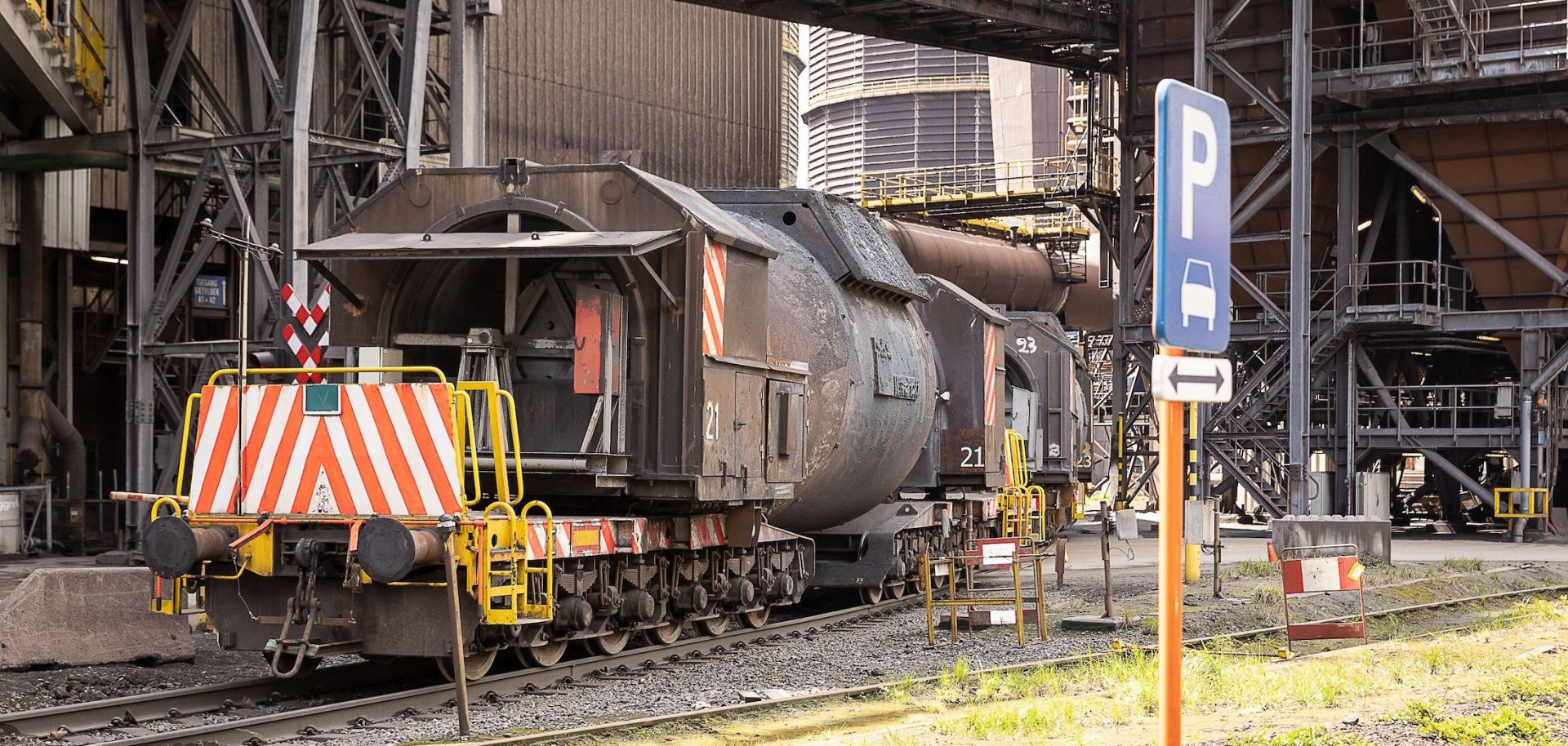
A production plant owned by the Luxembourgish steel manufacturing corporation, ArcelorMittal, is seen in Desteldonk, Belgium, on April 24, 2023.
A package of new climate laws will enable the European Union to cut carbon emissions within the main sectors of its economy by increasing the cost of polluting in the bloc, while also reducing the impact of that cost increase on vulnerable consumers, small businesses and industrial sectors. On April 25, EU member states adopted a series of key pieces of climate legislation, including a reform to the bloc's Emissions Trading System (ETS) that accelerates and increases the scope of emissions reductions by 2030. Before the end of the decade, the European Union now aims to cut emissions produced by ETS-covered sectors — which include electricity and heat generation, energy-intensive industries (like steel, aluminum, metals, cement, glass, paper, and chemicals), aviation and, for the first time, shipping — to 62% of 2005 levels, up from the previous 43% target. To hit that more ambitious target, EU countries have approved several changes to the ETS designed to reduce the supply of carbon allowances, phase out free permits for industries by 2034, and gradually bring in additional sectors to the carbon market beginning next year. The legislative package also includes measures that establish a new Carbon Border Adjustment Mechanism (CBAM) for taxing imported goods based on their carbon footprint, as well as a new separate emissions trading system for buildings (commercial and residential), road transport and other sectors. In addition, EU member states have agreed to temporarily set up a new Social Climate Fund between 2026-2032 to support vulnerable households, small businesses and transport users affected by the price impacts of the new carbon pricing. The EU Council's final sign-off on these proposals opens the door for them to become laws and enter into force over the next few years.
- Presented by the European Commission in 2021 under the European Green Deal, the so-called ''Fit for 55'' package of climate legislation sets the European Union's policy priorities to meet its commitment to achieve climate neutrality by 2050 and reduce its net greenhouse gas emissions by at least 55% by 2030 compared with 1990 levels.
- The adopted measures were previously negotiated by the EU Council and the European Parliament, which reached three separate provisional agreements on the ETS reform, on the CBAM, and on the Social Climate Fund in December 2022. The European Parliament approved the proposals on April 18; the final approval by EU member states marks the last step of the legislative process.
- The CBAM will be gradually rolled out over a nine-year period between 2026 and 2034, in parallel with the phasing out of free allowances in the ETS for covered goods.
- The shipping sector has been added to the ETS for the first time since the European Union's carbon emissions trading system was set up in 2005. By 2026, shipping operators will be forced to gradually surrender their free allowances currently provided by the ETS. Free emission allowances for the aviation sector will also be gradually phased out over the next three years, with 20 million allowances set aside until the end of 2030 to incentivize airliners' transition to sustainable aviation fuels. The new ETS for buildings, road transport and other sectors (mainly small industry) will apply to distributors supplying fuels to these sectors starting from 2027 (unless oil and gas prices are exceptionally high in the run-up to its launch, in which case this will be postponed to 2028).
- Revenues from the new emissions trading system, supplemented by national contributions, will provide up to 65 billion euros in financing for the new Social Climate Fund.
The updated ETS and newly established CBAM are meant to work in tandem, with the former encouraging decarbonization within the European Union, as the latter encourages more stringent climate regulation and higher carbon prices in the bloc's trading partners. Effectively a carbon border tax, the CBAM levies an import duty on goods destined for the European Union that are manufactured in countries with less-stringent climate legislation. Companies importing goods into the EU market from such countries will be required to pay the difference between the carbon price paid in the country of production and the one paid within the European Union for the same goods by purchasing CBAM certificates, of which prices will be pegged to that of ETS allowances. In other words, the higher the price of carbon allowances in the bloc's ETS, the higher the price third countries will have to pay to sell carbon-intensive products in the world's largest trading bloc. As such, the CBAM's introduction will have the greatest impact on countries with lower carbon prices (or o carbon prices at all) and high levels of exports of carbon-intensive goods to the European Union, which include Russia and China, and (to a lesser extent) the United Kingdom, Turkey, Australia, the United States and Canada, along with various North African and central Asian countries.
- Foreign companies importing goods into the European Union will purchase CBAM certificates based on the amount of carbon emitted in the production of those goods; the certificates will be priced based on average weekly ETS auctions.
- The CBAM is also meant to reduce the risk of a phenomenon known as ''carbon leakage,'' where European companies move production outside of the European Union to avoid paying higher carbon prices, and to protect domestic industries against competition from foreign producers paying lower carbon prices in their base country.
- Free allowances in the ETS are being phased out in parallel with the phase-in of the CBAM between 2026 and 2034, after which the CBAM will effectively cover more than 50% of emissions in ETS-covered sectors. The decision in Brussels to shift from free allowances to the CBAM was made on the assumption that the latter will more effectively address competition concerns since the CBAM directly accounts for carbon cost differences, thus leveling the playing field for domestic and international producers.
More broadly, the package of legislation is meant to accelerate the European Union's progress towards its 2030 climate targets by increasing carbon prices in the bloc, but the CBAM and Social Climate Fund will somewhat offset the negative impacts on EU citizens and industries. The more ambitious carbon-cutting targets for industrial sectors covered by the ETS will put upward pressure on the price of carbon in the European Union, which is currently about 85 euros per metric ton of carbon and is expected to surpass 100 euros per metric ton over the coming years. At the same time, the parallel phase-in of a carbon tariff on imports of carbon-intensive goods beginning in 2026 — including iron and steel, cement, aluminum fertilizers, electricity, hydrogen, and a limited number of downstream products — is meant to at least partially offset the advantages non-EU producers would enjoy from a rise in carbon prices within the European Union and remove incentives for EU-based companies to relocate to regions with looser climate regulations. Meanwhile, the launch of a new, separate carbon market covering emissions from fuels used in road transport and buildings in 2027 (or 2028, if energy prices are exceptionally high) is expected to increase gasoline and diesel prices by 0.10 euro per liter across the bloc — a likely contentious issue that could spark political and social backlash. The parallel launch of the European Union's new 86.7 billion euro Social Climate Fund in 2026 is aimed at mitigating the risk of such backlash by supporting vulnerable consumers affected by increased costs.
- The European Commission initially proposed completing the phase-out of free allowances in the ETS (and the simultaneous phasing-in of the CBAM) by 2035. But the European Parliament accelerated that phase-out schedule to 2034. The steel sector association Eurofer has warned this one-year difference ''risks wiping out'' 45 billion euros worth of EU steel exports.
- Carbon prices for home heating and transport fuels resulting from the new ETS scheme will be capped at 45 euros per metric ton to avoid the risk of a price escalation that could further raise the already high living and business costs in the European Union.
- In addition to financing temporary direct income support to tackle the increase in road transport and heating fuel prices, the Social Climate Fund will also provide EU member states with funding for long-term investments aimed at reducing their carbon footprint, like building renovations, renewable energy integration, EV charging infrastructure, and public transport.
- The phase-in of the CBAM in parallel with the phase-out of free allowances in the ETS is designed to only reduce the risk of carbon leakage and address competitiveness issues compared to non-EU producers. This means downstream sectors in Europe not included in either the ETS or the CBAM that consume a lot of energy, steel, aluminum, cement and other carbon-intensive inputs will be transferred most of the associated cost increases.
