
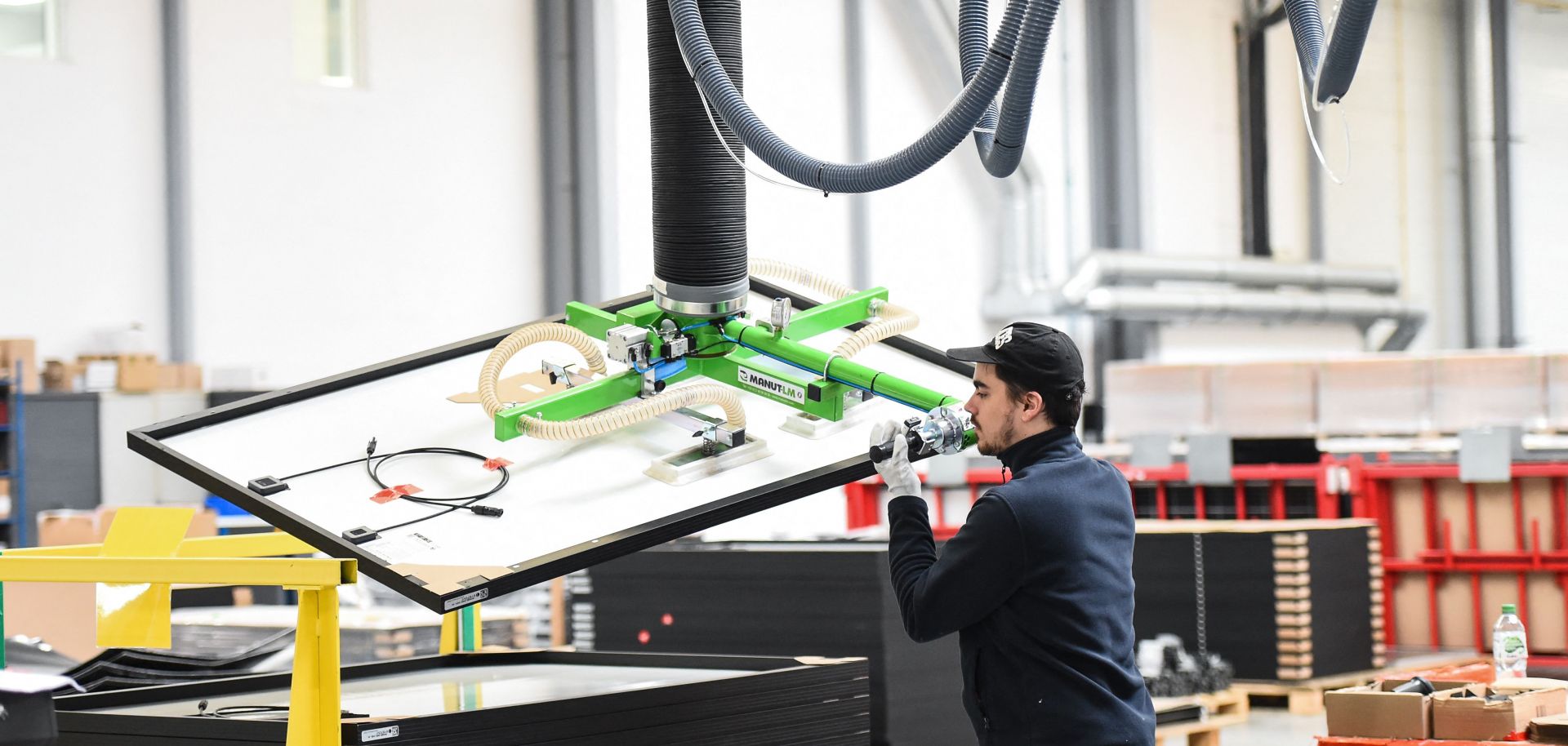
An employee works on a solar panel production line at a factory owned by the French company Systovi in Carquefou, France, on March 6, 2023.
Two key proposals for the future of the European Union's green industrial policy could help boost the bloc's green manufacturing capacity and further secure its supply of the raw materials needed to do so, but significant risks and constraints remain. On March 15, the European Commission unveiled its Net-Zero Industry Act and the Critical Raw Materials Act, two key proposals for the future of the European Union's net-zero transition and green industrial strategy. The former sets a goal for the European Union to domestically produce at least 10% and process at least 40% of its demand for materials critical to the energy transition, such as lithium and rare earths, by 2030. The latter includes a 40% industrial output target for green technologies in the European Union by 2030, as well as other measures aimed at streamlining regulatory requirements, shortening permitting processes, and improving labor skills. Both proposals will be subject to intense negotiations between EU member states and lawmakers in the European Parliament and may take months before either is approved.
- The Net-Zero Industrial Act would require EU member states to give clean-tech manufacturing projects special treatment by streamlining permitting procedures, granting them a priority and public interest status to ensure a rapid treatment in all judicial and dispute resolution relating to them, and giving authorities discretion to decide whether all of this should also override eventual environmental concerns. The proposal also calls on member states to support green projects by granting them access to financing and state aid, such as government guarantees, subsidized off-take agreements, and tax benefits.
- On procurement, the Net-Zero Industrial Act avoids explicit local content requirement provisions. But in public tenders, the proposal still introduces requirements for state authorities to consider ''security of supply'' based on ''the proportion of the products originating in third countries.''
- On March 17, the European Union also launched the new European Hydrogen Bank, which will contribute to the goals set out in the Net Zero Industry Act and Critical Raw Materials Act by supporting the financing of renewable hydrogen production and imports.
The European Union is seeking to secure its access to the technologies, products and raw materials that are key to the clean energy transition by boosting domestic production and diversifying imports. The Critical Raw Materials Act aims to ensure the European Union's access to ''a secure, diversified, affordable, and sustainable supply of critical raw materials'' that are central for strategic sectors like the green and digital industries. The Net-Zero Industry Act, for its part, aims to scale up manufacturing of clean technologies in the European Union to make sure the bloc is ''well-equipped for the clean-energy transition.'' Through these proposals, Brussels is hoping to reduce the bloc's deep-rooted reliance on China for both green products (like solar panels and batteries used to power electric vehicles), as well as raw materials (like rare earths and lithium) needed to domestically produce them. The Net-Zero Industry Act, in particular, is also designed to boost the European Union's ability to compete with China and the United States in the global race to develop and supply critical green technologies — especially as high energy prices and the global rise in protectionist trade policies fuel fears of an industrial exodus from Europe. A key element in the pursuit of both of these goals, in Brussels' view, is for member states to increase public support for green projects. To this aim, the European Commission recently proposed a new temporary crisis and transition framework that simplifies the bloc's state aid rules for green industrial projects, as well as for the production of critical raw materials.
- Demand for the raw materials used to manufacture products like heat pumps, solar panels and electric vehicles is projected to skyrocket in the coming years as the world moves away from fossil fuels. But Europe currently imports the vast majority of those materials — often from quasi-monopolistic countries like China, which supplies 98% of the European Union's rare earth materials, 97% of the bloc's lithium, and 93% of its magnesium. The European Union also only produces around 10% of the solar panels it deploys domestically.
- Europe lacks the mineral reserves and refining capacity to fully meet its domestic demand for rare earths, lithium or magnesium. Given this reality, the European Commission's Critical Raw Materials Act is meant to reduce the bloc's reliance on single countries for specific raw materials, rather than produce (or recycle) them all domestically. In doing so, the act also proposes establishing a so-called Critical Raw Materials Club to strengthen the European Union's trade relations with ''friendly'' resource-rich countries and boost investment in local production and refining, particularly in Africa. It would also see Brussels continue to pursue trade deals with resource-rich countries like Chile, Indonesia and Australia to further diversify the bloc's supplies.
- Europe also pays far more for its energy supplies compared with Asia and particularly North America. While prices have fallen sharply since hitting record highs in 2022, Europeans' gas and electricity bills are still much higher than those paid by industrial producers in China and the United States. The European Union unveiled a reform of its electricity market on March 14, though the proposal is mostly aimed at reducing volatility rather than drastically reducing prices.
- In recent months, a growing number of large European manufacturers have announced plans to move production outside of the Continent — particularly to the United States, where their bottom lines could benefit from lower energy prices and generous subsidies under U.S. President Joe Biden's new Inflation Reduction Act. On March 8, German car manufacturer Volkswagen said it was prioritizing the construction of a battery plant in North America over a similar facility planned for Eastern Europe after estimating that it could receive more than $10.5 billion in U.S. incentives under the Inflation Reduction Act. Swedish battery maker Northvolt also recently suggested that it could choose the United States over Germany for its next battery plant unless the European Union offers more concrete financial support.
- The European Union's Temporary Crisis and Transition Framework (TCTF) entered into force on March 9, which allows member states to subsidize a percentage of the investment costs for manufacturing capacities in green technologies (such as batteries, solar panels, heat pumps, wind turbines, electrolyzers, and carbon capture technologies), as well as in the extraction and recycling of critical raw materials.
But the protectionist measures included in the proposals would also risk disrupting the EU single market, increasing tensions with the bloc's trade partners, and raising the overall cost of Europe's energy transition — all without being guaranteed to sufficiently boost the European Union's industrial competitiveness. Pending approval by EU member states and European Parliament, the proposals will determine the direction of the bloc's industrial strategy for the green transition and inform reactions from other developed economies, with the potential to trigger a broader global subsidy race. In fact, besides cutting red tape and simplifying permitting processes, the industrial act introduces markedly protectionist provisions, including production targets for green technologies (which were made possible by the recent loosening of the bloc's subsidy restrictions) and requirements for public procurement (which effectively amount to hidden local content requirement clauses). If implemented, these import substitution efforts could end up impeding the European Commission's main goal of expediting and de-risking the bloc's energy transition by disrupting internal competitiveness within the EU single market, as some member states have more financial firepower than others to subsidize their own industries. The protectionist provisions would also risk triggering harmful disputes with the European Union's trade partners and could ultimately increase the price tag on green products for European consumers since manufacturing costs are higher in Europe. The commission's proposals also include less controversial measures — such as those aimed at reducing regulatory requirements, improving access to finance, and tackling skill shortages in the EU labor market — that are poised to vastly improve the bloc's investment environment for green technologies and products. Still, it remains uncertain whether such initiatives would be able to fully restore the competitiveness of Europe's green industrial sector given the persisting energy price advantage enjoyed by the United States and the new streamlined subsidy and regulatory framework provided by Washington's Inflation Reduction Act.
Disagreements among member states could result in numerous changes to the two proposals, particularly the Net-Zero Industry Act, and delay their implementation. Large member states like France and Germany have been pushing for an increase in subsidies to boost support to their industries. Smaller member states and/or those with less fiscal capacity to subsidize their green industries have been more skeptical of further relaxing the European Union's state aid rules for fear of undermining the level playing field provided by the bloc's internal single market. Moreover, differences remain between France and Germany, with Paris favoring more local content requirements to give EU producers a competitive edge over foreign suppliers. The role of nuclear power could be contentious as well. While the Net-Zero Industrial Act still defines innovative small modular reactors and fusion technology as renewable, nuclear energy is not included in the proposal's list of ''strategic'' technologies that could benefit from faster permitting and easier access to funding. This could trigger pushback from France, which wants to keep nuclear as an integral part of the bloc's future energy mix. Finally, the European Commission's drive to boost potentially environmentally damaging and water-intensive domestic production of raw materials will likely face opposition from environmentalist groups and some local authorities. Together, these outstanding issues mean the negotiation process is likely to last several months, as the package of proposed measures will need to ultimately be approved by member states and the European Parliament to become law.
