

A man stands near burning coal waste in India, which remains highly reliant on the fossil fuel despite the country's attempts to switch to renewables.
The Russia-Ukraine war and the shock to energy prices may accelerate parts of the global energy transition. But short-term policies in the United States and Europe to subsidize fossil fuel consumption — combined with the damage the ongoing conflict will cause to collaboration between the West and China — will ultimately undermine the international response to climate change. Since Russia invaded Ukraine on Feb. 24, a number of governments have announced strategies to deal with rising energy prices and potential shortages due to sanctions. Those strategies have frequently involved implementing price caps or tax cuts to alleviate the financial pain for households and companies. Many of these strategies have also included doubling down on coal, the cheapest (and dirtiest) fossil fuel. Meanwhile, the European Union and others have called for an acceleration of the energy transition and a gradual reduction of fossil fuel consumption in response to what will likely be a long-term rupture of relations between the West and Russia, the world's largest second-largest natural gas producer and third-largest oil producer. The sum of these policies will have a significant impact on the energy transition and the global response to climate change.
In the short run, global subsidization of oil, gas and coal consumption will make it even more difficult for countries to hit their 2025 or 2030 carbon emissions targets. Virtually every economy worldwide is struggling under the weight of high energy prices, and many of the wealthy countries that can afford to subsidize fossil fuel consumption are doing so. Financial assistance can be problematic for the energy transition because by subsidizing gasoline, heating oil, diesel and/or natural gas consumption, governments are effectively baking in higher demand through supporting the use of fossil fuels instead of more rapidly adopting other options that could have a more significant long-term impact on reducing carbon emissions. Moreover, governments that implement financial assistance programs may now find it politically and economically difficult to remove them anytime soon, even if prices start to decline to pre-war levels. Inflation is likely to remain elevated for several more months in many countries, particularly as the Ukraine conflict exacerbates other supply chain challenges, increasing prices on goods like wheat. This means that if energy prices decline but inflation remains relatively high, any end to a subsidy program or reintroduction of taxes could lead to another unpopular spike in consumer prices.
- In countries with a strong oil and gas lobby, like the United States, high energy prices will contribute to an extension of pro-hydrocarbon industry policies, which can include upstream incentives to boost production, but also downstream incentives to help refiners. If the Republican Party regains control of the Congress and the White House in 2022 or 2024 elections, there is a greater chance the U.S. government will use high prices as an argument to focus more on boosting U.S. hydrocarbon production at the expense of the energy transition.
In the immediate term, the crisis will also undermine calls by scientists to dramatically reduce oil and gas consumption as governments scramble to mitigate high energy prices, making it less likely that the world will be able to hit more ambitious goals to slow global warming. On April 4, the U.N. Intergovernmental Panel on Climate Change (IPCC) warned the implementation of nationally determined contributions announced by each country as a part of meeting their 2015 Paris Agreement would ''almost inevitable[ly]'' fail to limit global warming to 1.5°C above preindustrial levels, which would require greenhouse gas emissions to peak by 2025 and decline by 43% by 2030. The IPCC also highlighted the large gap between current global policies and those needed to limit global warming to even 2.0°C (the lower end of the target that the U.N. body is seeking to achieve), and noted that without changes to these government policies, the world was headed for median global warming of 3.2°C by 2100. The 1.5°C global warming target set in the Paris Agreement, as well as the IPCC's emissions targets, were likely unattainable even before the war in Ukraine broke out. But they are now even less likely to be reached as the fallout from the conflict pushes governments to subsidize oil and gas consumption.
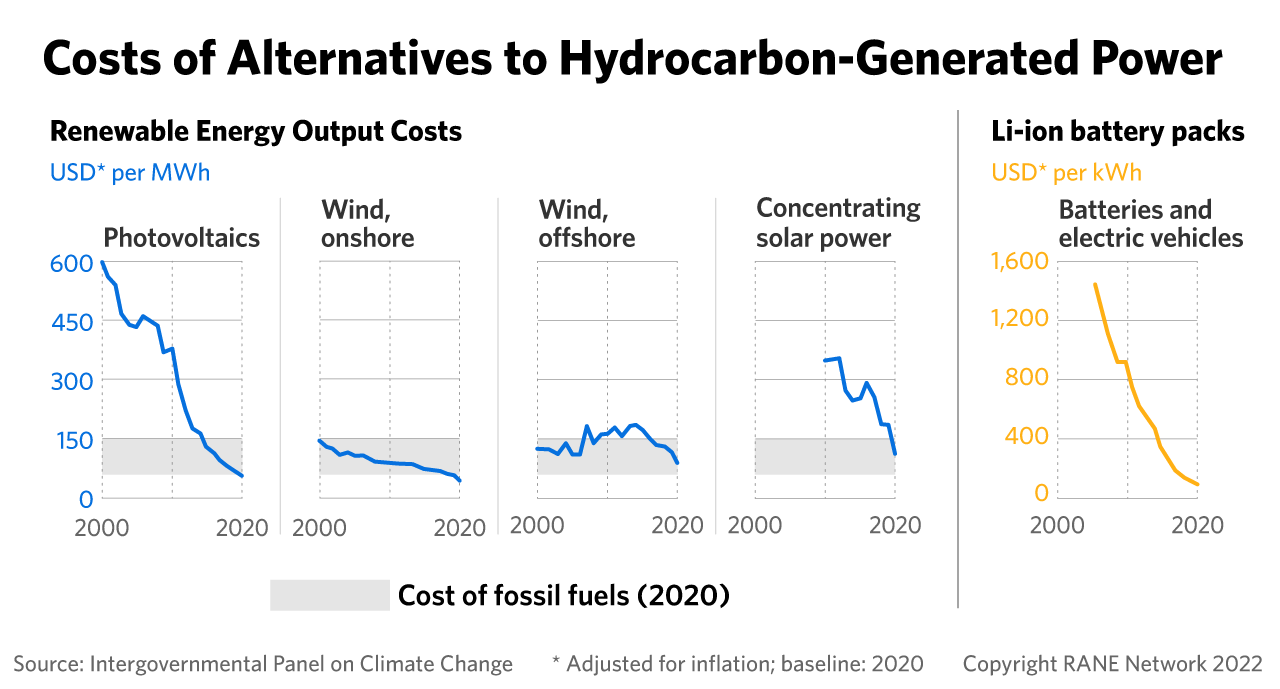
But in the medium-to-longer term, high energy prices and Europe's quest to reduce its reliance on Russian energy will accelerate the energy transition. The European Union, along with the United States and other countries, are currently calling for an accelerated energy transition in response to the Ukraine war and energy shock. The European Commission's REPowerEU strategy released on March 8 aims to reduce energy imports from Russia to zero before 2030. While some of this decline would come from simply substituting non-Russian oil and natural gas for Russian oil and gas, the European Commission also increased its targeted decline in natural gas consumption by 55%, primarily through accelerating renewable energy production and converting building heating from natural gas to electricity. These targets are likely overly ambitious. However, high prices will increase the financial incentive for households and the private sector to invest in alternative energy sources and green technologies because it proves their economic viability. Even prior to 2020, many green technologies had reached price parity with their fossil fuel counterparts — including concentrated solar power (CSP) and photovoltaic (PV) solar power, as well as both offshore and onshore wind power. Higher gasoline and diesel prices will also incentivize new car buyers to buy electric vehicles, which have a higher upfront cost but are overall cheaper to maintain and fuel compared with traditional hydrocarbon-powered vehicles.
In many Western countries, high energy prices will also increase interest in keeping nuclear power a critical component of the energy mix over the long term. In recent weeks, a number of countries have announced plans to either build new nuclear reactors or extend the lifetimes of existing reactors. Due in part to high natural gas prices prior to the Ukraine war, French President Emmanual Macron announced on Feb. 10 that France would build at least six new nuclear reactors in the coming decades to help the country achieve its target of reaching net-zero emissions by 2050. On April 7, U.K. Prime Minister Boris Johnson laid out a new energy strategy that targeted building eight new reactors in the United Kingdom by 2030, boosting the country's installed nuclear power capacity from 7 to 24 gigawatts by 2050, and having nuclear power generate 25% of its electricity by 2050 to come from nuclear power. Higher energy prices and more government support for nuclear power may also accelerate the development and adoption of next-generation nuclear power technologies like small modular reactors, making them more financially viable. Such technologies aim to be safer than conventional nuclear power plants due to their smaller size and the lower risk of a crisis if a nuclear disaster happens. In the United States, some utilities are also considering converting aging coal power plants and their sites into small modular nuclear reactor sites.
- In February, the European Commission included nuclear energy in the bloc's taxonomy for sustainable activities, which makes it eligible for private and public funding and compatible with the European Union's carbon reduction targets.
- The surge in energy prices is even increasing support for nuclear power in Japan, which faces recurrent challenges in dealing with external shocks (like the earthquake and tsunami that caused three reactors at the Fukushima Daiichi power plant to meltdown in 2011). A poll released in March by the Japanese outlet Nikkei found that, for the first time since the 2011 Fukushima disaster, more than half of Japanese citizens said they supported restarting the country's nuclear power plants.
- The shift in favor of nuclear power is not universal in the West, however. German Chancellor Olaf Scholz has repeatedly said he does not support extending the lifetime of Germany's remaining three nuclear reactors, which are slated to go offline later this year.
- In the long term, the financial health of Russian nuclear power company Rosatom will prove critical as to whether or not nuclear power beyond the West and China continues to grow. Should Rosatom ultimately either become bankrupt or subject to severe Western sanctions over the Ukraine war, it will probably not be able to build some of the overseas nuclear plants that it is currently negotiating with countries like Egypt.
Beyond the West, high oil and natural gas prices will lead China and India to rely more heavily on coal-fired power, particularly as they prioritize economic growth over the energy transition in the wake of the COVID-19 pandemic. In the immediate aftermath of the Ukraine invasion, China's daily coal output rose 15% in March as the Chinese government loosened restrictions on coal production and power plants in order to alleviate the impact of higher oil and natural gas prices. India, by contrast, has not been able to dramatically ramp up coal production and is, in fact, dealing with localized coal shortages due to internal transportation and supply bottlenecks. On April 18, Indian Finance Minister Nirmala Sitharaman conceded that the country's climate goals would be hampered by the increasing cost of natural gas, which India (like virtually every other country in the world) planned to use as a bridge fuel to reduce carbon emissions in the short term by substituting relatively low-emitting natural gas for high-emitting coal in feedstock for power plants. Both India and China will probably still take steps to reduce coal consumption in the medium and long term, but natural gas prices will certainly slow down the process if they remain at current levels.
The Ukraine-Russia conflict will also deepen global fragmentation, which will complicate global cooperation around climate change and the energy crisis. The U.N. climate summit held in November already exposed the significant divergence between the West and the rest of the world on environmental issues and highlighted how much that gap had widened in just the six years since the Paris Agreement was signed. While Western countries were willing to publicly target cutting emissions to zero by 2050, India, China and many developing countries shunned such a timeline. The Ukraine conflict and Russia's isolation from the West will only result in more hostility between the West and its rivals, including China, and lead to more strategic competition that is deleterious to cooperation on climate issues, such as collaborating on green and carbon abatement technologies. Moreover, the diversion of resources to combat the immediate domestic impact of high energy prices will also impede China and the West's ability to provide financial assistance to the developing world for the energy transition. Growing financial needs at home have already prevented Western nations from hitting goals like boosting climate financing to the developing world to $100 billion by 2023, as well as lending South Africa $8.5 billion over the next five years to help finance its transition away from coal. Collectively, this means that developing countries — where the rising cost of energy and food is further draining already limited financial resources — will face the pinch on both ends. Not only will their economies struggle in the wake of higher global commodity prices, but their governments will also struggle to keep up with the energy transition as the loss of international aid leaves them with even less cash to enact the sweeping infrastructural and technological advancements needed to reduce their reliance on fossil fuels.
