
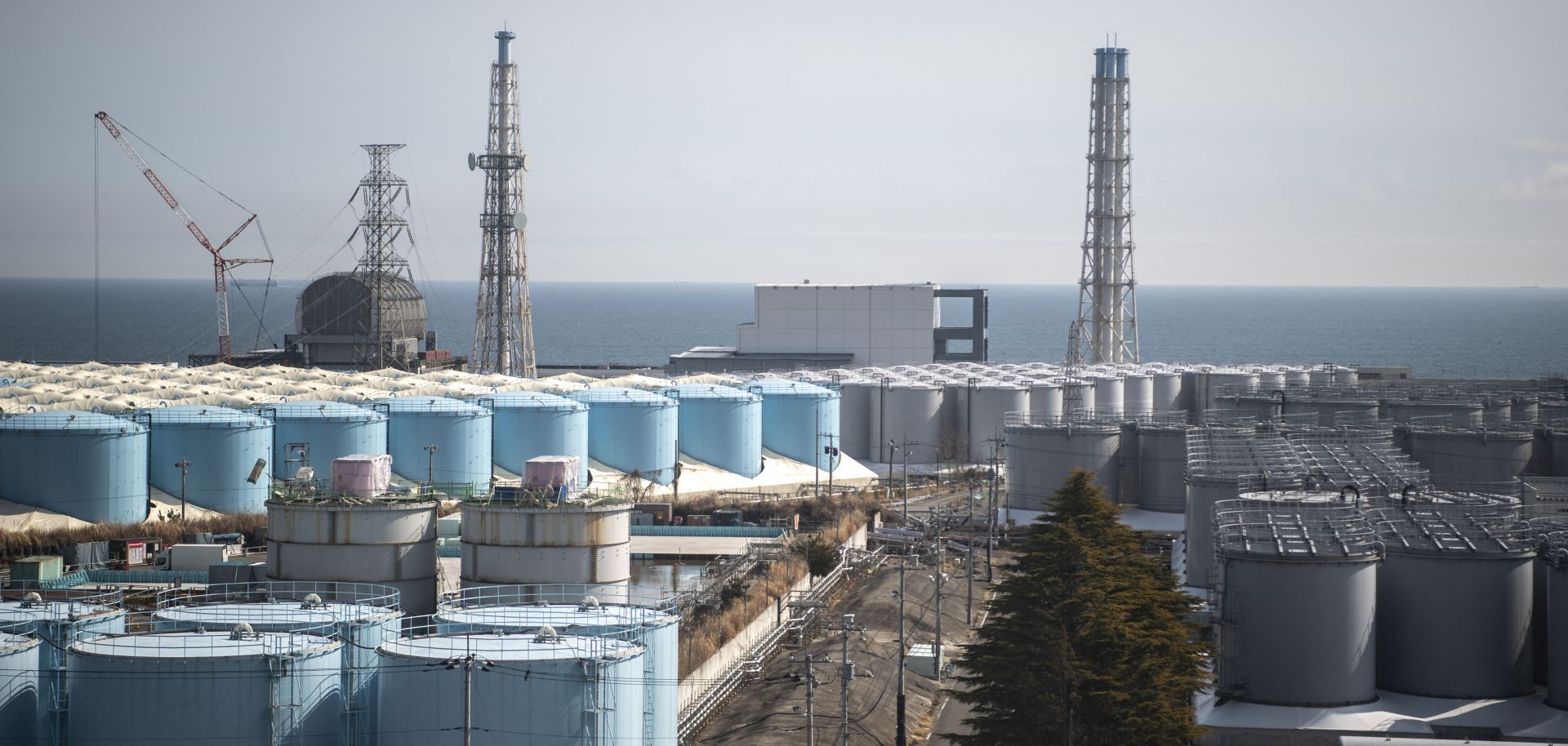
Reactor buildings and water storage tanks are seen at the Fukushima Daiichi nuclear power plant in Okuma, Japan, on March 5, 2022 -- nearly 11 years after a massive earthquake caused a devastating meltdown at the plant.
Rising popular support for nuclear energy will make it politically easier for Japan to restart some of its reactors, but Tokyo will nonetheless struggle to hit its nuclear power-related goals in its climate and energy strategies. A poll released in March by the Japanese outlet Nikkei found that 53% of respondents supported restarting nuclear power plants, compared with 44% in a similar poll released in September. Nikkei has carried out the poll semiannually since 2011 and the March 2022 poll was the first to find a majority supporting restarting nuclear reactors.
- In the wake of the 2011 Tohoku earthquake and tsunami that caused three reactors at the Fukushima Daiichi power plant to meltdown, Japan shut down all of its 54 nuclear reactors to increase safety standards and reform its nuclear safety and security regulations.
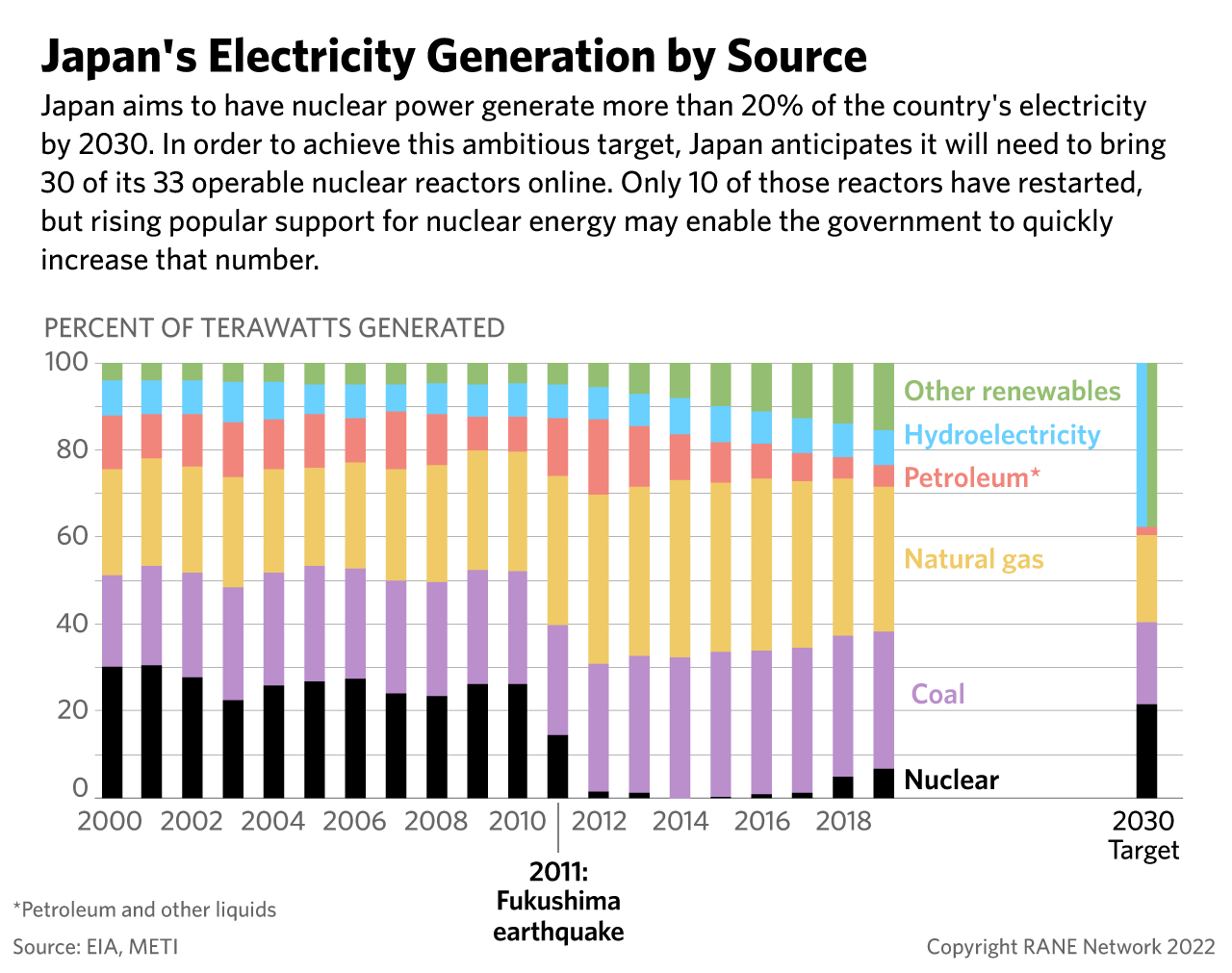
- In 2015, Japan started bringing back online some of the reactors that passed the country's new standards. But public opposition and the bureaucratic challenges of fulfilling the new safety requirements have slowed this process. Today, only 10 of the country's 33 operable nuclear reactors have been brought online, and even some of those are currently offline due to various reasons like maintenance.
- Nuclear power accounted for about 25% percent of Japan's power generation in 2010. But in 2019, it accounted for only 6%, according to Japan's Ministry of Economy, Trade and Industry.
Factors including high energy prices and electricity shortages are driving Japanese citizens and the ruling Liberal Democratic Party's (LDP) growing support of nuclear power. The Nikkei poll's release came after a 7.6 magnitude earthquake off the coast of Tohoku on March 16 knocked six thermal power plants offline, some of which could remain offline for months. The outage caused the Japanese government to issue a power outage alert in the Tokyo region on March 22 for the first time after the Tokyo Electric Power Co. projected that its operating reserves would fall to 0%. Ultimately, a blackout was avoided, but Japan's inability to cope with the plants going offline highlights how exposed the Japanese power sector remains to external forces. If most of Japan's nuclear power plants had been online, the risk of a blackout would have been minimal.
- Japan is currently suffering from limited spare capacity in its power sector after the electricity retail market was liberalized in 2016, opening up power producers to higher competition. In response, many utilities closed power plants that could not compete in the liberalized market. The majority of those closed power plants were old oil-fired plants that were brought back online to replace Japan's nuclear power plants after the 2011 earthquake. As a result, Japan's national power generating capacity has declined by 23% since 2016, making the country highly vulnerable to shortages if another natural disaster knocks off several power plants at once (like the 2022 earthquake did) or if abnormally cold weather causes a surge in demand.
Japan's higher reliance on natural gas and coal for power generation has made consumers more exposed to global price shocks. Given this, restarting nuclear power reactors may be the cheapest way to boost generation capacity and reduce domestic electricity costs. According to the latest figures available from the Japanese industry ministry, thermal power plants (which continuously burn through natural gas or coal) generated more than 80% of Japan's electricity in 2019. In the short term, these thermal power plants have higher marginal costs of electricity production than other power sources, including nuclear power plants (which have extremely low marginal costs of production in comparison and do not continuously burn through feedstock). Japan's high reliance on thermal power plants also leaves it highly exposed to price swings on imported coal and natural gas. Restarting nuclear power plants is the cheapest and quickest way for Japan to address these challenges. Nuclear power's low operating costs are often offset by the high startup costs of constructing the power plants. But for Japanese power producers, the plants are already built and operable, making them an attractive lower-cost alternative to quickly boost power generation capacity.
- The global fallout from the ongoing war in Ukraine has further increased energy prices in Japan, where consumers were already facing rising electricity bills prior to Russia's Feb. 24 invasion. In March, nine of Japan's regional electric utilities increased power rates to their highest levels in more than five years.
Growing popular support for restarting Japan's nuclear power plants will be crucial for Prime Minister Fumio Kishida and the LDP's ambitious climate and energy strategy. When Kishida took office in October, he appointed a number of pro-nuclear LDP politicians to cabinet positions, pitching nuclear power as crucial for Japan's strategy to reduce emissions by 2030. This marks a noted shift from his predecessor Yoshihide Suga, whose cabinet included powerful anti-nuclear voices Taro Aso and Shinjiro Koizumi as deputy prime minister and environmental minister, respectively. In October, Kishida's government approved a new strategic energy plan aimed at making nuclear energy account for 20-22% of Japan's power mix in 2030. The plan also lays out a roadmap for Japan to achieve net-zero carbon emissions by 2050 and includes a target to reduce emissions by 46% by 2030 from 2013 levels. LDP officials say that hitting the 2030 emissions reduction target will require bringing 30 of Japan's 33 operable nuclear reactors back online.
But even with more popular and political support, there are significant hurdles for Japan to make nuclear power a key contributor to its power generation beyond 2030:
- Safety regulations: Japan's safety regulations, for one, make it difficult for power companies to secure approval to restart reactors. Japan's Nuclear Regulation Authority, which was set up after the 2011 disaster, has been slow to issue new approvals and has pushed back against calls by pro-nuclear Japanese political figures like former Prime Minister Shinzo Abe to expedite the approval process. Between 2018 and 2021, the authority did not approve a restart of a single reactor. This means that Kishida and his ruling LDP's growing support for nuclear power may not necessarily translate to an easier certification process for bringing reactors back online.
- Aging infrastructure: Another big challenge facing Japan's long-term energy strategy is the fact that many of its nuclear power plants are aging. Under Japanese regulations, nuclear reactors can receive a 40-year license that can be extended by an additional 20 years, bringing the total life of a reactor to 60 years. Several of Japan's reactors will reach the 60-year lifespan in the 2030s or 2040s, and only about 20 will remain in operation by 2050 under the new rules. Japan is considering extending the lifetime of its nuclear reactors beyond 60 years as a way to forestall a decline in nuclear power generation capacity in the 2040s, in anticipation of popular opposition to building new reactors. Thus far, the Kishida government has given little indication that it would back building new reactors. But the energy strategy it approved in October was inherited from the less pro-nuclear Suga government and is one that Japan amends every three years. It is possible that growing support for nuclear power could lead to Kishida and other parts of the LDP supporting building new reactors to replace older ones, which is something that former Prime Minister Abe called for.
- Local opposition: Finally, even though there may be national support for restarting reactors, local mayors and populations in areas where the power plants are located may oppose restarts. And under Japan's rules, power companies must receive local consent to restart power plants.
If it struggles to restart old nuclear reactors and/or build new ones, Japan may not hit its 2030 and 2050 climate targets. This would force the country to rely on more costly abatement measures to reduce emissions — costs that might get passed on to households and businesses. Without nuclear power growing as a proportion of its energy mix, Japan will remain dependent on thermal power plants in 2030, likely requiring some of its power producers to start investing more in abatement technologies, like carbon capture and sequestration, to reduce emissions, driving up investment costs. If Japan does not build more reactors or extend the lifetime of its existing nuclear reactors, hitting Tokyo's climate goals will likely require replacing a significant amount of the country's thermal power with alternative zero-emissions energy sources beyond solar and wind. Investment into such technologies is not cheap, meaning that many power companies will eventually pass along the costs to consumers to fund the investments.
- Although Japan has substantial offshore wind power potential, its onshore geography has terrain challenges and somewhat limited space for new solar and wind power plants. Given the intermittent power supply from solar and wind, Japan would also still need a feedstock-based power source to make up for the gaps in energy generation that grid-scale batteries storing wind and solar energy cannot.
- Compared with wind and solar, hydrogen- and ammonia-based renewable fuels offer more promise for Japan, but grid-scale power generation from these sources remains in its infancy. Japanese companies and the government are investing heavily in both ammonia and hydrogen options. In 2021, Japanese engineering firm Mitsubishi Power announced that it had begun development on a 40-megawatt (MW) class gas turbine that is fueled by 100% ammonia, which the company aims to commercialize in 2025. The plant would be the world's first power plant to exclusively be fueled by ammonia. In the energy strategy it approved in October, the Japanese government said that 10% of the country's electricity mix by 2050 could come from hydrogen- or ammonia-fired power plants. But it still says that 30-40% of the electricity mix would still need to come from thermal or nuclear power plants.
