
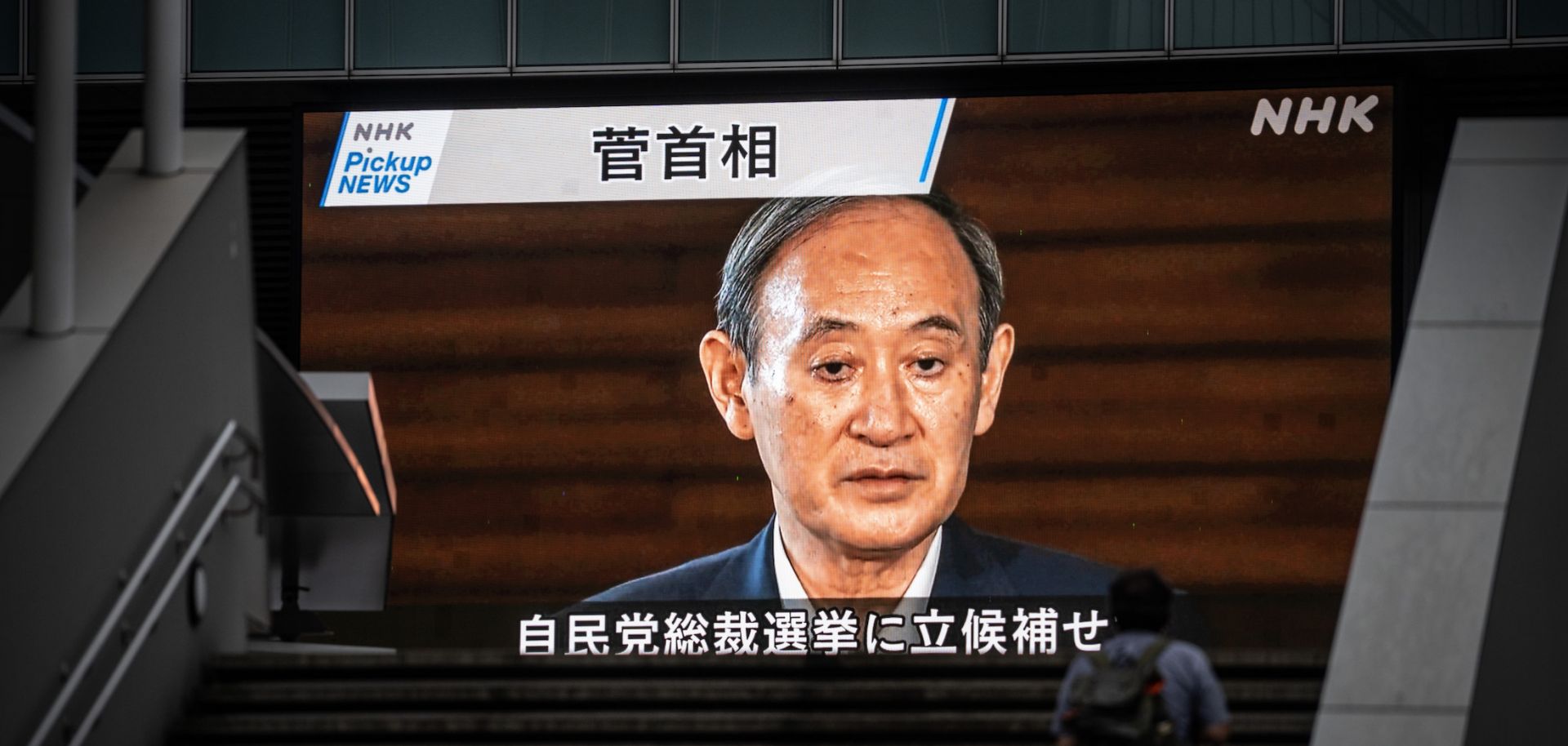
A screen in Tokyo broadcasts Japanese Prime Minister Yoshihide Suga’s resignation announcement on Sept. 3, 2021.
Unless former Prime Minister Shinzo Abe runs for election, Japan is likely to slip back into a period of revolving-door prime ministers, though a solid factional support base could stabilize LDP policy. Japanese Prime Minister Yoshihide Suga announced on Sept. 3 he was pulling out of leadership elections for the ruling Liberal Democratic Party (LDP), which are set for Sept. 29 and will determine who is Japan’s next prime minister. He has instead pledged to focus on managing Japan’s COVID-19 response. Suga will stay on in a caretaker capacity until a new prime minister is seated and plans to hold a press conference next week to explain his resignation. Suga also noted he would not follow through with a shakeup of his executive leadership, a move originally intended to inject new vigor into his LDP leadership candidacy.
Suga’s resignation is not a big surprise given his dropping approval ratings and lack of strong leadership over the conservative coalition. Suga took over after Abe resigned due to health problems in September 2020; at the time, Suga was supported by both the Abe administration and the LDP given his administrative adeptness. Soon after, however, his ratings started to drop as Japan experienced successively worse COVID-19 waves in November 2020, March 2021, and the current wave. He also came under pressure for his decision to host the Tokyo Olympics in July. Despite the majority of Japanese citizens switching from opposing the games in June to supporting them when the games closed in August, their approval of Suga did not rise along with the games’ popularity.
Many contenders are filling the field to take Suga’s spot, but the one who remains a mystery is Abe, who could most easily win the election if he chose to run again. Abe’s backing could also heavily sway the LDP leadership vote in favor of another candidate.
- Japan’s vaccination minister Taro Kono, who is expected to join the race next week, largely aligned with Abe’s policies while in his cabinet. Kono is also a member of a powerful faction within the LDP, and has polled well among voters.
- Japan’s dovish former foreign minister Fumio Kishida has also officially thrown his hat in the ring, but polls poorly among voters. Kishida believes in balancing relations with China and the United States, heads his own LDP faction, and was widely believed to be Abe’s heir back in 2020.
- The deeply conservative former internal affairs minister Sanae Takaichi would be hard on China in office, but she is unlikely to garner support from the 20 LDP members necessary to run in the election because she belongs to no LDP factions.
- Former defense minister Shigeru Ishiba has also polled well among voters and pushed for greater public spending to tackle wealth inequality, but he has not yet announced his candidacy.
- As for Abe, prospects of his candidacy have been only rumors so far. But given his broad popularity in the LDP, he could easily win the election if he chose to run again.
The LDP’s four major factions in Japan’s House of Representatives will largely determine who is elected LDP president and, thereafter, prime minister. The largest of these is the Hosoda faction, which is de facto led by Abe and has 96 members, followed by Deputy Prime Minister Taro Aso’s Shikokai faction with 53 members, and Secretary-General of the LDP Toshihiro Nikai’s Shisuikai faction with 47 members. Fumio Kishida, who is in the race for the LDP presidency, also leads his own faction, Kochikai, with 46 members. Aside from Kishida’s faction, the other three factions had all thrown their support behind Suga for the LDP election prior to his resignation, so it will be critical to watch who the leaders of those powerful factions support. Without one or more of these factions behind them, candidates for the LDP presidency have almost no chance of winning.
Any LDP president that’s not Abe will have difficulty managing his or her cabinet and the larger conservative coalition, which may soon rely heavily on Komeito for policy support. Abe was one of the only prime ministers in decades to effectively lead his cabinet and the conservative coalition on united policy initiatives. Any other LDP president is likely to herald a return to the era of revolving-door prime ministers for Japan. Though this instability may seem like a hindrance to Japan’s domestic and foreign policy at a time of continuing Japanese economic stagnation and increasing competition with China, Japan has been able to function well in the past with short-term prime ministers as long as the makeup of supporting LDP factions and factional leaders remains consistent. If the same three LDP factions that were supportive of Suga jointly support his successor, Japan is likely to exhibit relative policy consistency.
- Whoever replaces Suga will have to call a date for the next House of Representatives elections either on or before Nov. 28. If, as some LDP officials have suggested, the LDP loses its absolute majority in the lower house of the Diet, the ruling party will rely on the Komeito party to form a majority conservative coalition.
- Komeito’s anti-nuclear weapons and anti-armed conflict views could soften Japan’s stance vis-a-vis strategic cooperation with Taiwan and the United States, as well as Japan’s military improvements aimed at fending off China’s maritime encroachments and physical security threats to Taiwan.
