
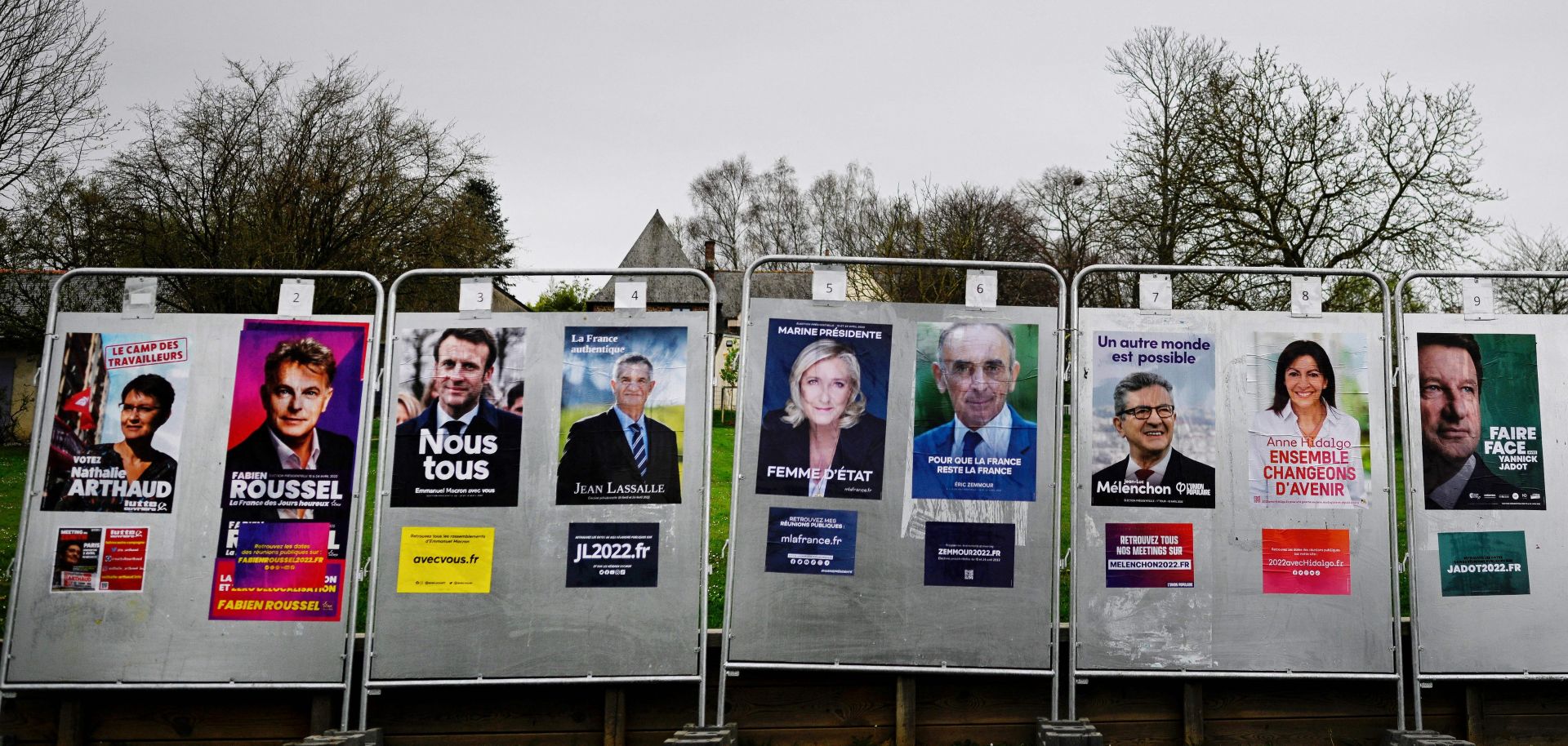
A photo shows presidential candidates' election posters on a billboard in La Baussaine, western France, on March 29, 2022.
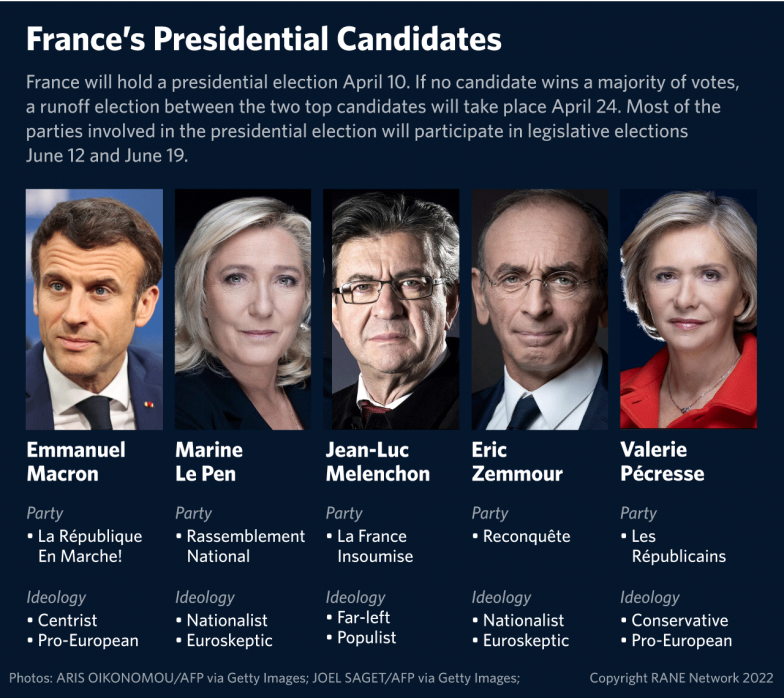
President Emmanuel Macron's expected reelection portends increased state intervention in France's economy and a continued push by Paris to make the European Union more self-reliant on industrial, energy and defense issues. If one of Macron's euroskeptic challengers wins the election, it would open the door to political and financial turbulence in Europe, though France would likely not exit the European Union. France will hold the first round of its presidential election on April 10, followed by a runoff election between the two top candidates on April 24. Then in June, the country will hold legislative elections, also in two rounds (June 12 and 19). Because the presidential and legislative elections happen within such a short period, it is common for the same political group to control both the presidency and the National Assembly, which tends to make it easier for French governments to approve legislation. According to opinion polls, centrist president Emmanuel Macron is set to win the presidential election, while his La Republique En Marche (LREM) party is expected to retain its majority in the National Assembly. However, polls also suggest that nationalist candidate Marine Le Pen is likely to make it to the second round of the presidential election, while far-left candidate Jean-Luc Melenchon is also expected to perform well.
- According to an Ipsos poll conducted between March 30 and April 2, Macron will obtain 26% of the vote in the first round, followed by Le Pen (21%), Melenchon (15.5%) and far-right candidate Eric Zémmour (11%). According to this poll, in the second round, Macron will defeat Le Pen 53% to 47%.
If he secures a second term, Macron will pursue interventionist policies and a combination of subsidies and tax cuts for companies and households, which would boost economic growth but also result in a high fiscal deficit and rising levels of sovereign debt. The COVID-19 pandemic and the subsequent supply chain disruptions, combined with the war in Ukraine and Europe's ongoing energy crisis, have convinced Macron and LREM of the need to strengthen France's self-reliance in areas ranging from energy production to manufacturing. Macron's campaign platform includes promises to fully nationalize France's partly state-owned energy giant EDF, as well as expand the state's presence in other sectors of the energy market. He has also promised ''massive state investments'' in sectors such as biotechnology, cloud technology and artificial intelligence, as well as ''the deployment of 100 percent French supply chains'' for products including electric cars, offshore wind farms and solar panels (though many of these plans are too ambitious, especially within the timeframe of a five-year presidential term and given the limitations connected to economies of scale). Macron's promise to increase the state's presence in the economy coincides with a pledge to cut taxes for businesses and households to promote investment and domestic consumption. While this combination would boost economic activity, it would also make it harder for France to reduce its fiscal deficit (which was around 7% of GDP by the end of 2021) as well as its sovereign debt (which is currently at around 115% of GDP). This should not be a problem as long as the French economy is growing and Paris' borrowing costs remain tolerable. But the French economy would be exposed to eventual financial crises in the eurozone or to changes in the European Union's investment climate.
- In October, Paris unveiled ''France 2030,'' a 30 billion euro plan to increase state investment in areas including nuclear energy, green hydrogen, semiconductors, electric and hybrid vehicles and agri-food activities.
- In February, Macron announced plans to construct six new nuclear reactors and update the country's aging nuclear fleet as a part of his government's strategy to enhance France's energy independence. Paris also pushed Brussels to include nuclear energy in the European Union's ''taxonomy'' of environmentally-friendly investments.
- Macron's electoral platform pledges to save French businesses 7 billion euro a year in taxes based on turnover, staff or properties rather than on profit.
If Macron is reelected, France will push for increased economic, political and security integration in the European Union, as well as a more protective approach to trade and penetration from non-EU companies in strategic sectors of the economy. Macron sees the European Union as a critical element of France's push for self-reliance, and will seek to replicate many of his domestic interventionist policies at the continental level. If reelected, Macron's government will push to give the European Commission the power to borrow on financial markets on behalf of the member states to pay for continent-wide programs to boost the bloc's industrial and energy independence. Under Macron, Paris will likely continue to support Brussels' increasing scrutiny of companies from outside the European Union that are entering strategic sectors of the bloc's economy like telecommunications, energy, critical infrastructure and defense. A second Macron administration will be skeptical of the European Union signing free trade agreements, especially if they're with countries with lower environmental standards and/or include agricultural products (a politically sensitive issue in France). Germany will offer some degree of support to these ideas, considering that two of the three members of the government coalition in Berlin share similar views on the future of the European Union. But other governments in northern Europe with more pro-market and deregulation views — such as the Netherlands, Sweden and the Baltic states — will push to water them down. Finally, if Macron secures another five-year term, his administration will remain skeptical of accepting new countries in the European Union, which will reduce the probability of candidate countries like Serbia entering the bloc. This could, in turn, reduce the European Union's influence in the Western Balkans and other regions and open the door to greater influence by non-EU players such as China, Turkey and Russia.
- In mid-2020, EU governments made the unprecedented decision to allow the European Commission to borrow on their behalf on international debt markets to pay for the bloc's massive COVID-19 relief program. France and other countries in southern Europe have supported granting the European Union renewed authorizations to do this again in the future to pay for other bloc-wide policies, but northern European governments are skeptical.
- According to EU diplomats, since late last year, France has pressured the European Commission to pause free trade agreement negotiations with Australia, New Zealand and the South American trade bloc Mercosur (which includes Argentina, Brazil, Paraguay and Uruguay) due to these countries' very competitive agri-food sectors.
- Under Macron, France has argued that the European Union should prioritize the deepening of its internal integration over the acceptance of new member states, arguing that the bloc has already become too large, complex and hard to govern.
While a nationalist or far-left president would not immediately result in France exiting the European Union, it would raise questions about the bloc's future that could trigger financial instability and weaken EU internal unity and foreign policy. While opinion polls indicate that Macron will win the presidency, they also suggest that roughly half of the French electorate will vote for far-right or far-left candidates in the first round of the presidential election, which illustrates the strength of anti-globalization and euroskeptic sentiments in the country. This means a scenario in which a candidate like Le Pen or Melenchon wins the presidency is improbable but not impossible. While both candidates are critical of the European Union, they are campaigning for renegotiating the terms of France's membership in the bloc to increase national sovereignty, but not for an outright exit from the bloc. Even if France is unlikely to exit the European Union in the short-to-medium term (particularly because of the precedent of the United Kingdom's long and complex exit), an anti-establishment president would raise questions about the future of the bloc — making companies, investors and households doubtful about the future of the eurozone, which would increase the probability of bank runs and sovereign debt crises in the bloc. It would also increase political, regulatory and compliance risks for companies, as the new government in Paris would bring the European Union's entire legal and regulatory framework into question. A more euroskeptic France that is unwilling to cooperate with EU institutions and governments would also result in an incoherent EU foreign policy that would weaken the bloc's influence on global affairs and open the door to greater interference from non-EU players such as the United States, China and Russia on EU internal affairs.
- Nationalist leader Le Pen's presidential campaign has centered on pledges to improve the standard of living in France by expanding the state's role in the economy and introducing higher taxes on large corporations. She has also focused on anti-immigration rhetoric and national identity issues. In previous electoral campaigns, Le Pen promised a referendum on France's membership in the European Union, though the issue has largely been absent from her current campaign in an attempt to attract moderate voters.
- If he is elected, far-left presidential candidate Melenchon has said he would push to reform EU treaties on issues ranging from fiscal rules to environmental standards. If the European Union rejects his demands, he has also said he'd be willing to act unilaterally and ignore EU rules. Melenchon's other campaign promises include guaranteeing jobs for the long-term unemployed, decreasing France's retirement age from 62 to 60, pulling France out of NATO, blocking future EU free trade agreements, freezing food and fuel prices, and increasing the minimum wage.
No matter who wins, the next French president will inherit a country that is politically divided and increasingly worried about issues like the cost of living and globalization, which creates a constant risk of social unrest and internal conflict. Opinion polls show that a significant number of French voters are concerned about the rising cost of living, a situation that the ongoing supply chain bottlenecks and the energy crisis have exacerbated. Polls also suggest that voters are worried about the future of France's large healthcare system and generous pension system — issues that will only worsen as France's population ages and the labor force contracts, unless Paris introduces structural (and likely very controversial) reforms to make both systems more sustainable. Finally, the popularity of far-right candidates shows that a sizable segment of the French electorate is concerned about immigration and its impact on France's economy and identity. All these issues will persist regardless of who wins the upcoming presidential election, and will create fertile ground for social unrest, strikes, protests and (to a lesser extent) sporadic acts of racially-motivated violence.
- An Elabe poll conducted between March 31 and April 1 presented French voters with a list of 17 political issues, and asked them to identify the three they found most concerning. 55% of those surveyed ranked the decline of their purchasing power as their top concern, followed by the healthcare system (27%), security (26%), pensions (24%) and immigration (22%). Supporters of Macron, Le Pen and Melenchon all mentioned purchasing power as their main concern. For Macron voters, the second main concern was healthcare, while for Le Pen voters it was immigration and for Melenchon voters it was inequality.
