
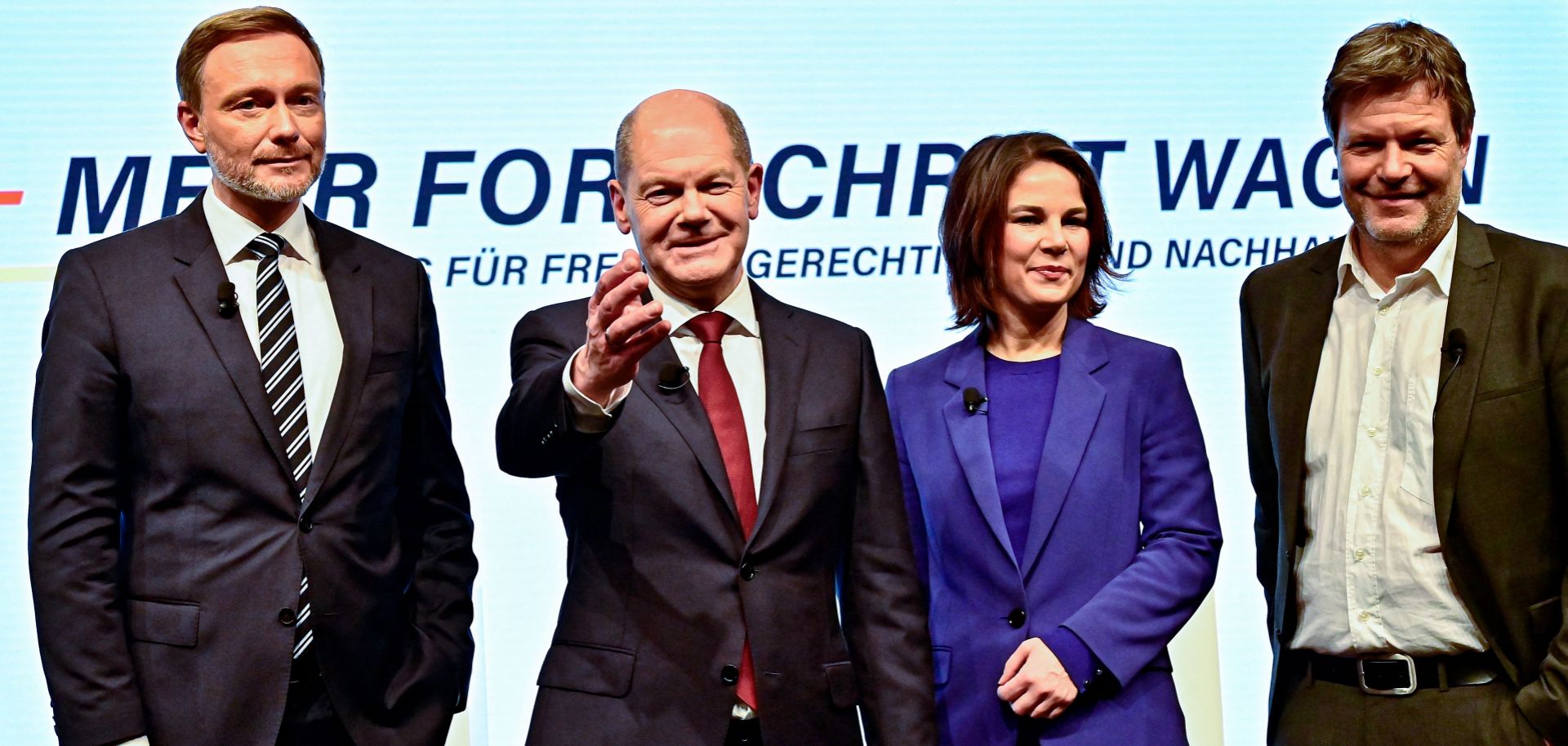
Germany’s new government will push for a faster energy transition, an expansion of welfare spending and a deepening of EU integration, but could face internal dissent on fiscal policy that slows policymaking. Germany’s center-left Social Democratic Party (SPD), the environmentalist Greens and the pro-business Free Democratic Party (FDP) announced on Nov. 24 that they had reached a deal to form a government after almost two months of negotiations. Each party will ratify the agreement internally in the coming days, with the goal of holding a vote in the Bundestag on the week of Dec. 6 to appoint SPD leader Olaf Scholz as chancellor before the final European Council summit of the year, which will take place on Dec. 16-17. This will mark the end of Angela Merkel’s chancellorship after 16 years in office.
- Germany held a federal election on Sept. 26. The SPD obtained 25.7% of the vote, followed by the conservative Christian Democratic Union (CDU) with 24.1%, the Greens with 14.8% and the FDP with 11.5%.
The new government’s immediate goal will be to address the significant increase in COVID-19 in recent weeks. The new administration in Berlin will seek a balance between restricting public activities while trying to minimize the negative impact on the economy. In recent weeks, a combination of supply chain bottlenecks, rising energy prices and growing inflation have slowed down Germany’s economic growth after significant expansion in the second and third quarters. To avoid doing further damage to the economy, Berlin’s will likely first focus on implementing localized lockdowns in the regions with particularly high numbers of infections, but a country-wide lockdown cannot be ruled out if infections get out of control. The new government will also have to make a decision on the controversial issue of making vaccination mandatory, which could spark protests and possibly some lower-level violence from anti-vaccination groups.
- On Nov. 24, Germany’s seven-day COVID-19 incidence rate (which shows the number of new infections within the past week per 100,000 inhabitants) passed 400 for the first time since the beginning of the pandemic.
- While COVID-19 infections are rising across the country, the situation is worse in the east, where vaccination rates are lower. Eastern states such as Saxony and Thuringia are seeing particularly high infection rates.
- According to the European Center for Disease Prevention and Control, only 68% of eligible Germans have been fully vaccinated, well below countries like Portugal (81%) or Spain (74%).
- New restrictions entered into force on Nov. 24, requiring people to show proof of vaccination, recovery or a negative COVID-19 test to use public transportation and go to work.
While the agreement should make the coalition stable, the government’s push to expand public spending while keeping a balanced budget will likely create internal dissent. Berlin is likely to push for a faster energy transition, including support for the European Union’s Green Deal that seeks to make the bloc carbon neutral by 2050. The Greens have pledged to make climate change an issue that will cover all areas of the German economy, including traffic, industry, construction, housing and agriculture. The SPD will, in turn, follow an agenda to expand welfare benefits for low-income households, raise the minimum wage and increase access to affordable housing. Finally, the FDP will push to reduce red tape and bureaucracy and offer tax incentives to modernize the German economy. While the three parties have promised to coordinate their policies, ideological differences between the SPD and the Greens, which are willing to raise taxes to finance their policies, and the FDP, which is against increasing the tax burden on households and corporations, is likely. This dissent is unlikely to threaten the continuity of the coalition, though it could slow down and, in some cases, freeze policy.
- The new German government is likely to be supportive of EU federalization, which will open the door to greater cooperation with Mediterranean countries like France and Italy. However, the FDP is likely to resist measures that would significantly increase financial risk-sharing in the eurozone, which could result in watered-down EU policies.
- Preserving Germany’s constitutional debt brake and avoiding policies that would result in a high fiscal deficit are at the core of the FDP’s ideology. The party is likely to use its control of the finance ministry to try to water down proposals from the SPD and the Greens that would result in higher sovereign debt or a deepening of the country’s fiscal deficit. The FDP is also likely to resist similar measures at the EU level.
- The Greens’ skepticism of deploying military forces abroad and increasing defense spending is likely to reduce the room for deeper military integration in the European Union, which is one of France’s main foreign policy goals. This could complicate cooperation between Paris and Berlin on this issue, though there will be significant alignment between the two countries on other policy areas, especially if a moderate candidate wins the French presidential election in April.
