
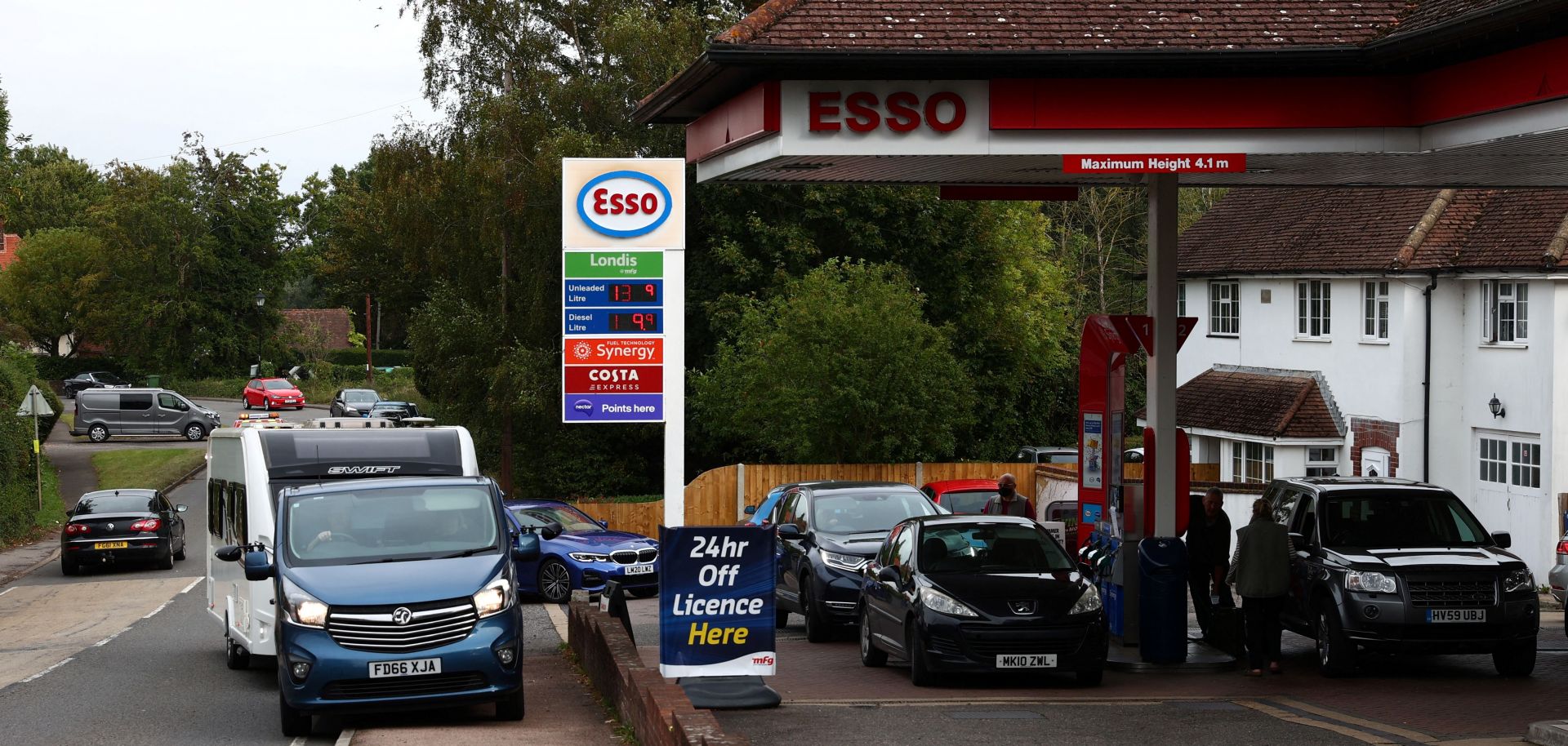
Cars line up at a gas station in the U.K. village of Odiham amid fuel shortages on Sept. 30, 2021.
High global energy prices are likely to remain through the end of the Northern Hemisphere’s winter, which will undermine COVID-19 economic recoveries in energy-importing countries, hurting low-income population segments the hardest. The higher prices will also exacerbate the global manufacturing sector’s fragile recovery and ongoing supply chain challenges, while increasing pressure on governments’ energy transition plans. On Sept. 28, European light sweet crude benchmark Brent hit $80 per barrel for the first time since 2018. As of Oct. 1, European natural gas hubs Dutch TTF and U.K. NBP benchmarks, as well as the Asian JKM liquified natural gas (LNG) benchmarks, were also all trading between $30 to $35 per British thermal unit (mmBtu), which is equivalent to about $170 to $200 per barrel of oil. Brent has since fallen back to around $78 per barrel. But even if prices remain in the $70s and natural gas demand rises, significant impacts will remain.
- Although natural gas prices have risen, the United States’ natural gas market continues to be shielded from global market conditions, with U.S. benchmark Henry Hub still trading at just $6 to $7 per mmBtu.
Energy markets are likely to remain tight over the coming months and much of the price risk is on the high side. How high natural gas prices go will depend on the severity of the coming winter in the Northern Hemisphere. In Europe, gas storages are low for this time of year as high prices and the gas supply crunch has deterred companies from raising inventories quickly. As of Sept. 28, European gas storage levels were at 73% full compared with 94.9% one year ago and a five-year seasonal average of 89% — meaning that increased heating demands from a cold snap could stress stockpiles. This also comes at a time when oil demand is already on the rise due to the global economic recovery from COVID-19 and the partial resumption of travel. High natural gas prices are also driving oil substitution for natural gas in industries where the two can be swapped as well, including power generation and plastics. A high level of substitution could see global oil demand increase by as much as 1-2 million barrels per day (bpd). Regardless, high oil prices will put pressure on OPEC+ — particularly at its Oct. 4 meeting — to change its current production plans and add more oil to the market on top of the 400,000 bpd the bloc is slated to add each month through the end of the year. Should oil prices remain around $80 per barrel, it may cause enough demand destruction for OPEC+ to step in. But throughout the course of the COVID-19 pandemic, the bloc has shown it will only conservatively raise oil production levels.
- In a Sept. 13 note to a client, Bank of America said oil prices briefly returning to $100 per barrel cannot be ruled out in the case of a colder-than-usual winter this year. In a Sept. 27 client note, Goldman Sachs — already one of the most bullish oil price forecasters — also raised its end of the year forecast for Brent from $80 to $90 per barrel. And in a Sept. 23 client note, Citi more than doubled its Q4 forecast for natural gas prices for JKM and TTF to $28.80 and $27.70 per mmBtu, respectively. Citi also said prices could increase to $100 per mmBtu (equivalent to roughly $580 per barrel of oil) if the Northern Hemisphere sees particularly low temperatures this winter.
- Higher natural gas prices in Europe will also fuel speculation that Russia is cutting back supplies to prop up prices and pressure Germany and Europe to give full approval to the Nord Stream 2 pipeline. Swedish trading house Trafigura downplayed such speculation in a Sept. 27 conversation with Bloomberg, saying that Russia was dealing with low inventories, seasonal maintenance and surging export commitments to Turkey and Asia that limits potential exports to the European market at this time.
Americas
In Latin America and the Caribbean, record energy prices will drive social unrest and inflationary pressures. Governments in Latin America and the Caribbean are likely to increase existing subsidies and tax exemptions in an effort to offset the effect of the higher prices on low-income households, as well as special interest groups like Brazilian truck drivers who have previously staged economically devastating protests over high prices. For countries with high fiscal deficits such as Brazil and Mexico, additional spending on subsidies could come at the cost of increasing fiscal pressures. As many countries in the region are recovering from the economic devastation of COVID-19, higher energy prices will likely spark civil unrest. The risk of rising energy prices sparking related anti-government protests is particularly high in Argentina, Chile and Colombia, which each have upcoming elections. Such economically motivated unrest in the lead-up to the votes could contribute to a shift toward leftist political leadership in these three countries, as seen in Peru’s June general election.
For Brazil and Mexico — Latin America’s two largest oil producers — higher prices could help fund more government subsidies and/or welfare programs, as well as boost the profits of their respective state-run energy giants Pemex and Petrobras, which could, in turn, increases tax revenue. Increased energy prices will also benefit Argentina and other countries with high taxes and tariffs on oil. Meanwhile, the region’s emerging oil producers like Colombia, Guyana and Suriname will likely see increased foreign investment, though European majors are unlikely to contribute largely to that boost given their aggressive focus on shifting new investments away from hydrocarbons.
Asia-Pacific
High energy prices will drive power outages in China as the wider Asia-Pacific region prepares for winter. In China, high prices — particularly for coal — and environmental policies designed to reduce emissions are causing power shortages across China. Power producers are also in a bind because Beijing continues to restrict its ability to pass on high electricity prices to consumers, causing many power plants to reduce electricity generation instead. Should China allow consumers to bear power prices or deepen subsidies for power producers, China’s energy demand could soar higher, which is good for China’s coal producers but could further raise global prices for other fuels. A cold snap last winter pushed China to use more natural gas, but with current LNG prices also now high, some power companies will still continue to reduce generation — even if officials improve at rationing electricity to minimize production delays and shortages in thermal coal.
Southeast Asia and Japan are also relying more heavily on pricey LNG to get through the winter electricity surge, which is driving policy efforts to both expand LNG exploration and extraction and reconsider more reliable alternative energies like nuclear, in the case of Japan. South Korea and Japan could again find themselves in a similar situation from last winter, when Asian LNG prices spiked to a then-record of nearly $30 per mmBtu in January. Similar to China, high energy prices will further complicate already fragile economic recoveries in East and Southeast Asia, particularly as many of these nations are considering reopening their economies despite ongoing COVID-19 outbreaks and incomplete vaccination campaigns, which will further increase regional energy demand from manufacturers, adding to the winter power surge. The near universality of this energy squeeze in Asia, as well as the continued economic impacts of COVID-19 shutdowns, will minimize widespread manufacturing relocations, though countries heavily exposed to power-strapped markets like China may make short-term moves to avoid production delays.
Eurasia
Russia will benefit from high energy prices, despite accusations of market manipulation. Higher prices will be a boon for Russia’s state-owned gas monopoly Gazprom and oil giant Rosneft, as well as private Russian companies like LNG producer Novatek. These energy producers’ increased revenues will provide a boost to Russia’s economy and ease constraints on the country’s federal budget. Other top hydrocarbon-producing countries in the region — namely, Kazakhstan, Azerbaijan and Turkmenistan — will also reap the benefits of higher prices.
Russia’s Gazprom, which has not booked additional gas transit to Europe via Ukraine since this spring despite record prices, will maintain gas transit levels through Ukraine. Additional Russian gas flows to Europe will instead primarily come via Nord Stream undersea pipeline to Germany and the Yamal-Europe pipeline via Poland and Belarus — providing additional transit revenues for those states.
Record energy prices in Europe will lead to persistent accusations that Gazprom and possibly other Russian producers are engaging in a Kremlin-approved effort to pressure or influence European states, tacitly reminding their governments that Russia can use high gas prices in winter to cause major political damage to European governments if they do not acquiesce to Kremlin’s desires. Russia is interested in convincing Europe of the necessity of the Nord Stream 2 pipeline and will seek through multiple avenues to convince European regulators to delay its operation once certification is completed, which is currently expected in January 2022. While the merits of the accusations of market manipulation are debatable and the Kremlin will continue to deny them, the price crunch will still bolster those in Europe calling for their states to invest in green alternatives and, in turn, reduce their energy dependence on Russia in the long term.
Europe
Rising energy prices are likely to slow down Europe’s post-pandemic economic recovery and lead to higher social unrest. Industries will face higher operating costs and households face higher costs of living, reducing their disposable income. Inventories at storage facilities across the continent are at dangerously low levels for this time of year, while Norway and Russia are struggling to meet natural gas and oil demands from their European customers. In the European Union, rising carbon prices are also contributing to higher costs for industries. Meanwhile, in the United Kingdom, insufficient wind has reduced the contribution of wind energy to the country’s supply mix. If this winter is particularly cold, European countries could face greater competition for LNG imports with East Asian countries, which are dealing with their own energy supply problems. This could put European companies across various sectors of the economy — from fertilizer producers to car factories — out of business. It could also result in higher inflation across Europe, which would have a particularly negative impact on low-income households, especially if food prices go up.
Should the current energy crunch in Europe continue, it could have significant social and political repercussions across the Continent. Governments are likely to provide subsidies and tax waivers, particularly to low-income households, to mitigate the impact of higher energy prices. But this could come at the cost of deepening their already high fiscal deficits, which would make it even harder for governments to return to fiscal discipline in the short-to-medium term. The risk of anti-government protests and an escalation of social unrest is particularly high in Southern Europe, where unemployment is still below pre-pandemic levels, but cannot be ruled out in other parts of the Continent. Finally, the ongoing energy crisis in Europe has led to louder criticism, particularly from countries in Central and Eastern Europe, of the European Commission’s plans to tighten its Emissions Trading System (ETS) and expand it to additional sectors of the economy as a part of its push to make the bloc carbon neutral by 2050. Critics argue Brussels’ plan will disproportionately affect low-income households and result in renewed protests like France’s Yellow Vest movement. Defenders of the plan, however, argue that rising oil prices actually underscore the need for a faster energy transition in the bloc.
The Middle East and North Africa
A rise in energy prices will benefit many governments in the Middle East and North African region, which is home to some of the world’s largest oil and gas reserves. Higher revenues will offer relief to indebted countries heavily reliant on energy exports like Iraq and Algeria, helping fund crucial budget items like public sector salaries that have taken a hit amid the pandemic-related drops in oil revenue. Higher energy export revenues will also benefit Saudi Arabia, the United Arab Emirates, Qatar and Kuwait’s state-run energy producers, enabling these Arab Gulf states to funnel more money into economic diversification efforts by helping pad their government budgets.
Should prices remain high for an extended period, however, it will risk also prolonging Middle Eastern and North African countries’ economic dependence on energy revenues, which will eventually become a liability and reduce the region’s market competitiveness once prices eventually come back down. Higher energy prices will also risk exacerbating U.S.-Saudi tensions over the former’s oil production policy, with Washington pressuring Riyadh to adjust its output more in line with its capacity to help manage global energy prices.
Meanwhile, for the region’s energy importers, higher prices will risk slowing near-term economic growth following pandemic-related slumps. This risk will be especially pronounced in countries like Lebanon and Turkey, where the added cost will exacerbate already high commodity prices and inflation — fueling more anti-government anger by further crippling citizens’ purchasing power. Higher energy prices will also encourage existing investment plans in countries like Egypt that are net energy importers seeking to become exporters.
South Asia
In South Asia, high energy prices risk slowing — and potentially even halting — the economic recoveries of the region’s largely import-dependent countries. India, which imports more than 85% of its oil supply, has already seen high domestic fuel prices in recent months. Higher fuel prices will increase inflation at a critical time of India’s economic recovery as vaccine coverage rises, and as lockdown measures and restrictions ease. On Sept. 30, India increased the local natural gas price from $1.78 mmBtu to $2.90 mmBtu for the next six months,
Increased energy costs will also exacerbate inflation in Sri Lanka, which already is reeling under a liquidity crunch and high foreign debt — raising the risk of food and other essential goods shortages in the country. Meanwhile, Pakistan, which is heavily reliant on LNG imports for its electricity needs, could see increased inflation and power outages in the coming months. Indeed, LNG import terminal officials In Pakistan are already warning that widespread blackouts are possible if prices continue to rise, potentially provoking social unrest.
Sub-Saharan Africa
African energy producers will struggle to meet demand as their consumers threaten unrest. Sub-Saharan Africa’s oil producers — namely Angola and Nigeria, Equatorial Guinea, the Republic of Congo and Gabon — are currently reaping the benefits of increased prices. These countries will try to use the profits to fuel their pandemic recovery efforts and/or help improve their fiscal position. But, even for oil-producing countries, the vast majority of economic activity for most citizens remains in other sectors. This means that if governments do not use higher oil windfalls to increase public spending, people living in these countries will likely see little improvement in their own lives and pocketbooks.
In Nigeria, sub-Saharan Africa’s biggest energy producer, the higher oil prices will put the government in a difficult spot when it comes to consumer fuel prices, as Nigeria’s delipidated refining sector makes the country — despite its high oil production — dependent on refined product imports. In Nigeria, rising gas prices are a major political issue and, if unabated, will cause nationwide strikes and unrest. Rising prices compounded with high inflation will also lead to mass civil unrest elsewhere in sub-Saharan Africa, and in some cases, violent government crackdowns on protests.
Meanwhile, consumers across sub-Saharan Africa are suffering from high food, water, gas and other commodity prices. In Kenya, fuel prices increased 6% overnight earlier this month after the government was forced to halt fuel subsidies. In East Africa, particularly, high prices are exacerbated by an ongoing drought, raising the cost of living for many regional citizens beyond reach. It’s a similar story in South Africa, where rising fuel prices are driving up consumer prices, which are nearly 20% higher than they were this time last year.
