
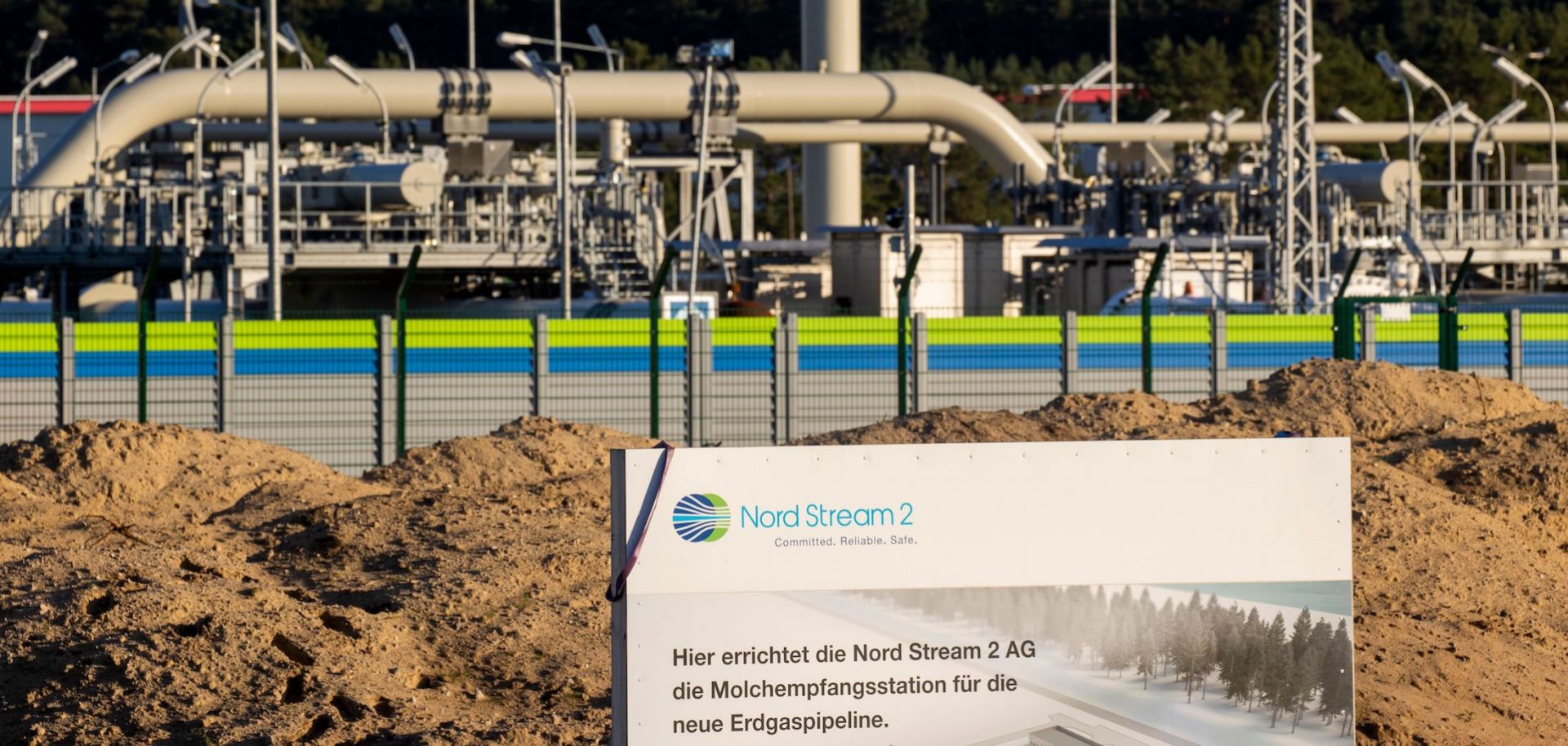
The landfall facility for the Nord Stream 2 pipeline is seen in Lubmin, Germany, on Sept. 7, 2020.
Continued U.S. and German discord over the Nord Stream 2 pipeline, along with the ongoing conflict in eastern Ukraine, reflect Ukraine’s struggles to convince Western policymakers to fully support its foreign policy. Domestic tensions in Ukraine due to perceived meager support from the West could further weaken President Volodymyr Zelensky’s government. The United States and Germany are planning to announce a deal on the disputed Nord Stream 2 pipeline in the coming days, according to unnamed sources cited in a July 19 Reuters report. This follows the July 16 meeting between German Chancellor Angela Merkel and U.S. President Joe Biden in which both leaders declared their unity against Russian aggression and agreed to collaborate on mobilizing investment aimed at helping emerging economies in Central and Eastern Europe transition to cleaner energy, but failed to resolve their countries’ differences on the natural gas pipeline between Germany and Russia. As part of the to-be-announced deal with Germany, the United States has reportedly agreed not to resume its currently waived sanctions against the company behind the $11 billion project, Nord Stream 2 AG, and its chief executive following assurances and yet unspecified investments supporting Ukraine’s energy transformation from Russian hydrocarbon imports to domestic green energy production. U.S. and German investments in the transformation, efficiency and security of Ukraine’s energy sector, however, are unlikely to be enough to prevent the Nord Stream 2 pipeline from reducing Ukraine’s crucial transit revenues in the coming years.
- In May, the White House decided to waive sanctions against the corporate entity and CEO in charge of the Nord Stream 2 project to protect its relationship with Germany and buy more time for negotiations. The move alienated partners in Central and Eastern Europe keen to oppose Russian influence and incited bipartisan backlash from U.S. lawmakers, both of which will resume in similar force.
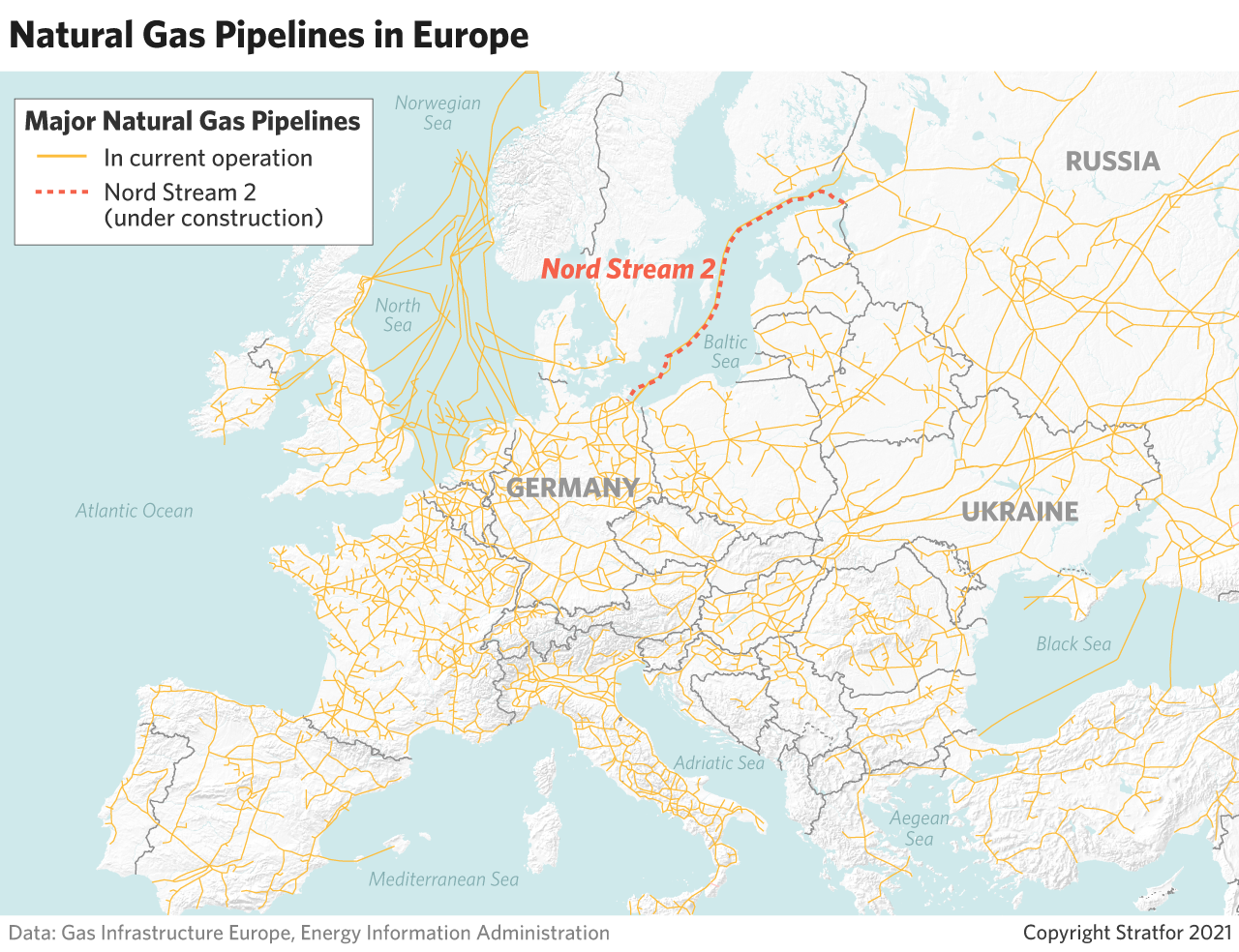
The still hazy details of a possible U.S.-Germany deal on Nord Stream 2 are likely to entail continued challenges for Ukraine. Both Biden and Zelensky had insisted on concrete investments as compensation or gas volume transit guarantees through Ukraine to offset or limit the pipeline’s potential use as a tool of Russian geopolitical coercion against Kyiv. Russian state-owned energy giant Gazprom is already preparing for an attempt to use high gas prices as a way to pressure German and EU regulators to allow the pipeline to quickly begin operations. The United States and Germany appear to have agreed on eventually investing in Ukraine’s energy infrastructure, but the continued lack of details could be an indication that the compensation will be underwhelming and most likely too late to seriously improve Ukraine’s energy security in the near term. According to the five-year transit deal that Russia and Ukraine signed in 2019, Ukraine’s minimum transport volumes can decrease from the minimum of 65 billion cubic meters (bcm) of natural gas in 2020 (which is already down from the 87 bcm Ukraine received in 2018) to 40 bcm in 2021-24. This means Ukraine could receive transit fees over the next three years on just half the volume of gas it did three years ago. After 2024, Gazprom could be in a position to demand a further decrease in its minimum transport volumes through Ukraine, and it is unclear if U.S. and German investments in Ukraine’s energy security will significantly improve the situation even by then.
- Gazprom has reduced bookings through the Ukrainian transit network by 20% this summer compared with previous norms. European states have, in turn, been unable to refill their gas storage prior to the fall, which is already low due to an unusually long winter across the Continent. This will lead to higher prices in the winter when Nord Stream 2 could near physical completion, which the pipeline’s backers will claim underscore its necessity.
While Nord Stream 2 is likely to be physically completed, there are still legal and political obstacles to the pipeline becoming operational. U.S. Secretary of State Antony Blinken called Nord Stream 2 a “fait accompli” at a congressional hearing on June 7, suggesting that the White House believes it will be completed. Additionally, earlier concerns of faltering German support for the project amid indignation over Russian conduct have largely faded. And while the Green Party, which calls for the abolishment of Nord Stream 2, could enter the German government after the federal election in September, it may do so only as a junior partner of Merkel’s conservative Christian Democratic Union (CDU), which supports the project. But physical completion, possibly as soon as the fall, doesn’t mean that the pipeline will enter operation in short order — particularly if the lingering risk of U.S. sanctions targeting the third-party service companies and insurance firms needed to operate the pipeline is not fully removed, which the reported U.S-German deal appears unlikely to achieve.
- While Russian vessels can complete construction of the project while under U.S. sanctions, certification and insurance will have to be done by large, non-Russian entities, and it isn’t clear which will be willing to do so. Indeed, the threat of U.S. sanctions already prompted at least 16 third-party companies to pull out of the project in February.
- Additionally, Nord Stream 2 must be fully compliant with German and EU regulations, and is likely to face a steady onslaught of legal challenges in both jurisdictions that could delay its opening and/or reduce its capacity once in operation.
- Russia has downplayed and tried to draw the international community away from risks related to certification and insurance. On June 3, Deputy Prime Minister Alexander Novak said the country sees no risks for the certification.
Domestic support for Zelensky’s government could fall as the perception builds that Ukraine is not receiving sufficient Western support against Russian aggression. Zelensky will seek political support from the United States during an upcoming meeting with Biden at the White House, which was previously scheduled for July but has been pushed into August. Domestic political tensions in Ukraine, meanwhile, have reached a high amid renewed national security concerns related to Russian President Vladimir Putin’s recent statements on reasserting Russia’s historical control over Ukraine and denial of legitimate Ukrainian sovereignty prior to the 2021 Russia-Belarus Zapad military exercise scheduled for September. Those security concerns have since only been augmented by the resignation of the country’s influential Internal Affairs Minister Arsen Avakov on July 12.
- The Zelensky administration is worried that some members of the U.S. government believe Kyiv should cave to Russian and Franco-German pressure by following through with the so-called Steinmeier Formula, which is an interpretation of the Minsk agreements that would grant the Donbas breakaway regions constitutionally-enshrined autonomy and the ability to hold local elections prior to Ukraine receiving control of its border with Russia. Since it was proposed by Germany in 2016, the Steinmeier Formula has sparked protests in Ukraine for being a capitulation and a dangerous trap unfavorable to Ukraine’s interests.
- Some U.S. officials believe the Steinmeier Formula could open the door for a de-escalation of the eastern Ukraine conflict, and could also enable the United States and Europe to more effectively focus on their true strategic priority of rallying an international coalition against China. But other members of the Biden administration are more willing to continue supporting Ukraine’s position that it should receive full control of its border with Russia before recognizing any local elections.
- Against this backdrop, individuals close to Zelensky have speculated that Ukraine’s frustration with the West could prompt Kyiv to explore increased investment from China and other Asian countries. To that end, Zelensky held his first phone conversation with Chinese President Xi Jinping on July 13 — the day before Merkel’s trip to Washington and the day after Zelensky’s meeting with Merkel in Berlin.
