
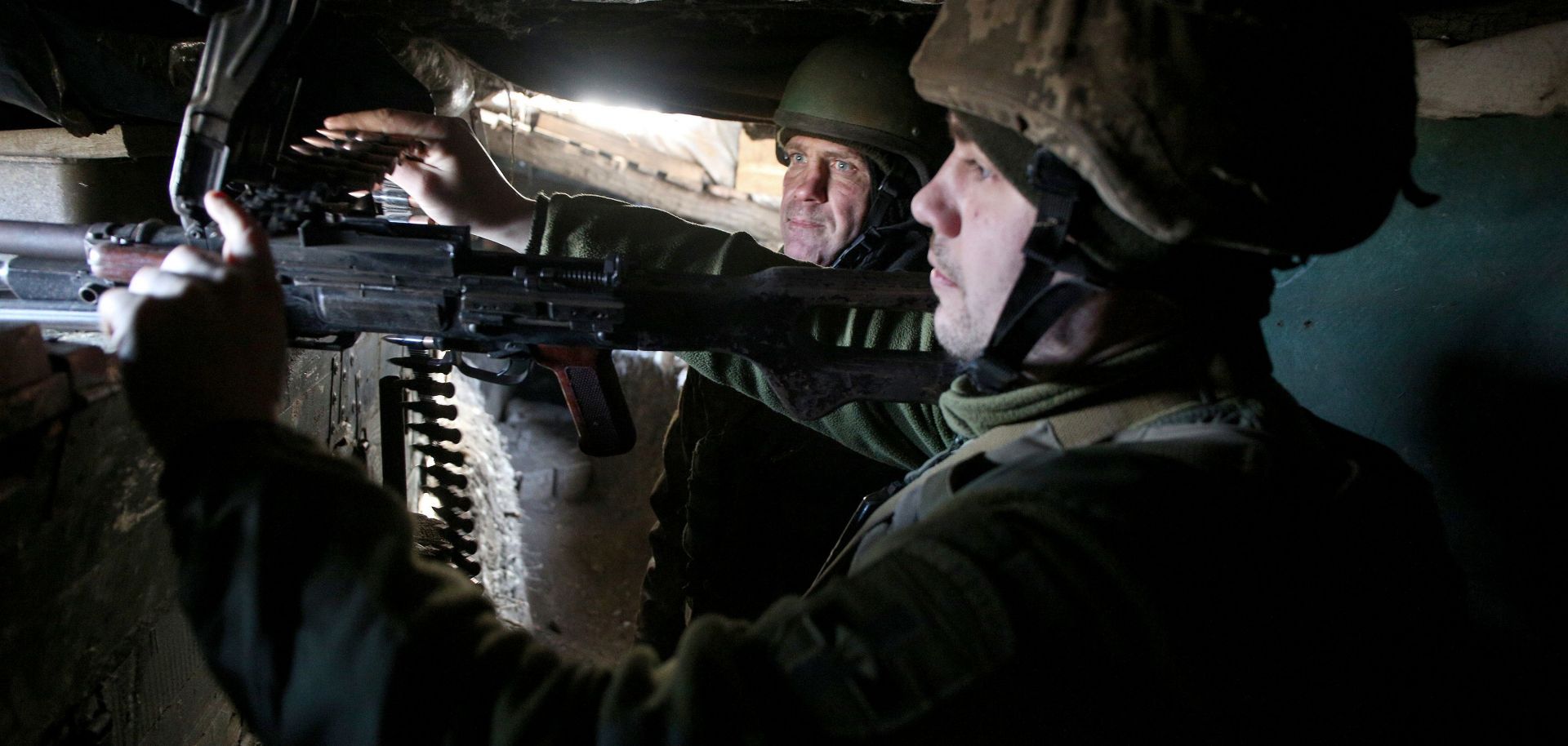
Ukrainian servicemen stand in position on the front line with Russia-backed separatists Feb. 19, 2021, in the Donetsk region.
Rising tensions in eastern Ukraine could lead to a deliberate or accidental return to sustained armed conflict between Kyiv and Russian-backed separatists. An estimated 14,000 people have died since fighting broke out in 2014 in the wake of Ukraine's Euromaidan uprising and the Russian annexation of Crimea. The most recent cease-fire, which was enacted in July 2020 and widely praised as far more effective than most of the two dozen others that preceded it, had seen dramatic drops in the number of violations and casualties until the start of the year. Since then, however, Ukrainian, Russian and international observers have all raised concerns that, more than previous bouts of skirmishes, the present escalation could give rise to renewed major conflict. On March 31, the chairman of the U.S. Joint Chiefs of Staff called his counterparts in Ukraine and Russia to discuss growing tensions amid reports of nearby buildups of Russian troops.
- On the deadliest day of the year, on March 26 four Ukrainian soldiers were killed near the separatists' de facto capital of Donetsk. According to reports, the fighting was notable not only for its high casualty count, but also because it lasted most of the day, whereas most fighting along the so-called "Line of Contact" typically occurs in discrete spurts.
- Since Russian troops failed to leave the Russia-Ukraine border area after completing military drills on March 23, U.S. European Command has twice raised its watch level from possible crisis to potential imminent crisis, the highest level.
- Russia and Ukraine earlier in March each conducted military exercises, in and near Russia-annexed Crimea, respectively, with troop maneuvers designed to signal resolve to the other side.
Ukraine and Russia are trading recriminations over blame for the uptick in violence amid renewed bilateral frictions. On March 30, the Ukrainian military's commander-in-chief accused Russia of systematically violating the cease-fire as it pursues an "aggressive policy towards Ukraine" and Ukrainian lawmakers approved a statement blaming Russia for "a significant increase in shelling attacks and armed provocations" since the start of the year. Later that day, Russian President Vladimir Putin accused Ukraine of provoking clashes with pro-Russian separatists and failing to follow its commitments to quell fighting in eastern Ukraine, according to a readout of a phone call Putin had with the leaders of France and Germany.
- Since the start of the year, Ukrainian President Volodymyr Zelensky has taken multiple steps to engage Washington and push back against Moscow. Most recently, on March 23 he approved sanctions against more than two dozen Russians or former pro-Russian Ukrainian leaders who fled the country, along with more than 80 Russian-linked legal entities, including businesses and media outlets.
- In separate incidents in February and March, Ukraine accused Russian hackers of conducting cyberattacks targeting, among other things, classified Ukrainian government data and the websites of the country's security service and military.
- In recent weeks, European cease-fire monitors have reported seeing separatists with new and improved weaponry and observed that artillery fire has become more frequent. Although the Kremlin denies the charges, most Western governments and independent observers argue that the separatists are Russian proxies who receive military supplies and at least some form of tacit, if not explicit, operational direction from Moscow.
Both Kyiv and Moscow will use the escalating tensions in eastern Ukraine for their own political purposes in ways that could cause a calculated or unintended return to full confrontation. Both sides also have an interest in using the conflict to appeal to their respective domestic constituencies and send signals to foreign powers. Even if neither side deliberately seeks to incite a return to war, there are increasing risks of both strategic and tactical miscalculation or miscommunication. The broader deterioration in relations between the West and Russia adds additional risks that the opposing parties will assume the worst of the other's intentions and feel that they have no choice but to escalate militarily.
- Zelensky faces domestic political pressure on a number of issues, including blowback against some of his contentious anti-corruption moves and violent protests over the conviction of a controversial far-right activist that have blossomed into more general public expressions of dissatisfaction. Being seen as standing up to Russia would help Zelensky refocus public attention and possibly enable him to rally support for his efforts to confront persistent Russian political and economic influence in the country.
- Growing tensions in eastern Ukraine also provide fodder for Zelensky to appeal to the United States and European allies for greater military support, one of his key foreign policy goals. Western governments have pledged mostly token assistance, but a flare-up — particularly amid accusations that Russia has been resupplying separatists with more advanced weapons and military gear — would enable Zelensky to make a stronger case for arms and financing.
- For his part, Putin can exploit stepped-up fighting in eastern Ukraine to distract Russians from their pandemic-induced economic concerns and an ongoing crackdown on dissent linked to the jailing of opposition leader Alexei Navalny. Historically, Putin has used foreign military activities to successfully boost his public support by promoting himself as defending Russian interests in the face of supposed Western belligerence, a portrayal he will want to cultivate in advance of parliamentary elections in September.
- Increasing Russian military support to separatists in eastern Ukraine also gives Putin an effective mechanism to signal to the West that he maintains asymmetric ways to hit back against recent Western sanctions and other forms of pressure.
