
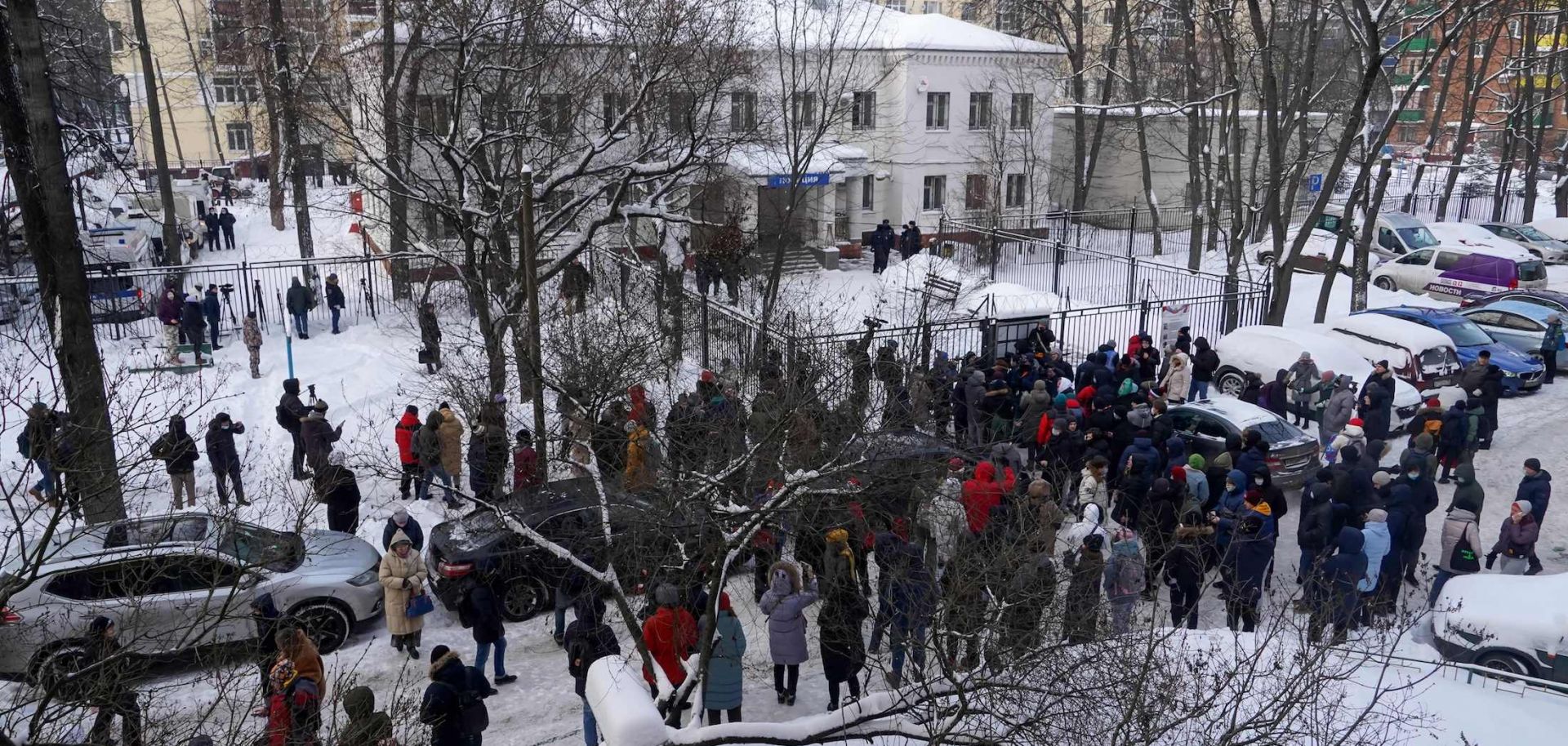
Journalists and supporters of Russian opposition leader Alexei Navalny gather near the police station where Navalny was held after being detained at the Moscow airport on Jan. 18, 2021, in Khimki, Russia.
Russian authorities’ attempts to silence opposition leader Alexei Navalny affirm their determination to extinguish dissent, which could complicate Moscow’s foreign policy goals by further deteriorating its relations with the West. On Jan. 18, just a day after Navalny returned home for the first time since being poisoned in a suspected assassination attempt by Russian security services in August, a makeshift Russian court ordered that he be jailed for the next 30 days. Navalny faces a potential three-and-a-half-year prison sentence for allegedly breaching the terms of a suspended sentence related to a 2014 fraud conviction, which he says is politically motivated. A court hearing on the matter is scheduled for Feb. 2.
- Just before Navalny returned home, police arrested one of his top allies on charges of inciting extremism online after he posted a photo on social media of a Russian journalist who set herself on fire to protest government harassment last October. In late December, police also charged another prominent Navalny ally with trespassing and threats of violence after she visited the home of one of the intelligence officers accused of trying to poison Navalny.
- Navalny is due in court on Jan. 20 on separate charges of allegedly defaming a World War II veteran, which carries a potential fine and up to five years in jail. Last June, investigators opened a probe after Navalny made social media posts critiquing the veteran and others who took part in a promotional video supporting constitutional amendments passed last summer.
- In late December, authorities opened a criminal case into Navalny’s alleged redirection of nearly $5 million in donations to his nonprofit organizations toward private purposes, including vacations abroad. He faces up to a decade in jail if found guilty.
- In August 2019, Russian investigators charged Navalny’s Anti-Corruption Foundation, which investigates public graft, with laundering approximately $15 million. Those involved in the organization’s alleged money-laundering scheme could face seven years in prison.
The Kremlin’s moves against Navalny demonstrate its resolve to further restrict what little space remains for public criticism in Russia, even as its actions are likely to prompt some short-term unrest. Navalny’s jailing comes shortly after various new laws came into force that give the Russian government additional ways to limit political opposition, which it will likely use ahead of parliamentary elections scheduled for September. In the past two years, Navalny and his opposition allies have encouraged anti-Kremlin voters to engage in a “smart voting” strategy to back the most viable candidate not running on the ruling United Russia party ticket. Moscow will seek to foil this strategy, which has had some modest success in regional elections, before this year’s legislative ballot.
- Under the new laws, Russian authorities can now label essentially any foreign-funded individual or organization a “foreign agent,” triggering a set of onerous requirements. They can also sentence individuals to jail time for various alleged offenses, including spreading online libel, blocking roads and disclosing state employees’ personal data — all of which observers worry will be used to target anti-government campaigners.
- Navalny and his allies have called for mass protests on Jan. 23. An application for a 10,000-person demonstration at the end of this month was also reportedly submitted to Moscow city authorities. Significant public protests would boost the profile of Navalny’s movement, possibly helping to convince ordinary Russians who are disenchanted with the government but skeptical that there is a viable alternative. The opposition’s calls for mass action, however, could also backfire by giving authorities an excuse to crack down or if they are poorly attended.
- More than 70 Navalny supporters and journalists were detained across the country on Jan. 18, according to a Russian monitoring group.
Amid broader ongoing tensions with the West, Russia will struggle to divorce its efforts to silence Navalny from its desire to achieve foreign policy priorities with Europe and the United States. Russia is anxious to complete the contentious Nord Stream 2 undersea pipeline project, which would carry natural gas directly from Russia to Germany. The United States fears it will give Russia too much leverage over Germany (and the European Union more broadly), while robbing Ukraine of lucrative transit fees. On Jan. 19, the United States imposed sanctions on the Russian ship involved in laying the final pieces of pipeline, although it is unclear how the incoming administration of President-elect Joe Biden will react. Meanwhile, both Moscow and Washington are eager to extend their last remaining major arms control pact, New START, before it expires on Feb. 5, following the collapse of the other key pieces of the two countries’ arms control architecture. Both sides have publicly affirmed their support for extending New START, which regulates nuclear weapons, though Navalny’s detention will provoke rhetorical broadsides amid what is likely to be at least a temporary extension.
- Some EU members — notably the Baltic states of Estonia, Latvia and Lithuania — have already demanded that the bloc expand its existing financial and travel sanctions against six Russians involved in Navalny’s attempted assassination to include those also involved in his detention. In addition, numerous EU leaders and member states’ foreign ministries expressed concern and called for Navalny’s release.
- Last month, the European Union passed legislation modeled on U.S. law that gives the bloc more powers to punish individuals and entities involved in human rights violations, although EU members with close ties to Russia — such as Greece, Hungary and Italy — are likely to resist applying the new mechanism in this case.
- Jake Sullivan, the incoming U.S. National Security Adviser, recently wrote on Twitter that “the Kremlin’s attacks on Mr. Navalny are not just a violation of human rights, but an affront to the Russian people who want their voices heard.” Outgoing U.S. Secretary of State Mike Pompeo released a statement also strongly condemning Navalny’s detention, which he claimed was “the latest in a series of attempts to silence Navalny and other opposition figures and independent voices who are critical of Russian authorities.”
- During a Jan. 19 conference call with reporters, Kremlin spokesperson Dmitry Peskov brushed off the foreign backlash against Navalny’s detention, saying the Russian government did not plan to take such condemnations into account over what he claimed was “an absolutely domestic matter.” On Jan. 18, Russian Foreign Minister Sergei Lavrov said that the West was trying “to divert attention from the crisis of the Western model of development” by protesting Navalny’s jailing.
