
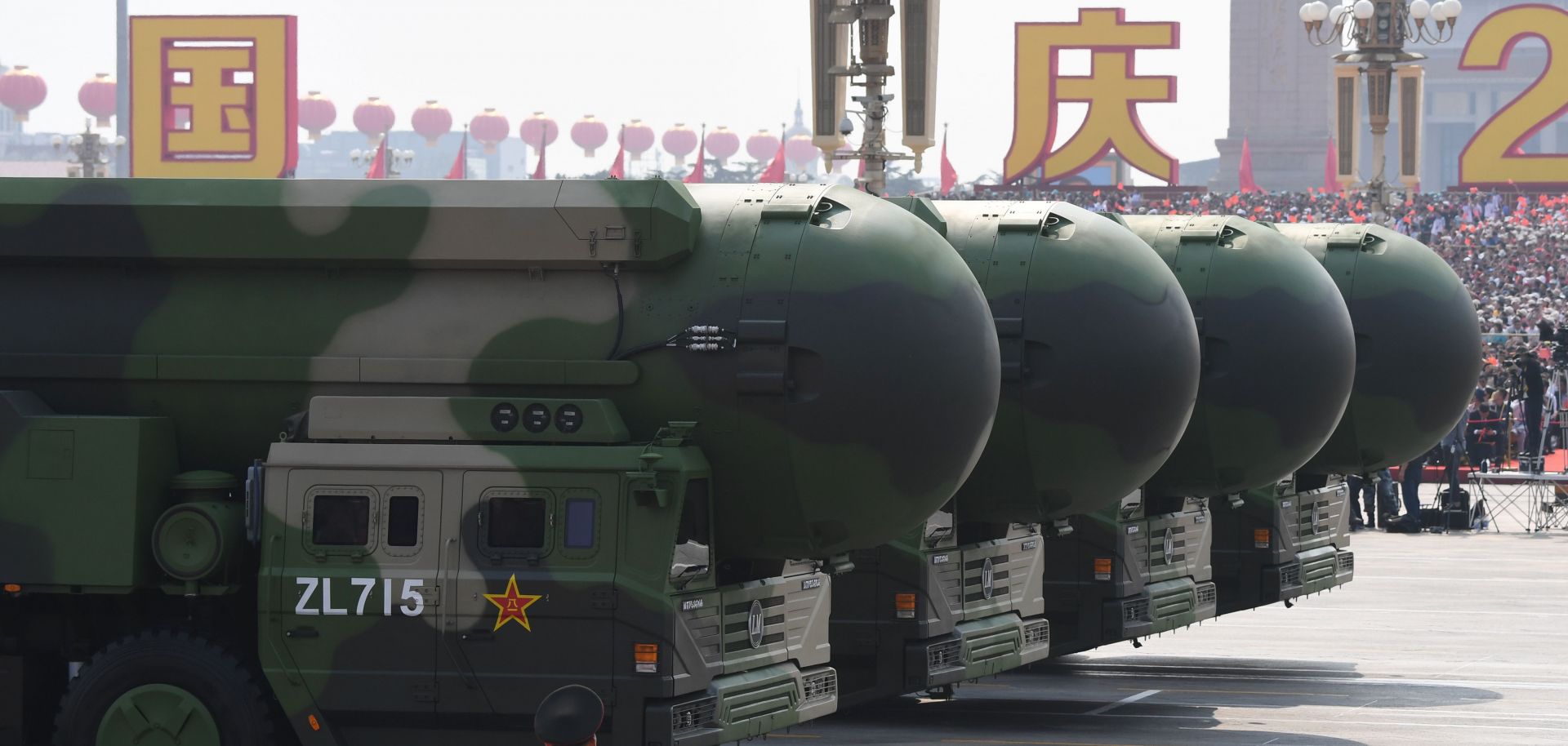
Nuclear-capable ballistic missiles are displayed during a military parade at Tiananmen Square in Beijing, China, on Oct. 1, 2019.
The United States is seeking to buy time in upcoming arms control discussions with Russia, and could agree to a brief extension of New START in an effort to draw China into a longer-term discussion about its potential inclusion in the treaty. Washington may now be more willing to preserve core New START elements that restrict the number of strategic nuclear weapons and delivery systems that each signatory can have.
- The White House’s arms control negotiator, Marshall Billingslea, and Russian Deputy Foreign Minister Sergei Ryabkov are slated to finally meet in Vienna on June 22 to discuss the future of New START, which came into force in 2011 and is now set to expire in February 2021 unless both parties agree to a five-year extension provided within the treaty itself.
- Recent leaks from the administration of U.S. President Donald Trump have suggested that a shorter extension (i.e. less than the five years) may be on the table, but the upcoming meeting will not guarantee any final decision.
The China Question
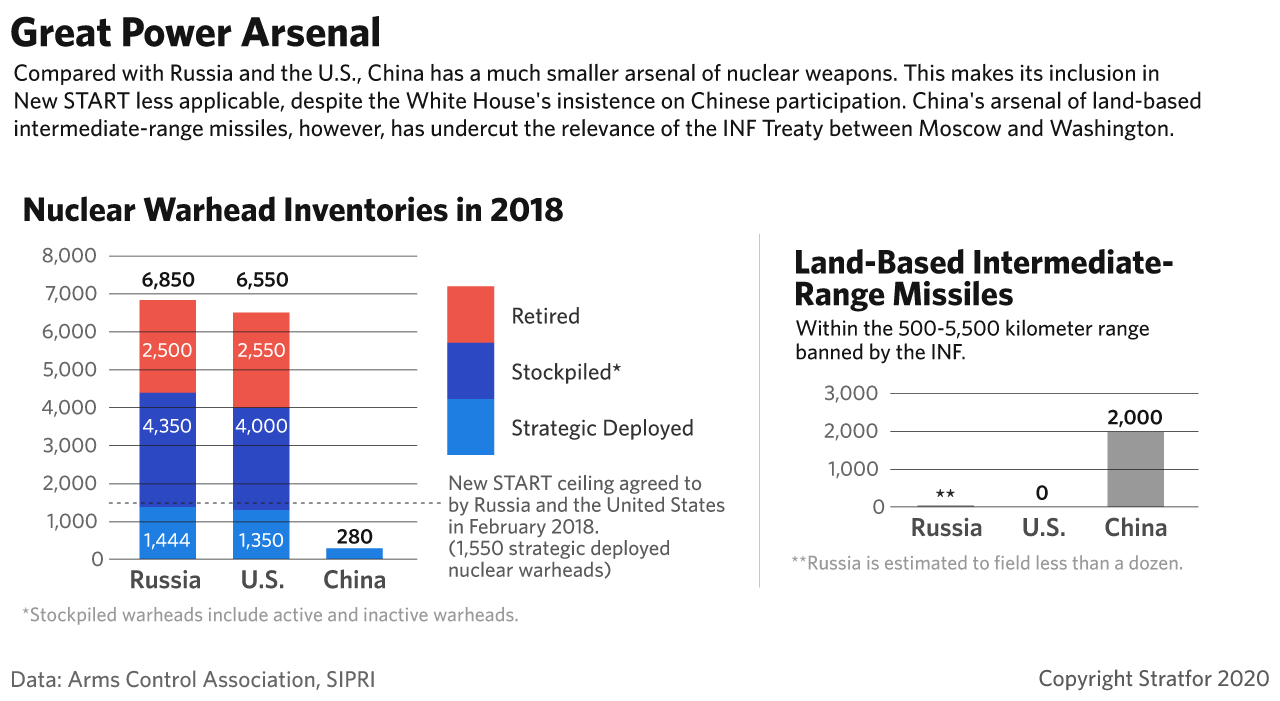
Washington’s primary objective of having China enter into the treaty continues to pose a significant obstacle to a straightforward extension or renegotiation. The Trump administration has been reluctant to accept or even negotiate the extension of New START in the past, as it is adamant that the future of strategic arms control must include China. Beijing, however, has shown no interest in joining the treaty as it has more to lose than to gain by doing so. Unlike the United States and Russia, China is not limited in the number of nuclear weapons it can field, which the Trump administration considers unbalanced given China’s growing global influence. In reality, however, China’s nuclear arsenal is much smaller than those of Russia or the United States. This means that for Beijing, taking part in the treaty would not guarantee it parity with its great power rivals, though it could limit the further development of China’s nuclear capabilities and, perhaps more importantly, provide the United States with direct access to its nuclear arsenal via the treaty’s verification missions.
Part of a Larger Trend
The debate over whether to extend or renegotiate New START is symptomatic of a broader, post-Cold War trend of devolving global arms control. Bilateral treaties between the United States and Russia risk setting them both back relative to China, while growing great power tensions also increasingly lead to non-compliance with these treaties.
- Perceptions of China and Russia’s growing military power have prompted the United States to withdraw from both the Intermediate-Range Nuclear Forces Treaty (INF Treaty) and the Treaty on Open Skies in a matter of just two years.
- This latest surge in collapsing arms control treaties also follows the United States’ withdrawal from the Anti-Ballistic Missile Treaty (ABM Treaty) in 2002 under President George W. Bush.
- Within this context, the future of the Comprehensive Nuclear Test Ban Treaty could be in question as well.
The rapid development of nuclear weapons in recent years has caused existing technology to evolve far beyond New START’s initial scope, highlighting the need for a new successor treaty. The ongoing arms race against the backdrop of rising tensions with the United States and China, as well as advances in missile defense technologies in other countries, has led Russia to explore new types of weapon systems to maintain its nuclear deterrent. New START’s narrow definitions of particular delivery systems — including intercontinental ballistic missiles (ICBM), submarine-launched ballistic missiles and strategic bombers — have enabled Russia to develop nuclear-armed torpedoes and cruise missiles, which are not covered by existing treaty language.
But even if the actual treaty expires in February, the United States and Russia are unlikely to abandon their compliance with New START in the short term. Without this bilateral treaty between the United States and Russia, existing limitations on the number of deployed nuclear weapons and delivery systems - such as ICBM or strategic bombers - would no longer be in place. This does not mean, however, that either the United States or Russia would have an immediate interest in increasing its nuclear arsenal if the treaty were to falter. Even during the Cold War, Washington and Moscow continued to observe agreed-upon limitations during lapses between coverage of various arms control treaties. Over time, however, if no successor treaty emerges, growing mistrust and balancing efforts could eventually bring a return to the increase of deployed nuclear arsenals.
