
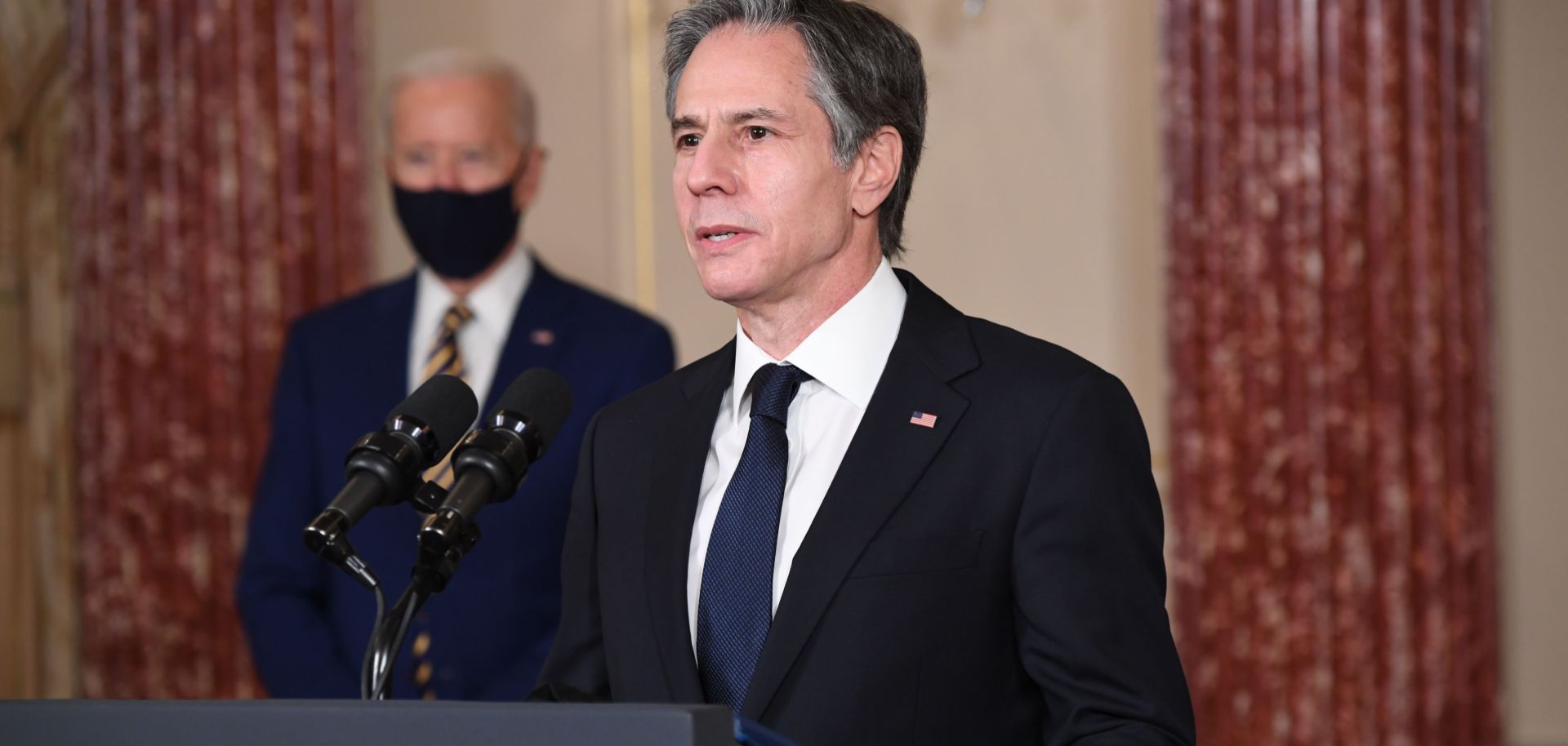
U.S. Secretary of State Antony Blinken discusses his recent call with Russia’s foreign minister on Feb. 4, 2021.
For Russia, potential new U.S. and U.K. sanctions targeting its economic interests would be seen as a significant escalation and compel a range of responses, calibrated according to the perceived aggressiveness of London and Washington’s actions. On March 4, Bloomberg reported that U.S. and U.K. officials are considering additional sanctions against Russia over the poisoning and subsequent jailing of opposition leader Alexei Navalny. Although officials have refused to comment publicly, the options on the table reportedly include sanctioning Russian business elites and imposing restrictions on trading Russia’s sovereign debt. Between these two options, the latter would likely be a last resort, while the former is more likely in the near term.
- To implement possible new sanctions, the United States is expected to draw on a 1991 weapons control law, which it used previously to sanction Russia for a prior attempted poisoning in the United Kingdom in 2018. Washington also has a variety of Russia-specific sanctions laws at its disposal, as well as the so-called Magnitsky Act, which authorizes U.S. officials to sanction individuals worldwide accused of human rights abuses or significant corruption.
- U.K. officials plan to coordinate with European allies, many of whom are skeptical of more meaningful economic action against Russia, despite a deterioration in relations. They also plan to push the Organization for the Prohibition of Chemical Weapons, the intergovernmental agency that oversees the implementation of the Chemical Weapons Convention, to continue to pressure Russia to account for its alleged maintenance and use of banned chemical agents, which the Kremlin denies.
The rumored additional sanctions would escalate the ongoing standoff between Russia and the West, with the United States also promising additional responses to Russian misbehavior beyond the Navalny case. On March 2, the United States and European Union announced asset freezes and travel bans on senior Russian government officials linked to last August’s poisoning and February’s jailing of Navalny. The United States also imposed export restrictions on 14 entities involved in chemical and biological weapons production, including nine commercial entities in Russia. These measures were widely seen as having more symbolic than practical effect, although U.S. officials have repeatedly said that they will be supplemented by additional actions to respond to other acts of Russian aggression.
- Divisions among EU member states prevented the European Union from directly targeting Russian business elites in its March 2 sanctions, despite calls for such action from Navalny’s allies in Russia and hawkish governments in eastern Europe.
- As they seek to synchronize actions with European allies, U.S. officials repeatedly have said that they are preparing more aggressive responses to U.S.-specific grievances, most notably the SolarWinds cyberattack, which was publicly disclosed in December 2020 and is widely blamed on Russia. During separate March 2 testimony, FBI Director Christopher Wray hinted that the United States was preparing cyber “joint sequenced operations.” White House officials have also promised more robust forthcoming actions.
Moscow would interpret the type of new sanctions that Washington and London are reportedly considering as escalatory and justifying reciprocal responses, probably in asymmetric ways. In response to the March 2 announcement of U.S. and E.U. sanctions, the Russian Foreign Ministry said it will publish a “blacklist” of U.S. citizens and officials. Since then, a spokeswoman with the ministry has warned the West not to “play with fire” and said other measures “will surprise them soon.” A Kremlin spokesman also called the potential new U.S. and U.K. sanctions “crazy,” with Russian Foreign Minister Sergey Lavrov promising actions that were “reciprocal, but not necessarily symmetrical.”
- In addition to the already-promised “blacklist,” Russian authorities are likely to increase harassment of diplomats and restrict their activities, including possible expulsions. They may also seek to take legal action against local entities that have Western links by using a recently enhanced “foreign agents” law to impose fines and curtail their operations.
- Russian activities targeting Western commercial interests could include imposing import bans on certain goods or services; issuing fines or restricting the activities of Western social media firms; and interfering in the local operations of Western businesses, such as by opening financial or criminal investigations into alleged wrongdoing. The Kremlin could also put restrictions on foreign investments in Western countries, focus on selling more debt to non-Western investors, or further adjust the currencies of its bond issues.
- Most aggressively, the Kremlin could make public and/or covert moves in the security sphere. The Russian government could endorse cyber operations targeting Western companies not merely to collect information, but to infect and damage their networks. Of most concern, but also the least likely at the moment, Russia could step up pressure in military conflict zones, such as increasing support for separatists in eastern Ukraine.
