
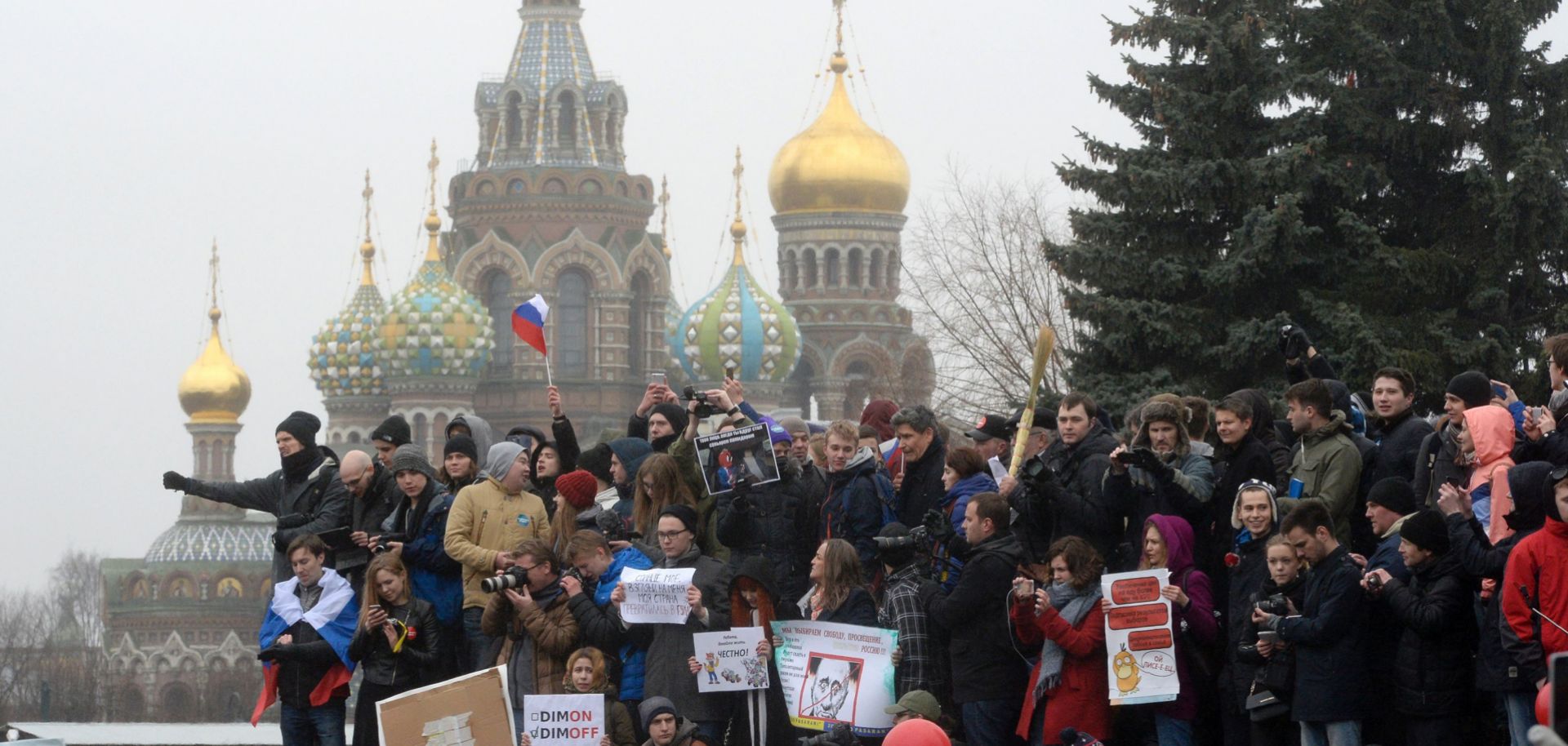
Demonstrations of political dissent have become larger and more frequent in several Eurasian countries since the Euromaidan uprising shook Ukraine in 2014.
The Euromaidan revolution of 2014 was a watershed moment. What began as a small group of just a few dozen people advocating for Ukraine's accession to the European Union in Kiev's Independence Square quickly turned into a mass demonstration after security forces violently disbanded the protesters. A few months later, the uprising unseated President Viktor Yanukovich, setting the conflict in eastern Ukraine in motion and kicking off the enduring standoff between Russia and the West. The demonstrations set a new precedent for protest movements, not just in Ukraine but across Eurasia: They illustrated the risks of a heavy-handed, authoritarian reaction to dissent and proved what a determined public could achieve through protest, with the help of social media. For governments throughout the region, these were troubling revelations. But as protests have become larger and more frequent across the region in the years since, leaders in certain former Soviet republics have heeded the lessons of the Euromaidan and adapted their response to the growing unrest.
Four Years Later
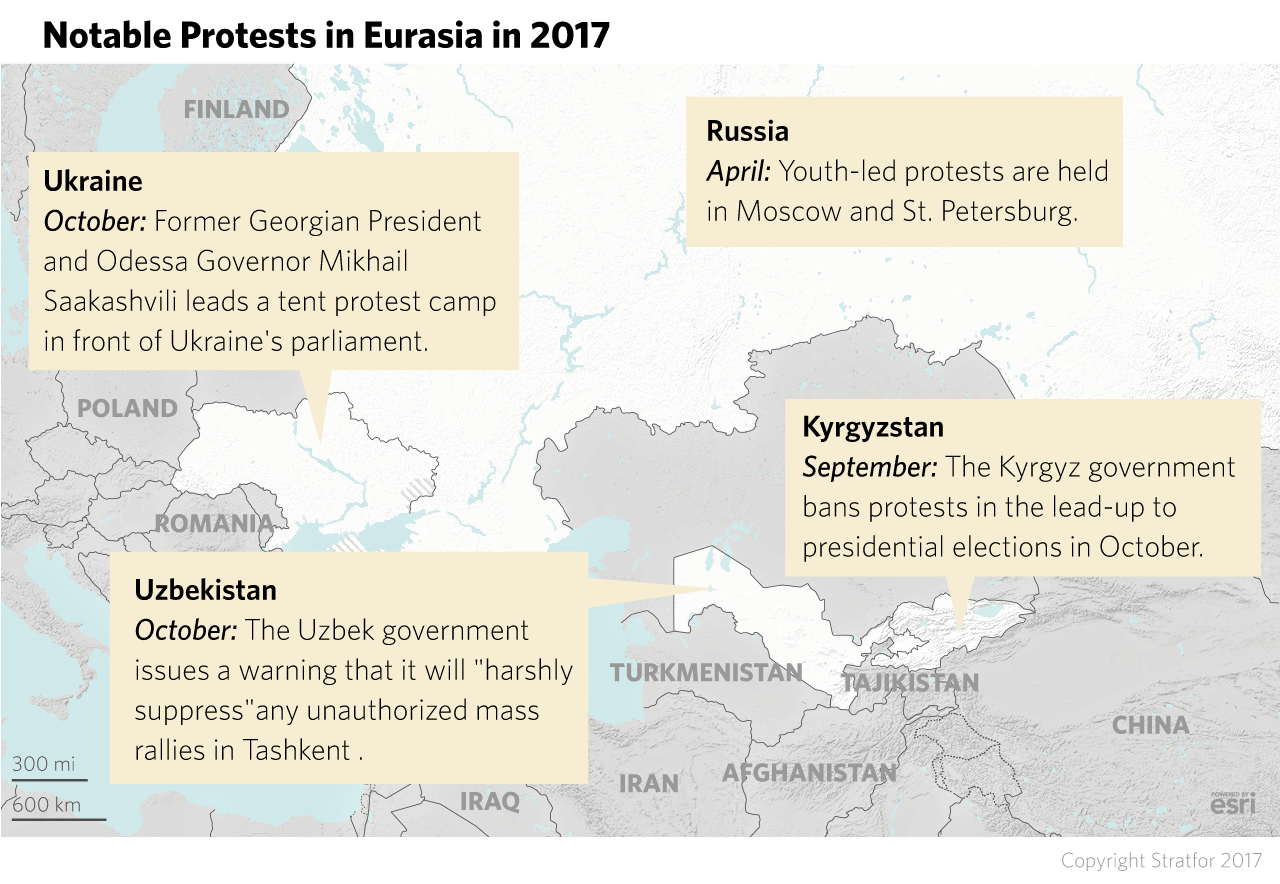
Nowhere is the change more apparent than in Ukraine itself. Four years after the Euromaidan protests began, demonstrations have become a regular occurrence in the country. Ukrainians take to the streets these days to protest against everything from economic issues to corruption to the conflict in Donbas. And security forces take a softer line on demonstrations than they did before (and during) the Euromaidan uprising; though scuffles occasionally break out between protesters and police, no major crackdown or confrontation has taken place since 2014. Ukraine's national police have recently deployed roughly 3,000 officers to the area around the parliament building in Kiev, where protesters have been gathered since Oct. 17 to call on President Petro Poroshenko to take a tougher stance on corruption. According to the police chief, however, the officers are there only to ensure public safety and "secure the citizens' right to express their will."
The government's new approach seems to be paying off for all parties involved. Lawmakers are currently discussing the protesters' demands, including anti-corruption legislation and a proposal to end legal immunity for members of parliament. Although the measures may take several months to get through the legislature, the fact that they are up for debate in parliament shows the Ukrainian government is taking the demonstrations seriously. The protests, in turn, have started to wind down instead of ramping up into another rebellion. By tolerating opposition movements, and entertaining their demands, Ukraine's leaders will probably be able to prevent street demonstrations from giving rise to greater instability so that they can focus instead on managing the conflict in Donbas and dealing with Russia's hybrid warfare strategy.
The Last of the Last Dictatorship?
Similarly, Belarus — known as Europe's "last dictatorship" — has adopted a more subtle way of handling dissent. President Alexander Lukashenko, worried that another major crackdown could lead to his own ouster, has moderated his notoriously forceful strategy for containing unrest since the Euromaidan revolution shook neighboring Ukraine. Rather than detaining participants at the protest site, for example, authorities have started issuing fines in certain cases or calling individual activists in for questioning after demonstrations.
Now that the government has relaxed its stance on public expressions of opposition, the pace of protests in Belarus is picking up. Thousands of people in cities across the country turned out in February and March to demonstrate their opposition to the government's economic policies, namely the so-called "social parasite" tax. The protests lasted for months, yet Lukashenko's administration refrained from mass arrests, detaining only select factions in the opposition. The strategy seems to be working, much as it has in Ukraine; on Oct. 21, another demonstration in the capital, Minsk, drew only around 200 people — a small turnout compared with the protests earlier in the year. Though Lukashenko could always revert to his old ways, for now his administration appears to have found an effective strategy to contain dissidence without quashing it.
No Choice but Tolerance
Even the Russian government has tempered its response to protest movements over the past few years. As mass demonstrations have spread across the country this year, mass arrests have been a relative rarity. Police detained more than 1,000 protesters in Moscow and St. Petersburg in June, but even so, the crackdown paled in comparison with the efforts to contain sweeping demonstrations in 2011-12. And while the Kremlin has taken steps to try to keep protests from taking place, for instance by restricting access to social media sites used to organize the events, many regional governments have granted permits to allow the demonstrations.
With less than six months to go before the next presidential election, President Vladimir Putin has little recourse for dealing with the dissent. A full-blown crackdown, after all, could spark a public backlash against his administration. To avoid further fueling the protests, the Kremlin has even eased up on members of the opposition, including Alexei Navalny, who has mobilized thousands of Russians, particularly young people, against Putin. Despite having banned Navalny from the presidential race — and sentencing him to 20 days in prison for organizing illegal protests — the Russian government has left the opposition leader some room to maneuver. (Moscow could, however, decide to enforce the suspended five-year prison sentence Navalny received for embezzlement at any time.) The Kremlin is concerned more with the prospect of a wider movement coalescing against it than with the threat Navalny's faction poses on its own. Consequently, the Russian administration will allow some protests to continue, at least for the time being, to keep the opposition in check.
A Different Strategy
Elsewhere in the former Soviet Union, meanwhile, leaders are taking the opposite approach to protests. The governments of Central Asia — which are generally more authoritarian than are their counterparts in the European regions of Eurasia — are keeping a firm hand with dissidents and activists, whom they sometimes dubiously label as provocateurs and jihadists. Police in the Uzbek capital of Tashkent, for example, issued a warning Oct. 23 that they would "harshly suppress" any attempt to organize unauthorized demonstrations in the city. Protests are rare in Uzbekistan; the last major demonstrations happened more than a decade ago and met with a ruthless response from security forces. Still, authorities in Tashkent are concerned with the threat of unrest — and prepared to address it. In Kazakhstan and Tajikistan, likewise, the governments have taken swift action to shut down or prevent protests. Even the administration in Kyrgyzstan, where popular uprisings have toppled leaders twice over the past 15 years, recently banned opposition protests, albeit temporarily, to mitigate the risk of political upheaval in the run-up to the presidential election.
By limiting demonstrations, Central Asia's leaders doubtless hope to keep instability at bay. But their tried-and-true methods for preserving the political order will become less and less effective as the economic and environmental pressures on the region mount. Facing growing unemployment and waning resources, Central Asia's governments may be forced to follow in the footsteps of the Ukrainian, Belarusian and Russian leadership and allow more room for dissent. Otherwise, they could wind up with a repeat of the Euromaidan revolution on their hands.
