
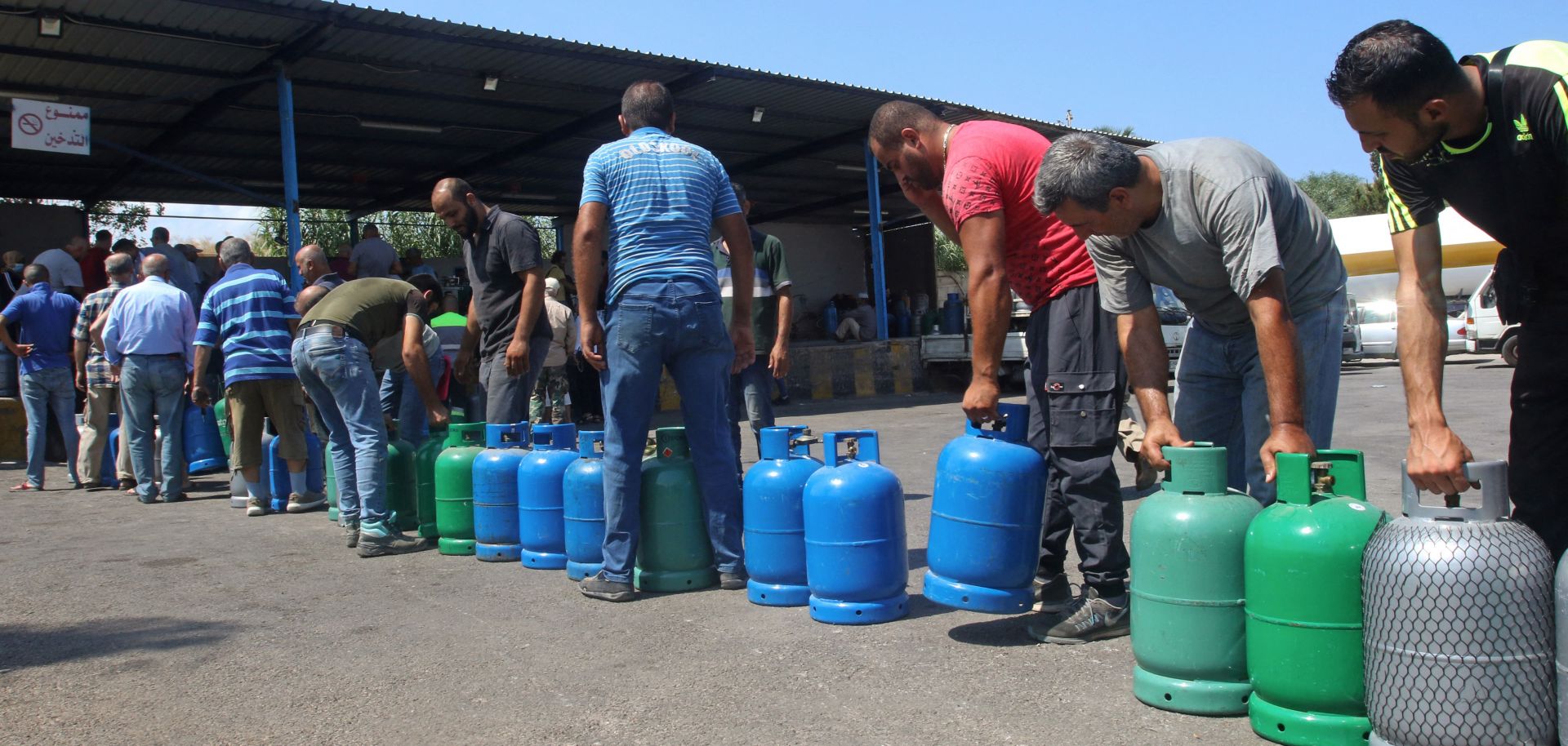
People wait to fill up fuel tanks in the southern Lebanese city of Sidon on Aug. 10, 2021.
Both the United States and Iran are offering solutions for Lebanon's energy crisis. But neither illicit Iranian fuel shipments nor Washington’s plan to revitalize the Arab Gas Pipeline will provide immediate relief, portending more economic and social unrest. Lebanon’s increasingly dire fuel crisis is causing the United States and Iran to compete against one another to provide relief. Hassan Nasrallah, the leader of the Lebanese political party and militant group Hezbollah, announced on Aug. 19 that Iran would send fuel ships to Lebanon. The same day, Lebanese President Michael Aoun announced that the United States was working to provide Egyptian gas to Beirut via Jordan and Syria (presumably through the Arab Gas Pipeline which runs from the Egyptian city of Arish to the Syrian city of Homs. Washington is also threatening Lebanon with sanctions should it openly take Iranian aid.
- Four U.S. Senators visited Lebanon on Sept. 1. During their trip, the lawmakers urged Lebanon’s leaders to form a government, offered U.S. aid to ease the current fuel crisis, and warned the United States would impose sanctions if Lebanon accepted Iranian fuel.
- According to Nasrallah and Iranian media, Tehran is planning to send three ships to supply Lebanon fuel, though none have apparently arrived yet.
- In recent months, fuel in Lebanon has become increasingly expensive and scarce due to a combination of the Lebanese currency’s declining exchange rate (which rose import prices), the central bank’s move to cut fuel subsidies last month, and the illegal hoarding and smuggling of fuel.
Hezbollah will likely try to smuggle Iranian fuel into Lebanon, which is risky as it would only provide temporary relief to the country. Iranian ships could first offload in Syria, which routinely brings in Iranian energy supplies, and then smuggle the fuel into Lebanon. Smuggling would alleviate the fuel crisis and boost Hezbollah’s domestic profile, while the United States would likely only target the smuggling networks and their enablers rather than the Lebanese central bank or government. But sneaking in Iranian exports is only a temporary solution for Lebanon’s fuel problem, and Hezbollah could face domestic public blowback for exposing the country to U.S. sanctions risks, which in turn could result in yet more capital flight by Lebanese middle- and upper-classes. Additionally, Hezbollah is likely to dole out supplies to its supporters first, leaving parts of the country without fuel and causing further domestic criticism of the group’s strategy. Corrupt Syrian officials could also disrupt Hezbollah’s smuggling strategy by intercepting some of the fuel in order to re-sell it in Syria. Such fuel supplies could become a target of Israeli covert action as well, given that Israel has previously attacked Iranian oil tankers and sabotaged fuel supplies in Syria.
Waiting for Western assistance may reduce the prospect of sanctions. But in the meantime, Lebanon will risk plunging even deeper into chaos as the country’s fuel crisis continues to worsen, increasing the risk of more social unrest and sectarian violence. The United States’ plan to provide Lebanon Egyptian gas through Syria will first require finding an exemption to the U.S. Ceasar Civilians Protection Act, which sanctions Syria and those who do business with it. As it tries to find a legal path forward, Washington may also lean on other regional actors like Qatar, the United Arab Emirates or Saudi Arabia to supply a temporary solution to Lebanon’s fuel crisis. But these Arab Gulf states might be hesitant to provide such aid for fear of ending up on the hook for supplying Lebanon fuel permanently, should the U.S. plan for the Arab Gas Pipeline fall through. These complications mean that it could be weeks or even months before U.S. aid actually materializes. In the meantime, Lebanon’s fuel crisis will continue to paralyze hospitals, businesses and transport — creating social tensions that will manifest in protests, riots and even clashes between sects competing for scarce energy supplies.
- Shiites and Christians rioted Aug. 29 in southern Lebanon after a dispute over access to scarce fuel supplies turned violent, wounding at least six people.
- On Aug. 15, a shocking tanker explosion in northern Lebanon killed 28 people who were desperately trying to fill up plastic containers with fuel.
- Lebanese Sunni leader Grand Mufti Sheikh Abdul Latif Derian recently warned the country was heading for complete collapse amid the ongoing crisis.
