
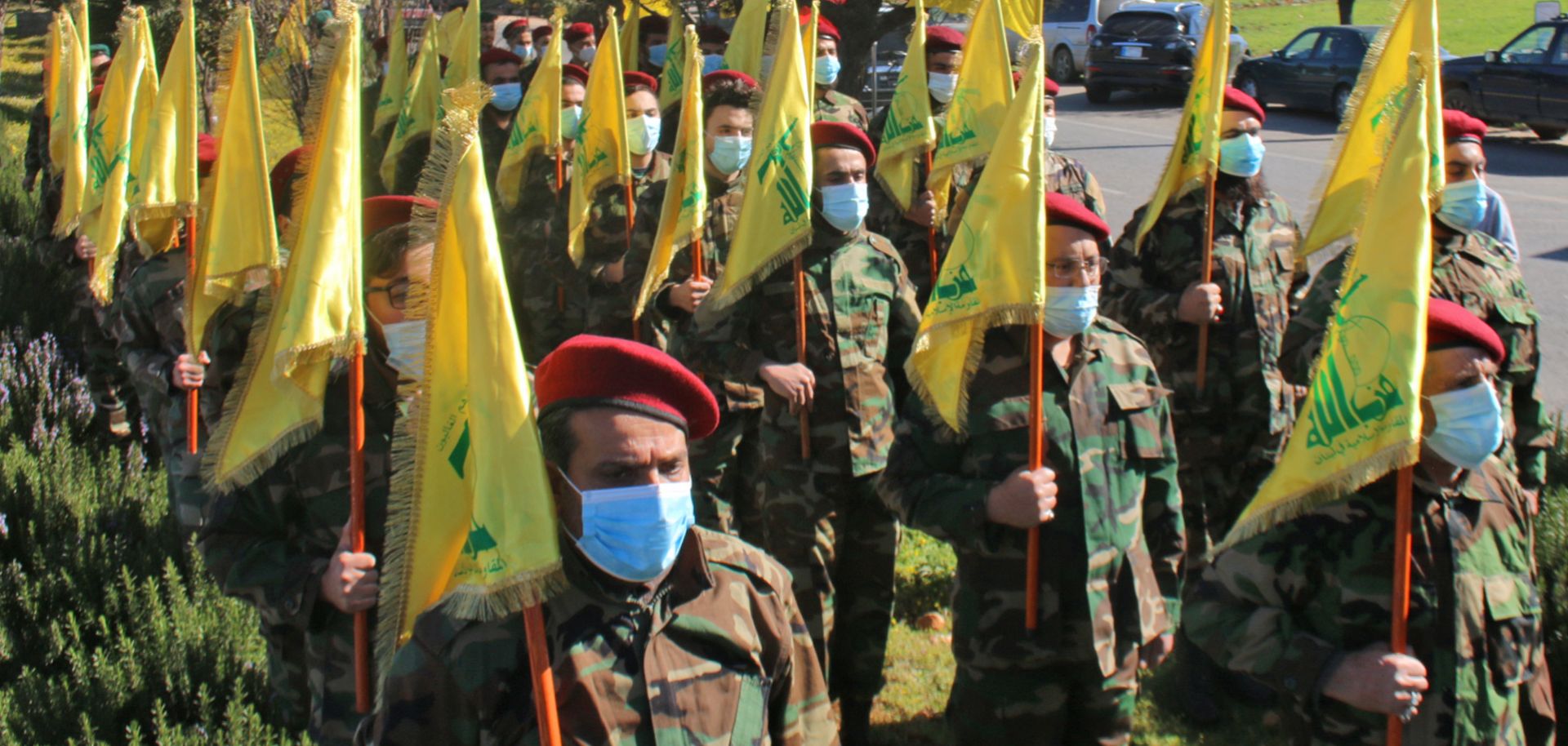
Hezbollah members hold a military parade in the Lebanese town of Riyaq on Feb. 13, 2021.
Hezbollah’s eroding position as a legitimate defender of Lebanese interests is exposing it to domestic challengers like protesters, opposition parties and rival tribes — raising the risk that the militant group will resort to force to maintain its hold on power in Lebanon. Hezbollah’s move to fire a dozen rockets toward Israel on Aug. 6 has since further harmed its reputation as a Lebanese national resistance movement by creating the potential for an escalation with the Israeli army. While war was averted as both sides have since de-escalated, the Iran-backed militant group and the political party faced notable criticism for its actions. In a significant incident, once-friendly Druze villagers in the Hezbollah-dominated south seized a Hezbollah rocket platform on Aug 6. Days later, a long-term critic of Hezbollah, Maronite Patriarch Bechara Boutros al-Rahi, urged the Lebanese army to take control of the country’s southern border.
- Hezbollah has already been facing more domestic pressure since the anti-establishment protest movement erupted in the fall of 2019. Hezbollah is one of several political parties in Lebanon that has been blocking deep political reforms for fear that changes to state spending will undermine its ability to provide jobs and wealth for its supporters. In a December 2020 poll, the Washington Institute found a slide in positive sentiment for Hezbollah among Shiite Lebanese, with those saying they held “very positive” views of the group dropping from 83% in 2017 to 66% in 2020.
- Hezbollah has also come under criticism for its involvement in the Syrian civil war alongside Iran and President Bashar al Assad’s regime in Damascus. Some Lebanese have worried the sectarian nature of the Syrian conflict could spill over into their country. Economically-strained Lebanon has also become the host of 1 million Syrian refugees, adding to Lebanese criticism of the war.
- Lebanese are also generally wary of another 2006 style war with Israel, which resulted in significant damage to the country and killed thousands — making them more sensitive to acts that might spark a greater military escalation, such as the Aug. 6 strikes conducted by Hezbollah.
Hezbollah’s claim to be a resistance movement will come under more political and rhetorical attacks in Lebanon, but such increased scrutiny is unlikely to shift the group’s identity as a pro-Iranian proxy. This criticism is likely to be heightened if the European Union, led by France, enacts sanctions on Lebanon’s ruling elite to force them to reform. With limited assets in the West exposed to such sanctions, Hezbollah and its pro-Iranian allies will be better able to weather the impact than other factions, potentially driving a wedge between Hezbollah and some of its political allies like the Free Patriotic Movement, whose leaders regularly travel to Europe and the U.S. and who hold substantial assets overseas. Additionally, Israel will continue to conduct its covert war against Iran in Syria, probably causing Hezbollah casualties in the process that could potentially spur the group to conduct more attacks against Israel from Lebanon. But new rounds of conflict with Israel will be unpopular in Lebanon and come up against more public protest. More Lebanese citizens could even try to directly restrain Hezbollah’s military maneuvers, like the villagers in the recent Druze incident. But despite these increased constraints, Hezbollah’s leadership will not risk their relationship with Iran nor with militant supporters by substantially changing policies to allow deeper reforms or de-conflict long-term with Israel.
- Since 2006, Hezbollah itself has expressed multiple times a desire to avoid a major war with Israel. But the group feels compelled to conduct revenge attacks for Israeli strikes on the group in Syria, as well as to react to Israeli strikes on Lebanese soil. These attacks raise the risk of a return to a 2006-style war, especially if Israel decides to escalate military operations against Hezbollah.
To maintain the group’s domestic independence, Hezbollah may be more willing to rely on force to fend off these challenges, from intimidating activists and protestors to even deploying its armed fighters against Lebanese opposition. Hezbollah has long used force to control the Shiite political spectrum and silence criticism from other sects and civil society groups. However, if criticism against Hezbollah begins to embolden more attacks on its members or interference with its military operations, the group is more likely to deploy its fighters to maintain independence. Using its fighters this way would raise the risk of Hezbollah directly clashing with rival tribes, sectarian militias or even the Lebanese military, dragging the country back toward civil war.
- Hezbollah’s suspected involvement in the early 2021 assassination of the prominent critic and journalist Lokman Slim fueled further criticism of the group, while anti-establishment protestors have demanded that Hezbollah distance itself from Iran.
