
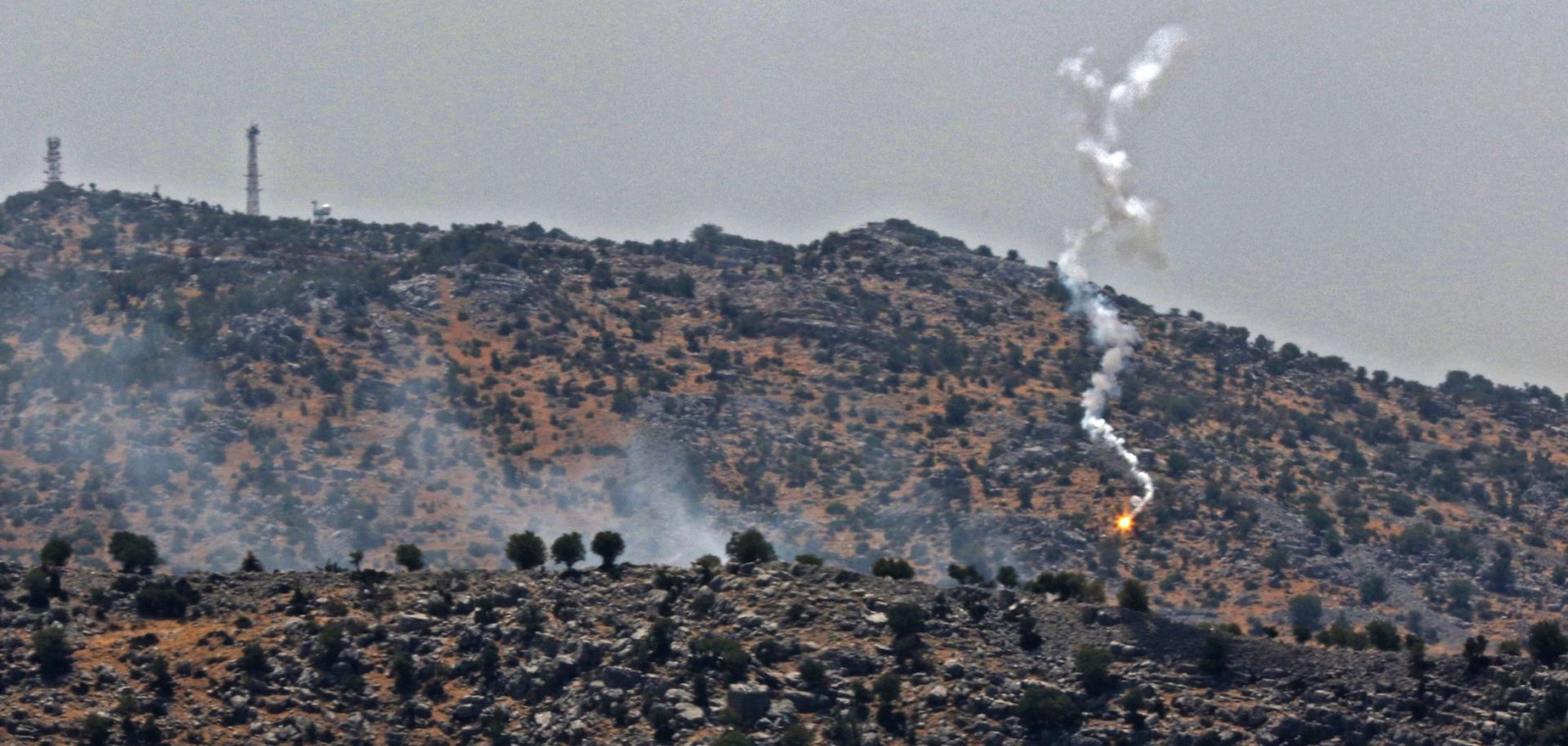
A photo taken on Aug. 6, 2021, shows a southern Lebanese village after it was hit by Israeli airstrikes.
Domestic and international constraints will pressure Israel and the Lebanese militant group Hezbollah to ensure their recent exchange of rocket fire doesn’t spiral into another war. But in Israel, the need to appease a more hawkish electorate could also push Prime Minister Naftali Bennett’s new government to assert its military dominance, increasing the likelihood of a near-term military escalation. On Aug. 6, the Lebanese militant group Hezbollah launched an estimated 20 rockets at Israel, some of which were intercepted by Israel’s Iron Dome defense system. The projectiles caused no damage and Hezbollah claimed through their media that they intentionally struck “open areas, suggesting the group had intentionally avoided populated targets in a calculated attempt to avoid a major war. In response, Israel launched airstrikes and artillery fire in southern Lebanon, while Israeli Defense Minister Benny Gantz warned that more strikes could be forthcoming if Hezbollah kept up rocket fire. Israel’s security cabinet will continue consultations in the coming days to decide on a course of action.
- Rocket attacks, largely blamed on Palestinian militants, originated in southern Lebanon in July and August. On Aug. 4, Israel struck positions in southern Lebanon with airstrikes and artillery in retaliation for this rocket fire. These strikes appear to have spurred Hezbollah, which postures itself as a defender of Lebanese sovereignty, to carry out its own attacks on the northern Israeli border.
- In 2006, a Hezbollah raid on Israeli troops sparked a month-long war that devastated Lebanon and resulted in thousands of casualties on both sides.
The considerable domestic pressure Hezbollah is facing to avoid another major war likely explains why the group does not appear eager to retaliate immediately for Israel’s most recent artillery and airstrikes. In a sign of notable domestic dissent, villagers in the town of Chouya in southern Lebanon stopped a Hezbollah rocket platform and took control of it, handing it over to the Lebanese army, in protest for Hezbollah using positions near their town to attack Israel. Additionally, Hezbollah’s political legitimacy is straining under Lebanon’s collapsing economy and its forces remain deployed in Syria as part of that country’s civil war — further undermining its incentive to engage in a widescale war with Israel that would bring about more economic harm to Lebanon and challenge Hezbollah’s ability to serve as a reliable ally in Syria.
For Israel, another war with Hezbollah would also risk exacerbating its COVID-19 crisis at home and further straining its relationship with the United States. Another major conflict with Hezbollah would require a call-up of reservists, which would disrupt Israel’s economic recovery from the COVID-19 lockdowns of 2020-21. The Israelis would also have to shift Iron Dome interceptors from the country’s southern border with Gaza to its northern border with Lebanon. Additionally, Israel has also been warning that it might impose another national lockdown as the Delta variant surges, especially among the country’s unvaccinated communities. In the event of war with Hezbollah, many Israelis would find themselves crowded into shelters under a barrage of Hezbollah rockets, potentially enabling the spread of the deadly virus further. Finally, the United States also wants to avoid another major conflict in the region and, in the interest of regional and Lebanese stability, even has taken steps to boost Lebanon in the midst of its domestic crisis, offering $100 million to Beirut in humanitarian aid on Aug. 4.
De-escalation options thus exist for both sides, which could enable Israel and Hezbollah to step back from the brink of a major conflict. If Hezbollah holds back from more rocket attacks and restrains the Palestinian militants who have been attacking northern Israel, Israel will be less incentivized to conduct a larger military or covert operation in Lebanon that could spark a major war. Additionally, the Israeli government could decide to conduct additional counterattacks in Syria, where Hezbollah forces have been bombed by Israel before without sparking a war. Less likely, Israel might also decide that the current round of artillery and airstrikes is enough to deter Hezbollah.
In Israel, however, Bennett's new government is also facing political pressure to ensure the security of the country’s northern border, which may compel it to carry out more expansive military or covert operations to deter Hezbollah and satisfy domestic critics. Bennett is coming under attack from far-right politicians and even one member of his own party for not doing enough to stop Hezbollah attacks on the north. Many Israelis are also more hawkish. The cease-fire agreement that ended the Gaza war in May, for example, was largely unpopular in Israel as many felt it didn’t go far enough to deter the Palestinian militant group Hamas. With this sentiment still high, many Israelis will probably want to see Israel stop rocket attacks from Lebanon as well. For Bennett, not satisfying these popular demands for more security would risk collapsing his government’s narrow 61-59 majority. This, in turn, raises the potential of Israel instead deciding to conduct operations that will push Hezbollah to conduct its own counter-attacks, entrenching the military escalation.
