
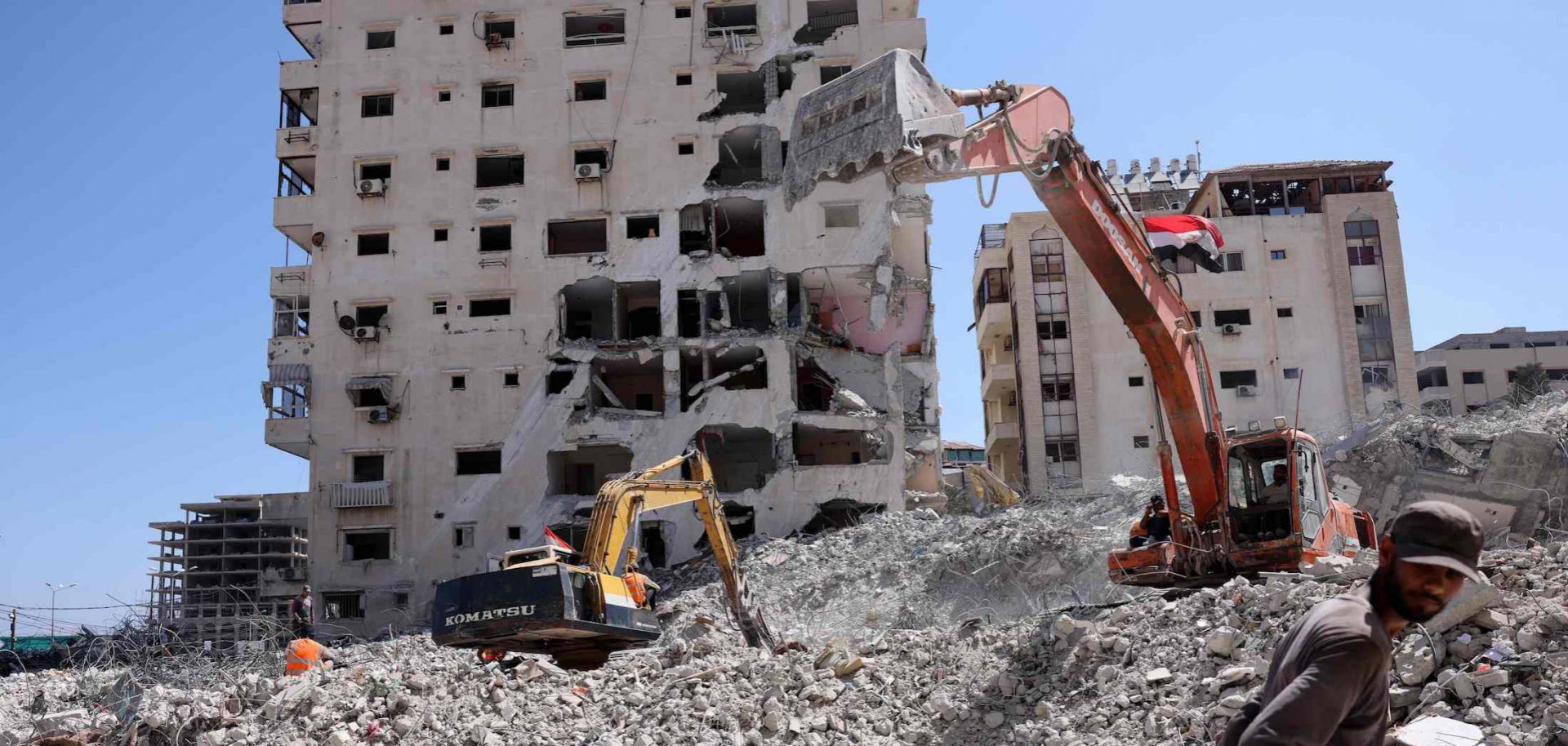
Excavators provided by Egypt help clear the rubble in Gaza on June 23, 2021, following last month’s flare-up between Israel and the Palestinian militants.
Israel risks eroding U.S. support and opening the door to renewed violence as it attempts to ensure Hamas doesn’t use new humanitarian aid for Gaza for military purposes. Aid negotiations between Israel and the Palestinian militant group Hamas hit an impasse on June 21, with the latter rejecting an Israeli-backed and U.N.-mediated offer for a new mechanism that would put stricter controls over new funding to Gaza than in previous deals. Hamas threatened to resume attacks on Israel’s southern border if the new foreign aid slated for the Palestinian territories, mostly from Qatar, did not arrive. The threats are coming up against a new and more hawkish Israeli government in which Prime Minister Naftali Bennett is attempting to build a stronger deterrence against attacks from Gaza.
- During the last four years of former Prime Minister Benjamin Netanyahu’s term, Israel used an aid-for-peace strategy with the Palestinians that allowed foreign cash into Gaza in exchange for halting militant attacks on the southern border. Bennett’s new government, however, is staffed by more Gaza hawks who think that strategy failed to prevent Hamas’ military build-up.
- The Israeli military recently estimated that Hamas still had 8,000 of 14,000 rockets from before the May 2021 war available, many of which are domestically produced. Israel is concerned the flow of new aid to the Gaza Strip will be used to rebuild this arsenal.
- Gaza endured significant damage during the May 2021 war, and Hamas is not incentivized to escalate back into another major war in the near term as it attempts to rebuild.
- During the May 2021 flare-up, international media outlets, including the Associated Press, took a more critical tone of Israeli military operations — marking a notable shift from more neutral coverage of past Israeli-Palestinian.
Israel’s strategy risks making it appear like it’s blocking humanitarian aid for Gaza, which will reinforce pro-Palestinian narratives and raise the potential for limited violence in southern Israel. Bennett is unlikely to return to his predecessor’s aid-for-quiet strategy for fear of causing allies in his coalition, like Gaza hawk Avigdor Liberman, to bolt the government and force new elections. In response to Israel’s moves to restrict aid, Hamas is likely to conduct arson attacks and stage protests on the southern border. Rocket strikes against nearby Israeli communities are also a possibility. Such harassment by Hamas is unlikely to generate significant international outrage, especially if it only results in fires and property damage and not widespread Israeli casualties. Palestinian provocations will, however, likely produce Israeli military retaliation.
- The Israeli government has only 62 of 120 members of the Knesset in its coalition, meaning the defection of any party would likely collapse the government. Liberman fatally weakened the Netanyahu government in 2018 when he defected over Gaza policy-related disputes.
Israel’s weakening influence over the narrative of the Palestinian-Israeli conflict will fuel more international criticism, especially in the United States, which could eventually trigger the reversal of pro-Israel U.S. policies. The administration of U.S. President Joe Biden has tried to keep its criticism of Israel to private channels, especially during the May Gaza war. But elements of Biden’s Democratic Party have become more vocal in their scrutiny of Israel. In a letter sent to Biden on June 24, 73 Democrats in the U.S. House of Representatives urged the president to re-emphasize the traditional two-state solution in Gaza and to abandon his predecessor’s “Vision for Peace” plan. The signatories only represent a portion of the Democratic Party. However, U.S. lawmakers’ increasing criticism of Israel could shift more attitudes among the American public over time, pressuring the White House to take a sterner line against Israel’s Gaza strategy and expansionism in the West Bank.
- For the first time since the new Bennett government took office, the Israeli military greenlit new West Bank settlement construction on June 23.
- The administration of former U.S. President Donald Trump moved to normalize West Bank settlements. Its Vision for Peace plan also saw most of those settlements remaining under Israeli control permanently. The Biden administration has not yet made it clear how it views settlements in the long term.
