
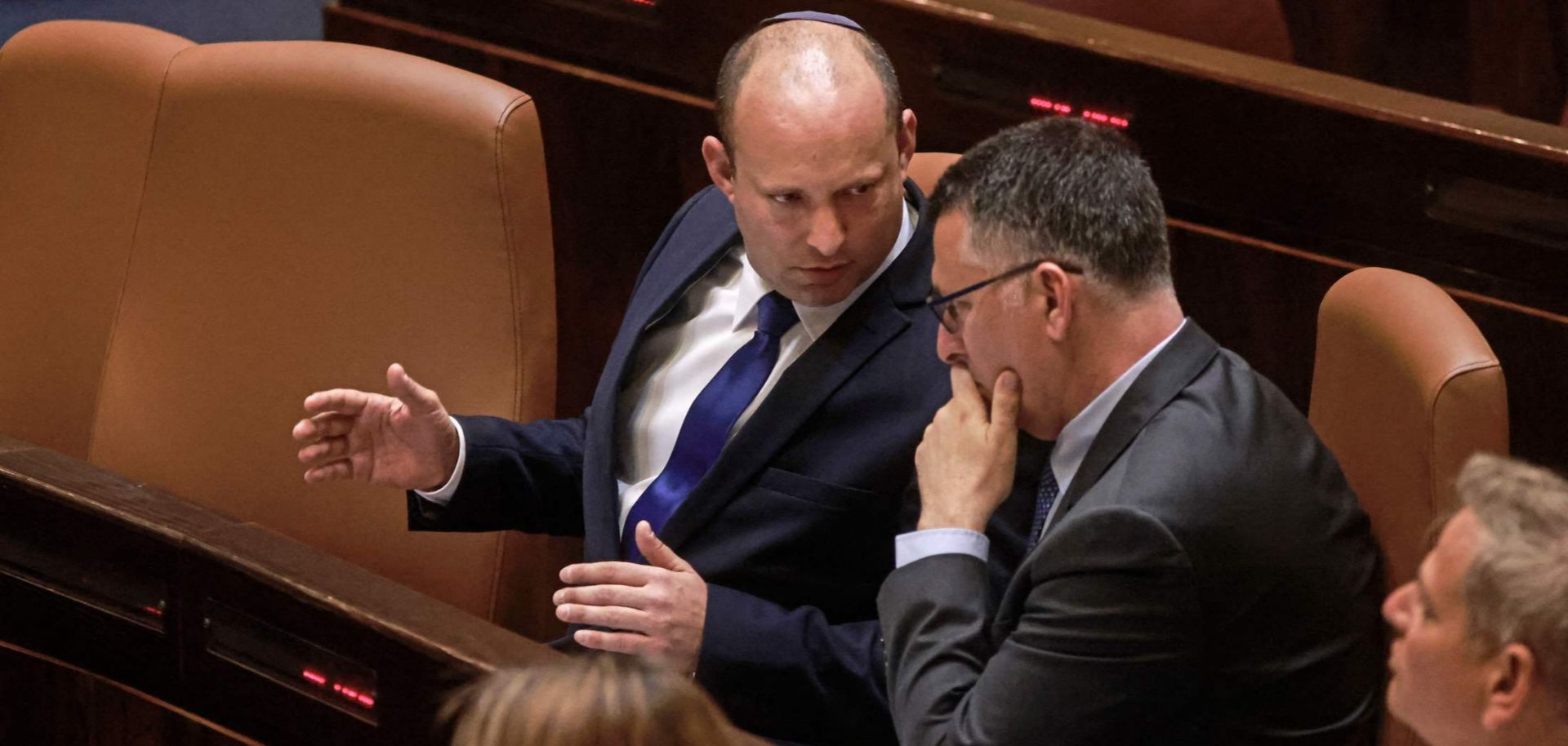
Israeli Prime Minister Naftali Bennett (left) speaks with Justice Minister Gideon Sa’ar in the Knesset on June 16, 2021.
Israel’s new government is already signaling a shift toward more hawkish policies, raising the risk of both accidental Gaza escalations and diplomatic pushback from the United States, as well as more unrest across Israel and the West Bank. Overnight on June 17, Israel’s new governing coalition, led by right-wing nationalist Prime Minister Naftali Bennett, conducted an increased number of airstrikes against militant targets inside Gaza after Palestinian militants launched incendiary balloons against the southern Israeli border. There were no casualties on either side and escalation does not appear imminent. The airstrikes, however, could signal the beginning of a policy shift in Israel’s Gaza strategy away from the relatively restrained policies of the former Prime Minister Benjamin Netanyahu’s government toward a more hawkish stance favored by right-wing nationalists like Bennett, along with his coalition partners Gideon Sa’ar and Avigdor Liberman.
- In 2017, Netanyahu’s former government began slowly crafting a policy of aid-for-peace with the Palestinian militant group Hamas, allowing humanitarian aid to enter in exchange for halting rocket and balloon attacks on the southern border. The policy was unstable at times and came under serious criticism from southern Israelis and officials like Bennett, Sa’ar and Liberman. Liberman left Netanyahu’s coalition in November 2019 in part over his dissatisfaction with its Gaza strategy.
- The Israeli military also recently released a public statement that it was preparing for another major military operation in Gaza. The statement appeared to be geared toward signaling, rather than actually preparing, new operations since it did not accompany major new troop movements or equipment deployments.
For fear of jeopardizing their other policy priorities, the pro-peace and Islamist parties in Bennett’s new coalition government are unlikely to seriously push back against military operations in Gaza. With hawks like Bennett, Liberman and Sa’ar in power, and with many Israelis dissatisfied with the recent cease-fire with Hamas, the Israeli government will face political pressure to conduct more operations in response to Palestinian provocations. Ra’am and Meretz — the government’s Islamist and left-wing parties, respectively — are unlikely to risk their positions by threatening to collapse the coalition over Gaza as long as they believe their other goals (like securing more funding for Israeli Arab communities and more pro-environmental legislation) can still be accomplished.
- Under Netanyahu, some minor acts of harassment against Israel’s southern border did not entail a military response in an effort to avoid potential escalation in Gaza.
- Another uniting factor of Israel’s new coalition is its members’ shared opposition to Netanyahu himself, who has not lost his position in Likud and who could, if a new election was called, still win enough seats to return to power. Meretz is very unlikely to join another Netanyahu-led government, and Ra’am cannot be sure they could gain the same level of concessions from a returned Netanyahu coalition that they have from the Bennett government.
- Bennett’s new government is also attempting to use the aid needed to rebuild Gaza after the May 2021 war as leverage to force Hamas into a more sustained cease-fire, as well as to prevent Hamas from using aid for military means. This incentivizes Hamas and other militants to continue harassment of the Israeli border.
Stronger Israeli responses could provoke large-scale retaliation from Hamas, spark unrest inside Israel and/or the West Bank, and engender more criticism from U.S. officials against Israel’s long-term Gaza strategy. Hamas often feels compelled to respond to Israeli military operations to maintain its domestic legitimacy. More expansive Israeli operations could thus incentivize the militant group to conduct larger-scale rocket attacks that risk triggering another war. Israeli operations that produce Palestinian casualties could also produce new grassroots Palestinian protests and riots in the West Bank or spread discord back into Israeli Arab communities, where tensions remain high after the surge of Jewish-Arab intercommunal violence during the May 2021 war. Finally, while the United States is not engaging in a deep push for Israeli-Palestinian peace, U.S. President Joe Biden and legislators in Congress have a stronger interest in preventing violence and military escalation between Israel and Hamas.
