
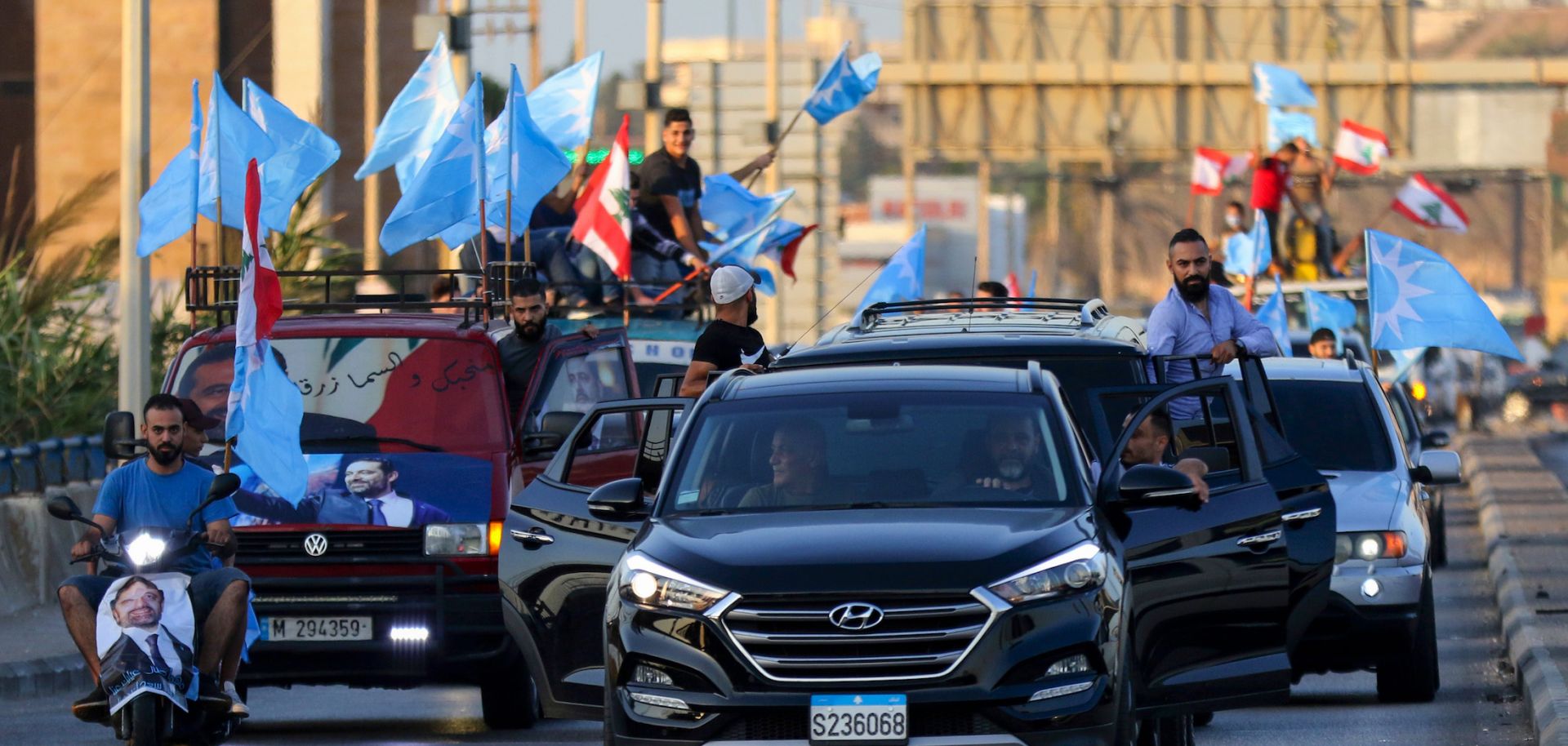
Supporters of Lebanon’s Future Movement party wave the party’s flag alongside the country’s national flag during a parade in the southern Lebanese city of Sidon on Oct. 22, 2020.
After a year of severe economic and political instability, Lebanon is edging closer toward a full-blown crisis that could overwhelm even the most entrenched members of its ruling elite, raising the specter of widespread unrest or another civil war. Little about Lebanon is tenable, with its economy in shambles, its national budget unsustainable, its infrastructure in disrepair, and its security at constant threat from extremists, regional conflicts and internal unrest. But with no checks on their power, Lebanon’s various political factions are still finding ways to ritualize this dysfunction, scrambling to stay one step ahead of a disaster that upends their place in power — and with it, the remaining threads keeping the country from coming apart at the seams.
Unchecked Corruption Breeds Dysfunction
At the core of Lebanon’s woes is the fact that there remain little checks on government corruption. The judiciary, executive and legislature are all held by establishment factions and leaders who have little incentive to change the system. Despite years of international demands and advice, they have budged very little on the necessary spending and governance reforms needed to earn international aid. Even the investigation into the disastrous Beirut port explosion in August 2020, as well as the Dec. 10 indictment of former Prime Minister Hassan Diab for his government’s involvement in the gross negligence that led to the blast, appear unlikely to upend Lebanon’s political system.
Even abroad, the country’s key allies are uninterested in applying the kind of pressure that might force a real shift in sectarian behavior. After the Beirut port blast, France postured as if it might take a more notable role in addressing Lebanon’s internal disorder. But Paris has since instead deferred to its traditional strategic approach that prioritizes Lebanon’s stability via negotiated, incremental change. French goals continue to prize holding onto its former influence over the country, which still runs through sectarian parties like the Sunni-dominated Future Movement party.
Under President Donald Trump, the United States has lumped Lebanon into its anti-Iran campaign, sanctioning Hezbollah-linked banks and institutions. But instead of forcing positive change, this increased financial pressure from Washington has only accelerated Lebanon’s economic deterioration, with the country’s political system still intact.
The other traditional foreign influences in Lebanon have also, for different reasons, given up on using the country as a direct proxy theater for their regional advantage. Saudi Arabia and Iran have both taken their proxy conflicts elsewhere in the region — namely Iraq and Yemen. And Syria, consumed by its civil war, has few resources left over to interfere in Lebanon’s internal dynamics. Having fought the stalemated 2006 war with Hezbollah, Israel has little interest in repeating that expensive history. For Israel, rocking the boat in Lebanon could also jeopardize its ongoing negotiations with Beirut over a maritime border that could stabilize Israel’s access to sizable energy reserves in the Mediterranean. Iran, for its part, has little reason to upend the sectarian system that has allowed it to entrench Hezbollah as a proxy against Israel. Tehran, however, may start to intervene if Lebanon’s economic and social instability begins to directly threaten Hezbollah’s influence. But for now, Lebanon’s dysfunction remains largely an internal matter.
Potential Avenues for Change
With the international community unwilling to help, the most likely drivers to break Lebanon’s political impasse appear to be domestic. This could include grassroots outrage that is able to break the sects by producing new parties and leaders through avenues like university elections, local and municipal elections, and even potentially splits within existing factions sitting in parliament. New factions within sects could counterbalance some of the existing establishment, forcing them into positions of compromise. However, such grassroots political challenges would likely require a high turnout from opposition voters in a national election, which isn’t scheduled to happen until at least 2022. And while there are clear signs of high anger with establishment parties, Lebanon has historically struggled to introduce viable new factions within its sectarian system. In 2016, for example, the Beirut Madinati, a new political movement, won a sizable turnout in Beirut’s municipal election but still failed to secure any council seats.
Another potential vector of change could come from the establishment itself. But Lebanon’s political elite is unlikely to change their ways until their physical and economic security is directly threatened. If Lebanon remains on its current path, the trickle of Lebonese refugees now making their way for Europe may become more of a surge, as Lebanon’s humanitarian and social situation degrades further and produces even deeper anger. Such a refugee wave could spur European countries — in particular, France — to take action against Lebanon’s government that forces its leaders on a path to reform. Decaying economic prospects could also radicalize Lebanese youth who might engage in more sustained and violent protests, raising the risk of clashes with security forces and political authorities that could spiral into a security crisis. If severe, such a security crisis could compel establishment figures to seek reform as a means to restore stability — but it could also upend the balance of power between Lebanon’s myriad of political and religious groups that has kept the country from tipping into another civil war.
