
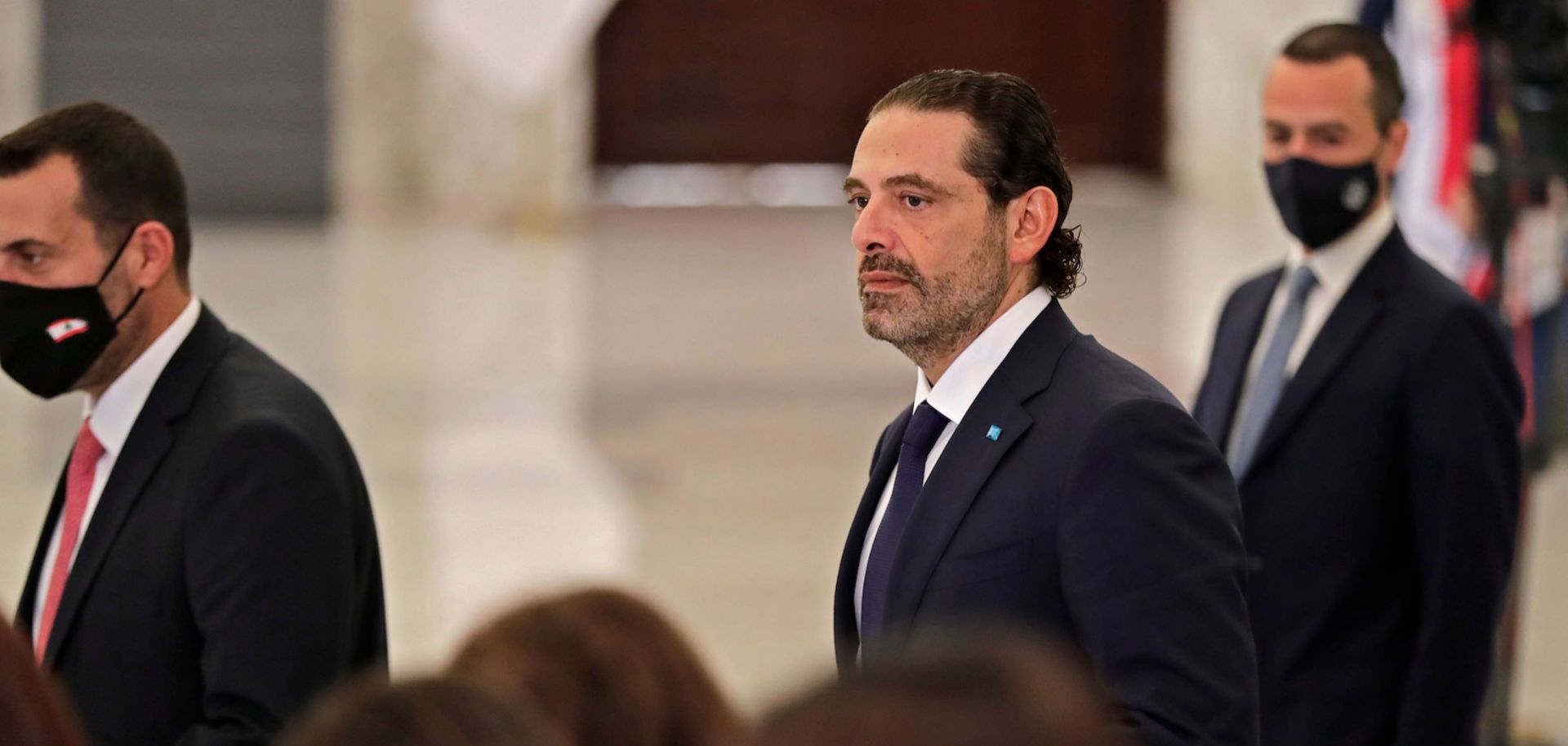
Former Lebanese Prime Minister Saad Hariri arrives at the office of President Michel Aoun after the latter appointed him to form a government on Oct. 22, 2020, in Beirut, Lebanon.
Saad Hariri’s return as Lebanon’s prime minister will unlock access to French aid and likely improve the country’s economic stability, but it will also trigger a fresh round of unrest by reinforcing popular perceptions that political reform is unlikely. On Oct. 22, Lebanese President Michel Aoun named Hariri, a prominent Sunni politician, prime minister-designate and tasked him with forming a government. Most political parties approved the nomination, indicating cross-sectarian approval for the three-time prime minister. The Iran-backed militant group and Shiite political party, Hezbollah, even tacitly approved Hariri’s nomination, despite disapproving of other candidates up to this point.
Hariri is a compromise candidate who excels at managing Lebanese political infighting as well as Beirut's foreign relations, which will restore and retrench status quo political dynamics. In the months since the catastrophic Beirut Port explosion deepened the political chaos triggered by an ongoing financial crisis, Lebanon’s political elite struggled to find a suitable candidate who could guarantee all of their interests while also satisfying the country’s complex ethno-sectarian quotas. Having done the job for years, Hariri is a familiar source of stability.
- The Lebanese lira currency rose following the news of Hariri’s appointment, an indication of relief in the domestic financial market since Hariri’s naming presents some stability via familiarity.
- Hariri has decades of experience maneuvering between the complex web of politicians in Beruit, as well as mediating between external allies such as France and the United States, along with Arab Gulf states such as Saudi Arabia, where Hariri is a dual citizen.
- Hariri is likely to create a technocratic administration focused on executing limited economic reforms that satisfy French conditions on promised financial aid. The sectarian leaders who join Hariri’s government will preserve their political and economic capital and factional interests during government formation. French President Emmanuel Macron promised millions of dollars in financial aid to Lebanon in exchange for economic and political reforms, including shake-ups to the administration of the country’s corrupt electricity company, changes to how government procurements are made, better oversight into corruption, and making a plan for removing some subsidies without creating an undue burden on the Lebanese poor.
Hariri’s preservation of a stagnant political dynamic will aggravate many Lebanese citizens who are eager for structural changes, which will probably encourage a fresh round of popular demand for deeper political reforms from the government. In response to the news of Hariri’s imminent nomination, anti-government demonstrators set fire to a monument in downtown Beirut on the evening of Oct. 21 and vowed to keep demonstrating. This type of unrest is likely to continue as Hariri attempts to form a government, given that his nomination directly violates a key demand of the anti-corruption protest movement: nonpartisan successors to the established political elite. Many Lebanese will also continue to lose faith in their politicians’ ability to change their circumstances, meaning attempted emigration from Lebanon will still remain high during this period.
- Lebanon has experienced a substantial anti-government protest movement since October 2019, triggered by a worsening financial crisis that has seen the Lebanese lira depreciate and quality of life deteriorate.
- Lebanon’s political system is historically difficult to reform, given that the system was created to end a civil war and thus prioritizes bringing all of Lebanon’s sects to the table over efficient governance.
- Lebanese and Cypriot authorities have noted increased illegal immigration attempts by boat from Lebanese shores over the last several months, indicating the severity of the economic crisis in Lebanon and declining optimism among Lebanese and refugees alike about Lebanon’s future.
