
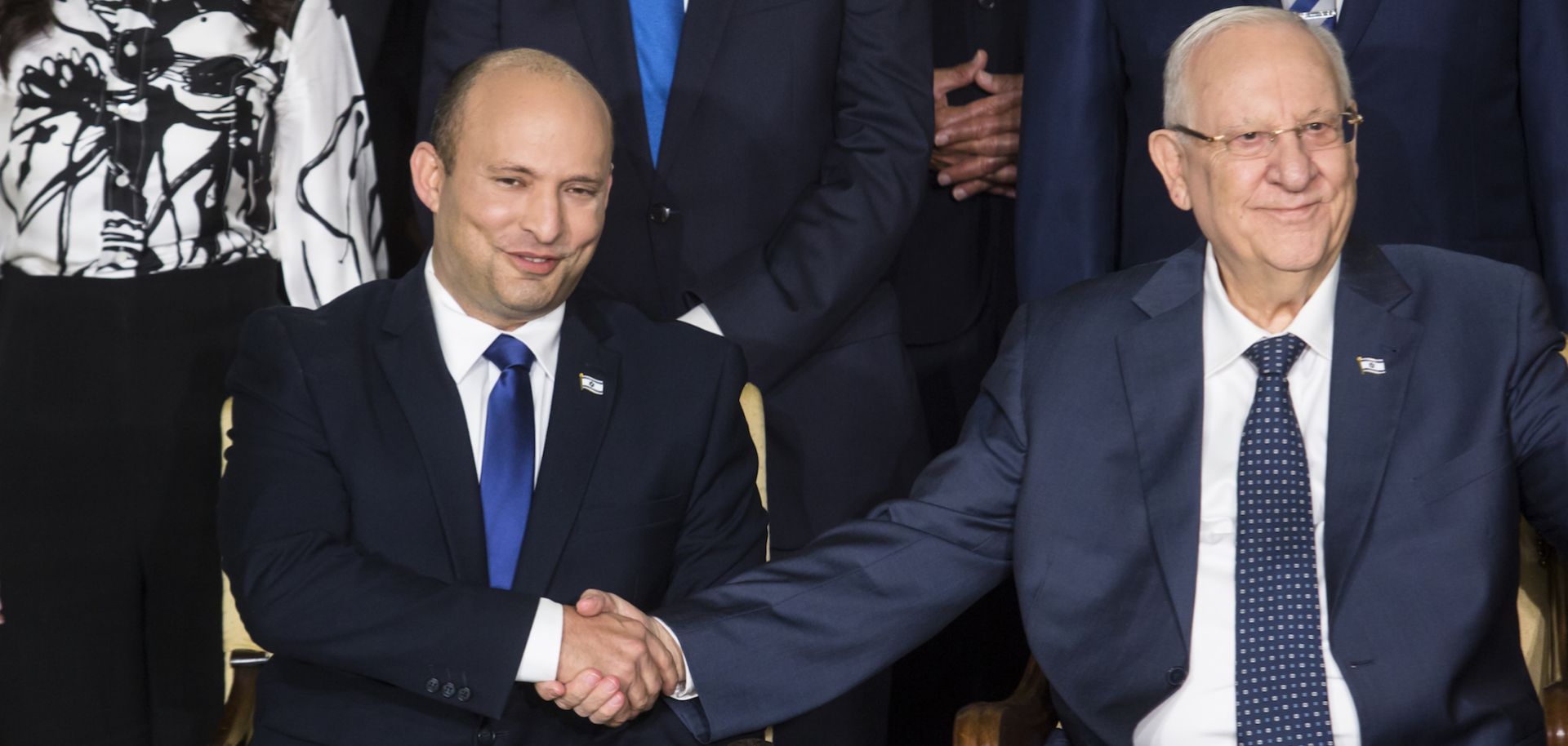
Israeli President Reuven Rivlin shakes hands with Prime Minister Naftali Bennett during the official swearing-in of Israel’s new government on June 14, 2021.
Burdened by deep ideological divisions, Israel’s new government will struggle to find a path forward and respond to pressing domestic security issues. The main imperative of Israeli Prime Minister Naftali Bennett’s new so-called “change government” is to transition from Benjamin Netanyahu’s 12-year rule. But after two years of political paralysis and four inconclusive elections, just holding together for a matter of months will be seen as a feat for the fragile coalition.
- Bennett was sworn in as Israel’s new prime minister on June 13 after narrowly winning a vote of confidence in the Knesset. His “change” coalition government officially took office the following day.
- Bennett is the leader of Israel’s nationalist right-wing Yamina party. He will serve as prime minister for the next two years before handing the reins to Yair Lapid of the centrist Yesh Atid party, assuming the coalition doesn’t collapse before then.
The members of Israel’s new ruling coalition have little in common beyond sharing a desire to oust Netanyahu and move past Israel’s repeated election paralysis. Bennett has positioned his premiership as a way for Israelis to avoid yet another election after Netanyahu once again failed to form a coalition after Israel’s fourth ballot in two years. This new government brings together left-wing, centrist and right-wing parties, as well as center-left parties that have been out of power for many years. But the coalition’s formation does not represent a shift to the left, despite its inclusion of those parties.
- In Israeli history, unity governments typically come together in periods of security or political duress.
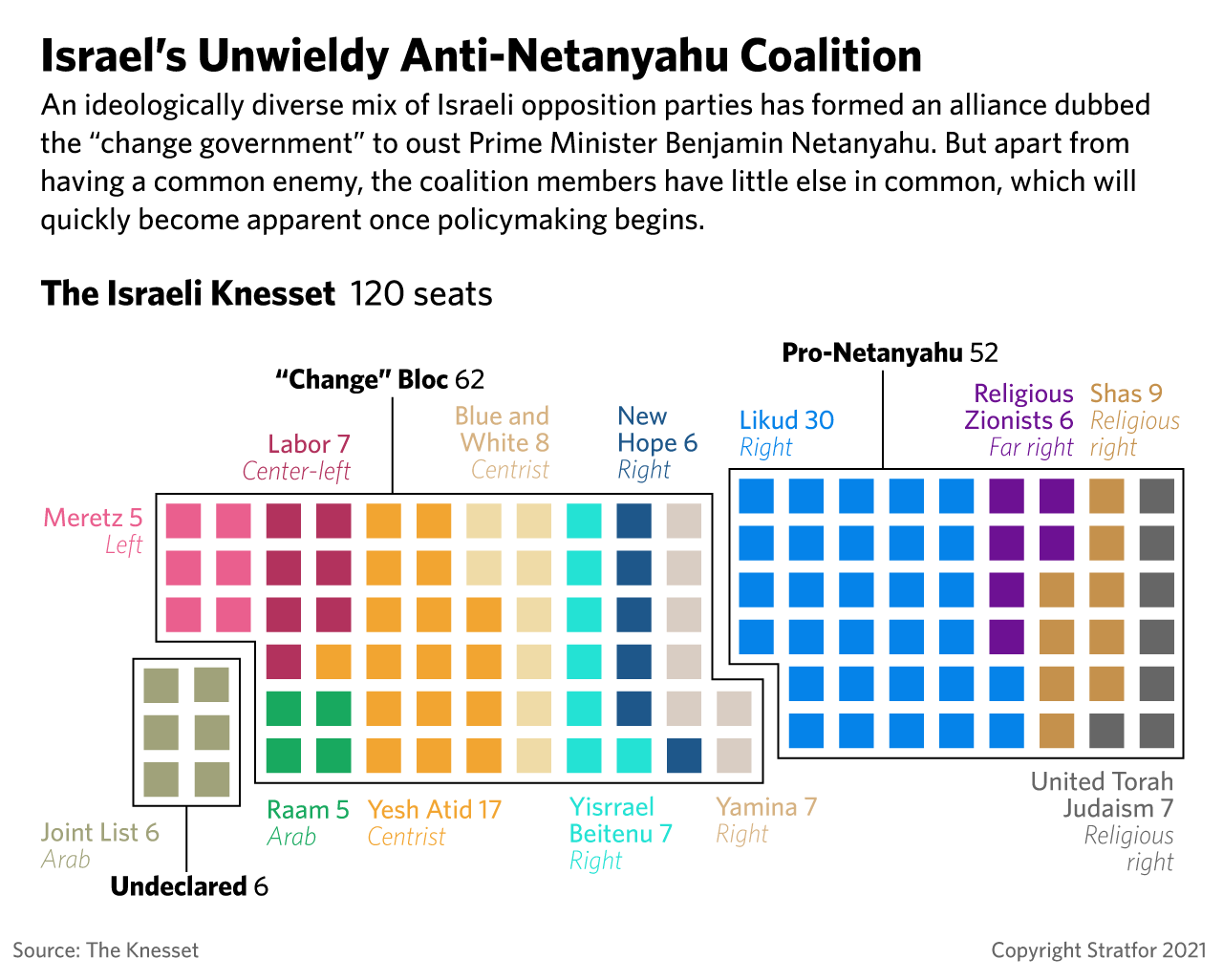
With only a short-term objective in common, Israel’s new government is very likely to encounter political paralysis in policymaking and could even fall apart under the weight of its own differences. The coalition brings together a host of new precedents. Ra’am’s inclusion marks the first time an Arab party has been integral in an Israeli coalition. Bennett’s appointment also marks the first time a prime minister has hailed from such a small faction in the Israeli Knesset, weakening his mandate. But what makes this unusually diverse government historic is also what makes it weak and vulnerable to an early collapse. Internal divisions will reduce the coalition’s common political ground and a likely steady stream of opposition attacks will roil its stability and legitimacy in front of the Israeli public.
- Netanyahu is already corralling the opposition to attack the security credentials of this new government. Prior to his brief transitional meeting with Bennett on June 14, Netanyahu made public statements about the new government posing a threat to Israel’s security.
- Bennett’s own Yamina party is struggling to keep from falling apart amid numerous threatened defections in recent months. Politicians from Netanyahu’s Likud party on June 14 also critiqued Bennett’s mandate as weak.
The new government will struggle to face strategic security issues on which coalition members have mixed views — especially regarding threats from the Palestinian militant group Hamas, as well as growing grassroots violence inside Israel. A mix of moderate and hard-line views on Palestinian statehood, as well as Jewish settlements and Israeli annexation in the West Bank, will make such securities issues difficult to legislate on for the new government. Popular violence throughout the recent May 2021 Gaza war indicates that the growing threat of grassroots and far-right violence. A June 15 nationalist flag march taking place in Jerusalem will provide a first test of the new government’s willingness to either allow or contain nationalist, right-wing actions that risk polarizing Israeli Arabs and Palestinians. Strategic external security threats like Iran will likely be easier to agree on than the domestic issues on which coalition members have opposing views.
- The Islamist Ra’am party’s inclusion in the coalition could bring a unique new perspective in advocating for Palestinian interests. But other coalition members like Yisrael Beiteinu and New Hope are vehemently opposed to the formation of a Palestinian state and promote more settlements in the West Bank.
