
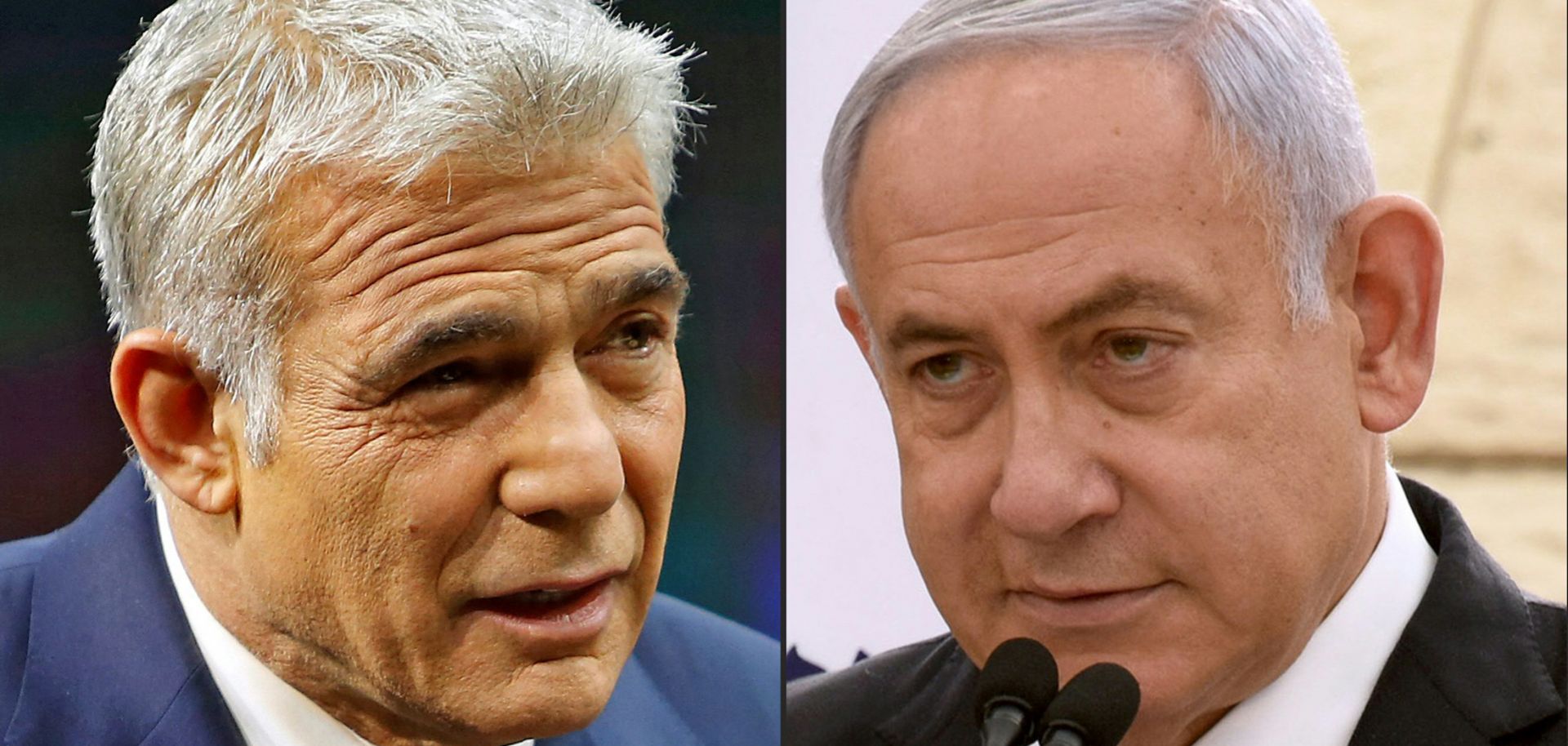
A photo combination shows the leader of Israel’s centrist Yesh Atid party next to Israeli Prime Minister Benjamin Netanyahu.
Israel may soon emerge from its period of prolonged political paralysis, but demands for structural change to its political system and social tensions produced by far-right Israelis are likely to persist. On May 4, Israeli Prime Minister Benjamin Netanyahu lost his second mandate to form a government in less than two years. His rivals, led by Yair Lapid of the centrist Yesh Atid party, appear to have cobbled together a unity coalition with seven of the 13 parties that won seats in the March 23 election. If Yesh Atid is able to convince Israel’s Islamist Ra’am party to join the coalition, the additional four seats would bring it over the 61-seat threshold needed to form a government and remove Netanyahu from power after 12 years. Such a unity government would bring together Israel’s settlers, anti-corruption centrists, anti-Netanyahu nationalists, Islamists, leftists and liberals, while excluding the far-right, ultra-Orthodox and nationalists who still support the long-standing prime minister. However, Israel’s history with ideological unity governments suggests that a new, post-Netanyahu coalition wouldn’t last long.
Regardless of what happens with the government formation process, Israeli voters’ distrust of the current political system will likely fuel calls for structural changes focused on preventing future bouts of paralysis. After five largely inconclusive elections since 2019, voting polls have shown an exhausted Israeli electorate that wants to put recurrent ballots behind them. This will likely result in widespread support for reforming Israel’s electoral system to make future governments more stable. If Yesh Atid can’t form a government, or if the government that it does form is short-lived, these calls will gain steam across the country’s political spectrum.
- Israel directly elected prime ministers in elections in 1996, 1999 and 2001. But this process was abandoned after it became clear that the premiership elections were not providing longer-lasting governments.
- Israel’s prime ministers do not have term limits, creating a less predictable calendar for elections. Israel’s constitution, which governs the country’s electoral system, also allows for a fluid legislature and rapidly changing coalitions.
Israel’s ultranationalist far-right will also continue to exert their influence in government and on the streets, raising the risk for social unrest in the near term. Religious Zionism, a far-right political alliance based on an ideology that combines Israel’s nationalist movement with Orthodox Judaism, now holds an unprecedented 6 seats in the Knesset. Its members are highly unlikely to hold any positions of power in a government not led by Netanyahu. But the alliance’s presence in the legislature will nonetheless allow them to air their far-right views and sway voters for future elections, as well as influence the cultural discourse of the country. With Religious Zionism in the Knesset, anti-assimilation groups like Lehava will also be emboldened to further showcase their public strength to recruit more supporters, raising the risk for more disruptive protests and clashes with Israeli Arabs and Palestinians throughout the country.
- Israel’s far-right has grown in recent years, fueled by years of conflict with the Palestinians, along with the rise of ultra-Orthodox and hyper-nationalist youth groups. On April 22, Lehava helped organize anti-Arab street riots in Jerusalem that spread to other cities. Grassroots far-right activists have also recorded and shared various violent acts against Arabs on social media in recent months.
- In addition to Arab Israelis and Palestinians, far-right Israelis’ more autocratic and theocratic vision for Israel has also long pitted them against secular and left-wing Israelis, as evidenced by the 1995 assassination of left-leaning Israeli Prime Minister Yitzak Rabin by an Israeli right-wing extremist.
