
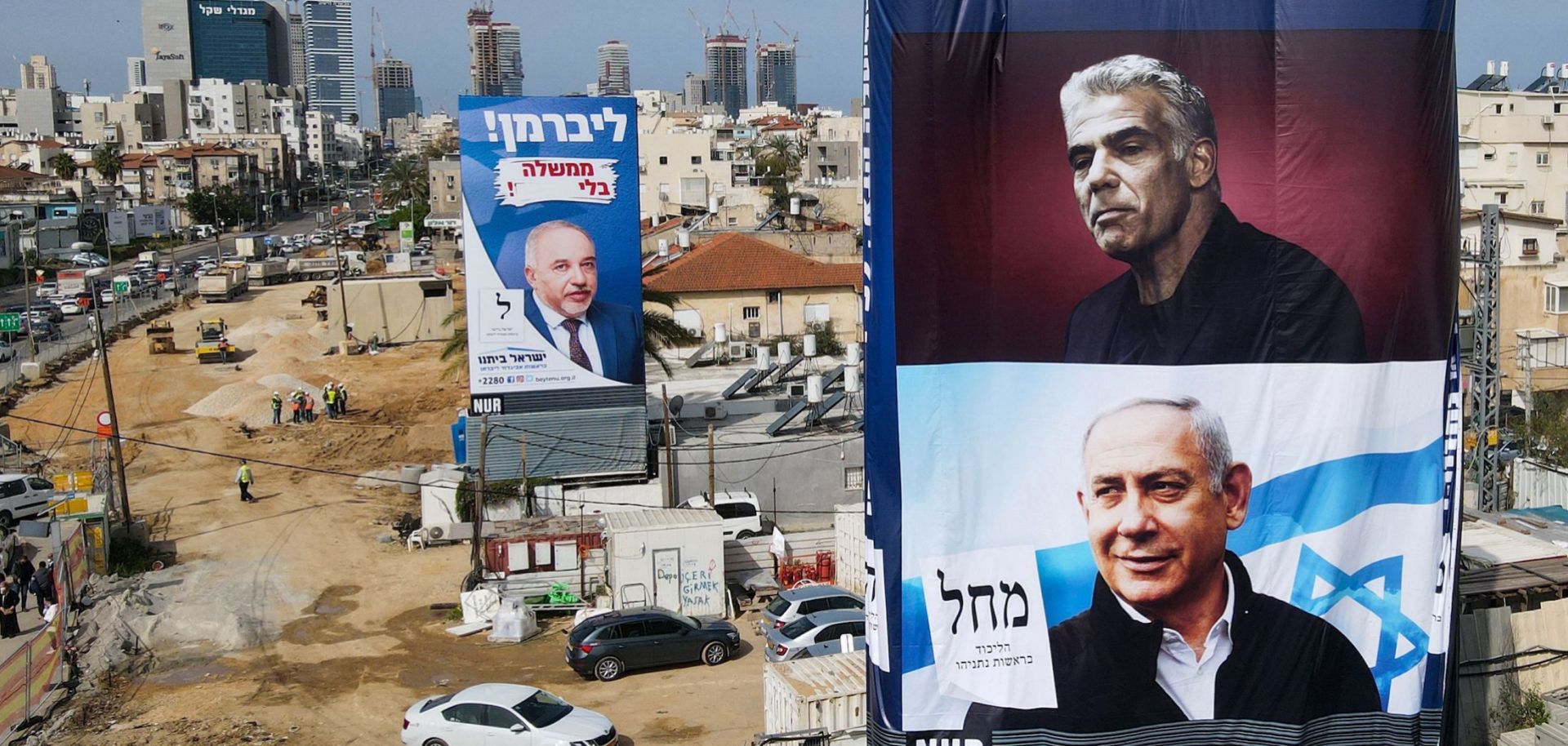
Campaign posters hang over a construction site in Bnei Brak, Israel, on March 14, 2021.
Israel’s upcoming election will confirm its right-wing drift, but divisions within the country’s political right over who will lead the country, what the role of the ultra-Orthodox should be, how quickly Israel should expand its settlements will hamper the formation of a new government. If neither Prime Minister Benjamin Netanyahu nor his rivals are able to form a coalition, the continued political uncertainty will impede Israel’s ability to reap the full benefits of its success in curbing the health and economic impacts of the COVID-19 pandemic. Israel’s next election on March 23 will pit anti-Netanyahu parties and politicians of various ideologies against the prime minister and his remaining loyalists. While polls suggest that Netanyahu’s Likud party has a lead, they also indicate that he has no certain coalition behind him large enough to form a government.
Possible Election Outcomes
Israel’s fourth national election in two years will either result in a Netanyahu coalition, an anti-Netanyahu coalition or yet another round of elections:
1) Netanyahu could cobble together another narrow right-wing coalition that favors settlements, annexations, far-right identity politics and undermines the country’s often liberal courts. Through backroom deals and potentially some defections from rival parties, Netanyahu could manage to earn yet another term as prime minister, leading a coalition likely composed of secular-nationalists, religious parties, and a handful of extremist members of parliament. This coalition would likely be held together by a thin margin, and therefore susceptible to pressures from minority parties and even individual members of the Knesset. A strong performance by right-wing extremists like Religious Zionism would make such a scenario more likely, which suggests that a future Netanyahu government would be more influenced by far-right ideologies that favor Israeli expansionism, further entrenchment of Jewish identity in Israel at the expense of its Arab and Druze minorities, extended or expanded privileges for the country’s ultra-Orthodox community in education and military service, and a willingness to undermine institutions like the comparatively liberal Supreme Court in order to reshape of Israel’s national culture. It would also put Israel into the uncharted constitutional territory if Netanyahu is convicted of bribery while prime minister.
2) The anti-Netanyahu coalition could also triumph, but with the unifying factor gone, would likely have a short shelf life. A combination of center-left, left and anti-Netanyahu secular right-wing parties could make for an ideologically diverse coalition focused on removing Netanyahu from power. It’s unclear who exactly would lead such a coalition, though polls suggest that Yesh Atid, an anti-corruption party, would do well enough to put forth its leader, Yair Lapid, as prime minister. With such an array of ideologies, it seems likely this coalition would focus primarily on passing the national budget and guiding the country out of the COVID-19 crisis, while also attempting to erode the ultra-Orthodox community’s exemptions in military service and education. But its internal ideological contradictions and personality clashes would quickly manifest once the unifying challenge of removing Netanyahu from power had passed. The coalition might also buckle in the face of a national security crisis (such as a flare-up in Gaza or the West Bank, an incursion by Hezbollah on Israel’s northern border or Iranian harassment across the Golan Heights), as right and left-wing parties squabble over how to respond, which could once again collapse the government.
3) Should neither side form a government, the Knesset will likely do as it did after the inconclusive June 2019 and dissolve itself for another election. As has been demonstrated numerous times in the past 18 months, this situation would create political but not strategic paralysis. Settlement expansion, particularly pre-approved construction, could continue. But Israel’s national budget would be frozen. And without strategic state spending, the country’s COVID-19 recovery would be more reliant on the performance of the private sector. Several more months would pass before Israel held another poll.
The Constants
Some policies, however, will not change regardless of the election outcome, as potent national security and foreign policy issues cross party lines.
- Israel’s anti-Iran strategy will continue to see it deploy covert action and airstrikes in proxy theaters like Syria, Iraq and Lebanon, as well as on the high seas and in cyberspace.
- Israel will also seek to influence, not upend, U.S. diplomatic efforts to reach a new nuclear deal with Tehran.
- Israel will remain poised to retaliate for harassment from groups like Hamas and the Palestinian Islamic Jihad in Gaza, Hezbollah in Lebanon, and Iran in Syria, but it is unlikely to seek another major military operation that would be economically and materially expensive.
- And Israel’s outreach efforts to normalize relations with the Muslim world will also continue, though a new prime minister might change the speed at which normalization occurs.
