
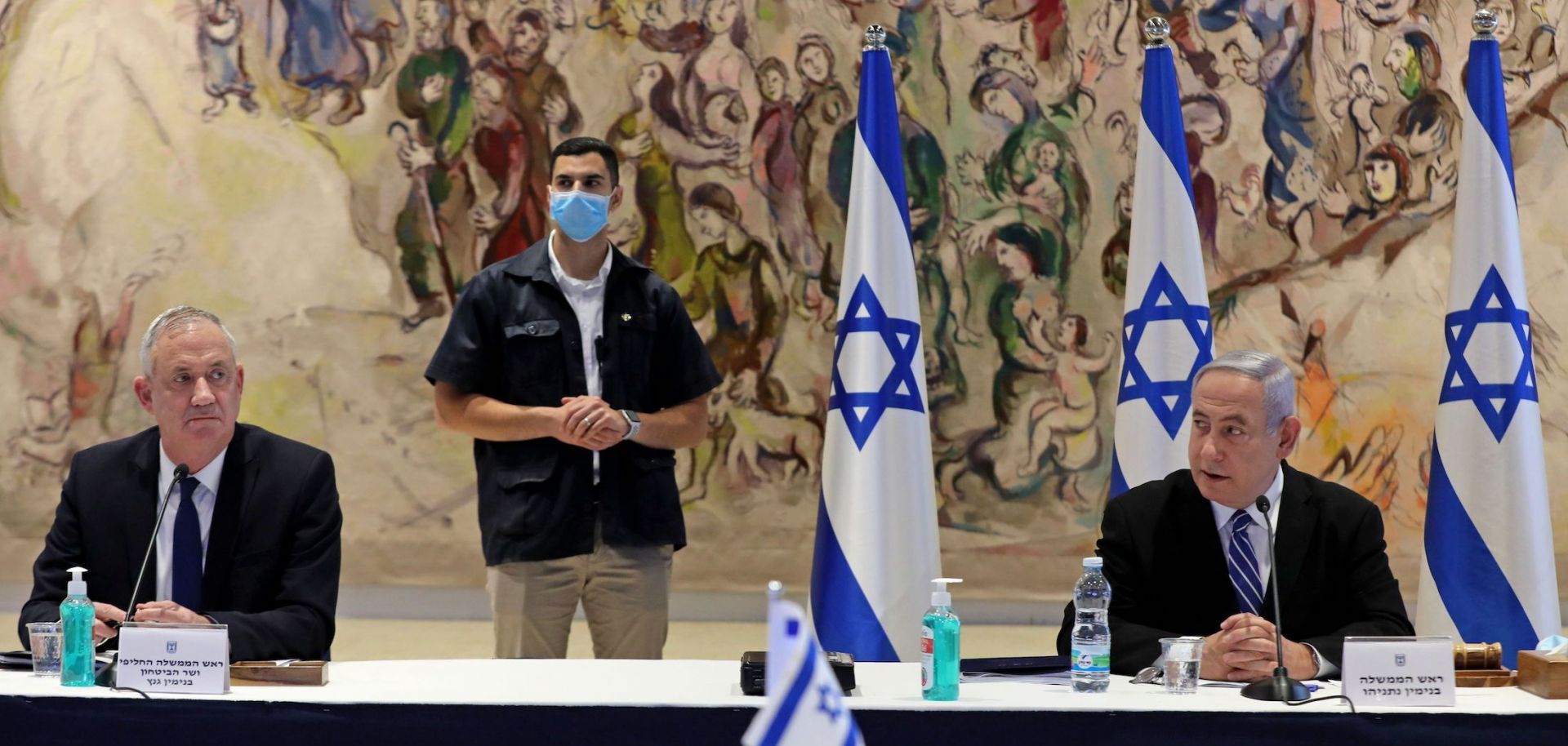
Israeli Prime Minister Benjamin Netanyahu (right) and Alternate Prime Minister and Defence Minister Benny Gantz (left) attend a cabinet meeting in the Knesset on May 24, 2020.
Israel’s new election season will empower Israeli nationalists and foreign policy hawks, straining relationships with its U.S. and European allies and potentially setting back normalization efforts with states such as Sudan, Morocco, Oman and Saudi Arabia. After failing to pass a national budget, Israel’s Knesset dissolved itself on Dec. 22, triggering yet another early ballot. Disputes over the length of the budget timeline helped catalyze long-standing tensions between the Israeli unity government’s primary political anchors, with Blue and White party head Benny Gantz accusing Prime Minister Benjamin Netanyahu and his right-wing Likud party of trying to use the national budget to better position themself for future elections. Israel’s fourth general election in less than two years is now set for March 23.
Israel’s nationalists stand to strengthen their political position in the new election season, pulling the country toward their policy goals, particularly in the West Bank. Right-wing campaigns have increasingly relied on annexation pledges to win votes — a trend that will undoubtedly strengthen in the next election cycle, especially in light of Netanyahu’s failure to follow through on promises to seize parts of the West Bank in July 2020.
- A string of policy failures and unpopular leaders from the left and center-left, combined with an increasingly nationalist youth, has left Israel’s political field dominated by nationalist, religious and settler parties.
- As the leader of the center-left Blue and White party, Gantz once appeared like he might revitalize Israel’s left after decades on the sidelines. But his decision to join the unity government with Netanyahu in March 2020 has since discredited Gantz in the eyes of many center-left voters. The move also prompted Yesh Atid, another large centrist party, to exit the Blue and White alliance.
The recent formation of Gideon Sa’ar’s right-wing nationalist party, A New Hope, will also grant expansionists a clear alternative to Netanyahu ahead of the election. Sa’ar was a high-ranking Likud member of the Knesset and minister, and many of his policies are seen as similar to Netanyahu’s. But he lacks Netanyahu’s corruption allegations, making him more attractive to anti-corruption voters. Sa’ar has also long opposed the formation of a Palestinian state. A Sa’ar-led government would be more reliant on settlers and expansionists to form a right-wing coalition to offset the exclusion of Netanyahu’s Likud.
- Recent polls from Israeli outlets Channel 12 and Maariv have indicated that the next election may grant Sa’ar’s New Hope anywhere between 19-21 seats in the Knesset, which would make it the second-largest party in the legislature after Likud.
A drift towards expansionism both during the campaign and potentially with a Sa’ar-led government will strain Israel’s relations with the United States and Europe, which both oppose annexation and settlement expansions. U.S. President-elect Joe Biden is also more likely to signal opposition to settlement growth.
- Under the administration of U.S. President Barack Obama and then-Vice President Biden, the White House temporarily froze Hellfire arms shipments to Israel during the 2014 Gaza war. In 2016, the Obama administration also decided to abstain rather than veto a U.N. resolution condemning Israeli settlements.
But more tangibly, future Israeli expansionism could freeze aspects of Israel’s wider normalization efforts with its Arab Gulf neighbors and the rest of the Muslim world. The emergence of a more right-wing, post-Netanyahu government would risk spurring Arab and Muslim states to pause or even reverse their pursuit of normalized Israeli ties for fear of stoking public anger and political backlash at home.
- Sudan and Morocco, who both recently began normalization processes with Israel, have notable domestic constituencies that favor a Palestinian state. Sudan, in particular, has a civilian government able to pressure a slow down in formalizing the country’s economic ties with Isreal, stirring up protests against normalization in Sudan. Morocco’s king has greater power to enact unilateral normalization, but he also has a long-standing interest in maintaining positive relations with pro-monarchy Islamist parties that are likely to protest against Israeli expansionism.
- Saudi Arabia’s King Salman has repeatedly signaled that no public normalization deal will happen without Isreal first pledging to form a Palestinian state.
- Oman’s Sultan Haitham has also not shifted publicly toward overt normalization, instead favoring Muscat’s traditional neutrality.
- The United Arab Emirates and Bahrain, who both inked normalization pacts with Israel earlier this year, are less interested in a Palestinian state than in the past and favor deeper economic and security relations with Israel. But some Israeli nationalists have criticized specific investments that the two normalization pacts have so far yielded, including the purchase of Israeli football club Beitar Jerusalem by an Abu Dhabi royal.
