
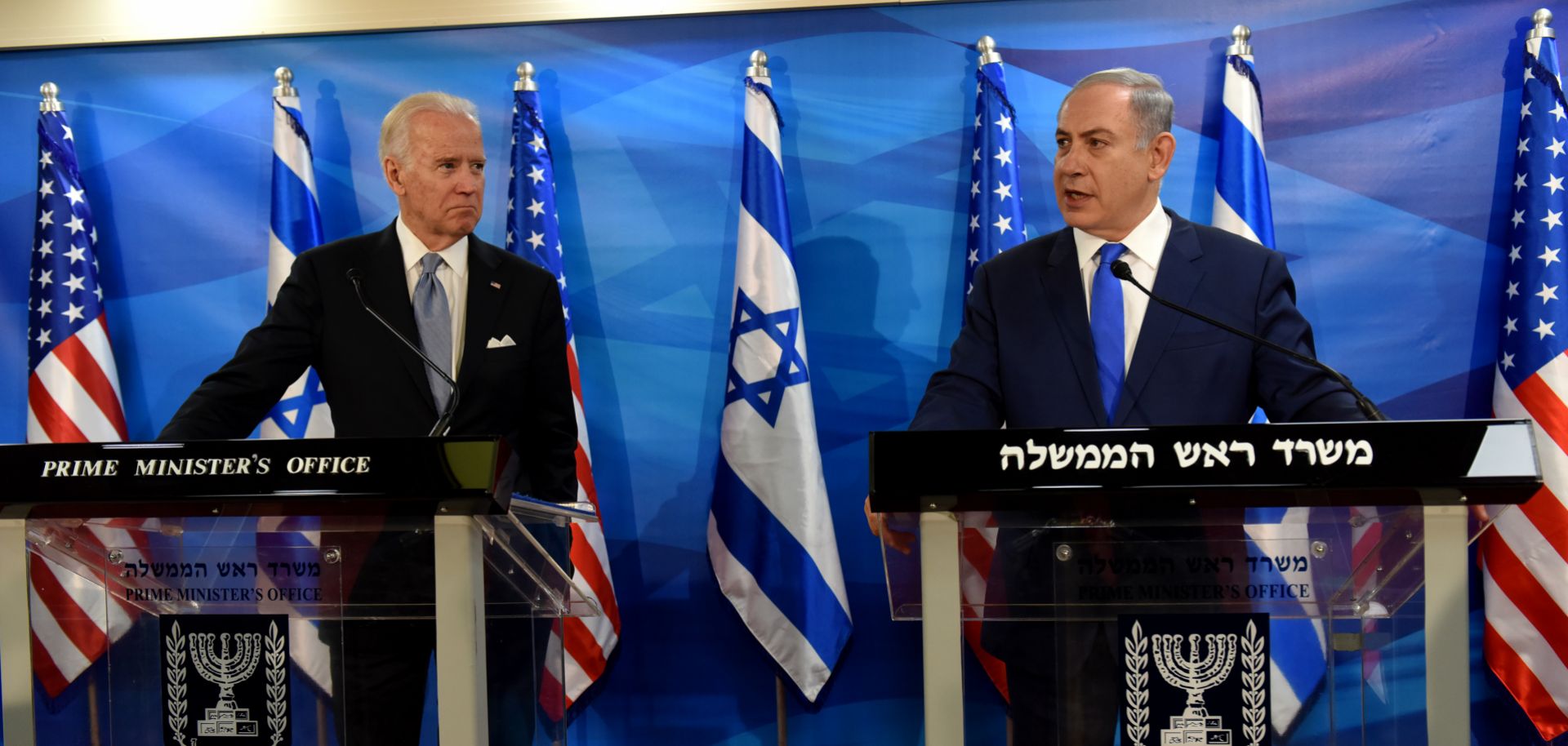
Then-U.S. Vice President Joe Biden (left) listens to Israeli Prime Minister Benjamin Netanyahu talk during a joint press conference in Jerusalem, Israel, on March 9, 2016.
Before U.S. President-elect Joe Biden assumes power in January, Israel will attempt to cement his predecessor’s pro-Israel policies in the West Bank and against Iran. Israel will likely pursue the least risky path to achieve both of these aims by focusing on expanding settlements in the West Bank, while using its political and covert influence to undermine U.S.-Iran negotiations. But should its fragile unity government falter, right-wing challengers will push Israel to consider more hawkish strategies, including potential annexations of additional Palestinian territory, as well as preparing more unilateral military and covert moves against Iran’s nuclear program and regional proxies.
Israel is rapidly approving new settlements in East Jerusalem and formalizing previously illegal structures through the West Bank to solidify the strategic gains it has made during the past four years. Through its Israeli-Palestinian peace plan, released in January, the administration of U.S. President Donald Trump helped encouraged Israeli expansionism. While Biden said he would not support annexations on the campaign trail, he has not spelled out what policy changes his incoming administration might take to discourage further settlement construction.
- On Nov. 15, the Israel Land Authority announced it was moving ahead with a plan to build 1,257 homes in the sensitive area of Givat Hamatos near East Jerusalem.
- In addition to undermining a future Palestinian state, settlements in the West Bank offer Israel security protection and establish permanent, de facto Israeli control along the highways and roads that supply them.
Political instability within Israel will further heighten the risk of additional annexations in the coming months, as the Israeli government faces rising pressure from right-wing settlers who are angry with its failure to annex territory in the West Bank as promised in July. This anger has translated into political gains for Yamina, a pro-settler nationalist party whose leader, Naftali Bennet, is a rival for Prime Minister Benjamin Netanyahu. The weakening or even collapse of Netanyahu’s frail unity government would further empower such pro-annexation forces in the country.
- Israel’s unity government is riddled with political divisions. Its primary actors, Netanyahu and Defense Minister Benny Gantz, continued swipes against each other could eventually erode trust enough to collapse the government.
- Current polls suggest that Netanyahu would face a notable pro-settler challenger from Bennet and his Yamina party under such circumstances.
When it comes to Iran, Israel will attempt to influence any U.S. political discussions regarding the pace, scope and speed with which to potentially re-enter negotiations with Tehran. Israel is highly concerned that the Biden administration will repeat history and negotiate a new deal with Iran over its nuclear program that does not address Iran’s regional proxies in Lebanon, Syria and Iraq, its hostility to Israel, or Tehran’s ability to develop technologies that ease its path to a nuclear weapon system.
- In an opinion piece published on Sept. 13, Biden criticized the Trump administration’s hardline Iran policy under its maximum pressure campaign, as well as the White House’s 2018 withdrawal from the Iran nuclear deal, formally known as the Joint Comprehensive Plan of Action (JCPOA).
- Biden has also expressed he’d be open to quickly re-entering the JCPOA if Iran returned to full compliance.
In doing so, Israel will leverage intelligence leaks, covert action and lobbying in Washington to portray Iran as a bad faith actor. In an effort to tie Iran to al Qaeda, Israel likely leaked the recent news that the global jihadist group’s second-in-command, Abu Mohammed al-Masri, was assassinated in a joint U.S.-Israeli operation in August. Israel’s covert apparatus may hold further secret intelligence that it decides to leak to further undermine Iran’s international reputation and influence a negotiation process.
- A handful of pro-Israel U.S. lawmakers, including Representative Eliot Engel and Senator Martha McSalley, lost their seats in 2020 elections. But Congress, and in particular the Senate where treaties must be ratified, remains largely pro-Israel. These voices may signal to Iran that a Biden agreement could be subject to the same withdrawal process Trump undertook and undermine confidence in negotiations.
- In April 2018, just before the United States withdrew from the JCPOA, Israel publicly revealed intelligence on Tehran’s so-called secret “Atomic Archive,” which helped fuel U.S. calls to withdraw from the agreement.
Israel will consider covertly or even militarily provoking Iran as well in an attempt to cause retaliation that undermines Tehran’s diplomatic reputation. But Israel remains unlikely to directly attack Iranian nuclear facilities without clear evidence of an imminent nuclear breakout. In 2012, Israel publicly broadcasted its “red lines,” including a 20 percent uranium enrichment level, to help pressure Iran to negotiate and give up its nuclear program. Israel has not publicly carried out the same strategy this year, suggesting that, for the moment at least, Israel is not yet immediately concerned about Iranian nuclear developments. However, the Iranian nuclear program is unpopular with right-wing Israelis, and could emerge as a political issue should the unity government falter.
- Israel has carried out airstrikes in Lebanon, Syria and Iraq designed to undermine Iran’s regional military footprint, with the most recent being the Nov. 17 attack on Iranian armed forces in Syria. Some of these attacks have provoked Iranian retaliation on Israel, U.S. forces, or U.S. allies like Bahrain’s embassy in Iraq.
