
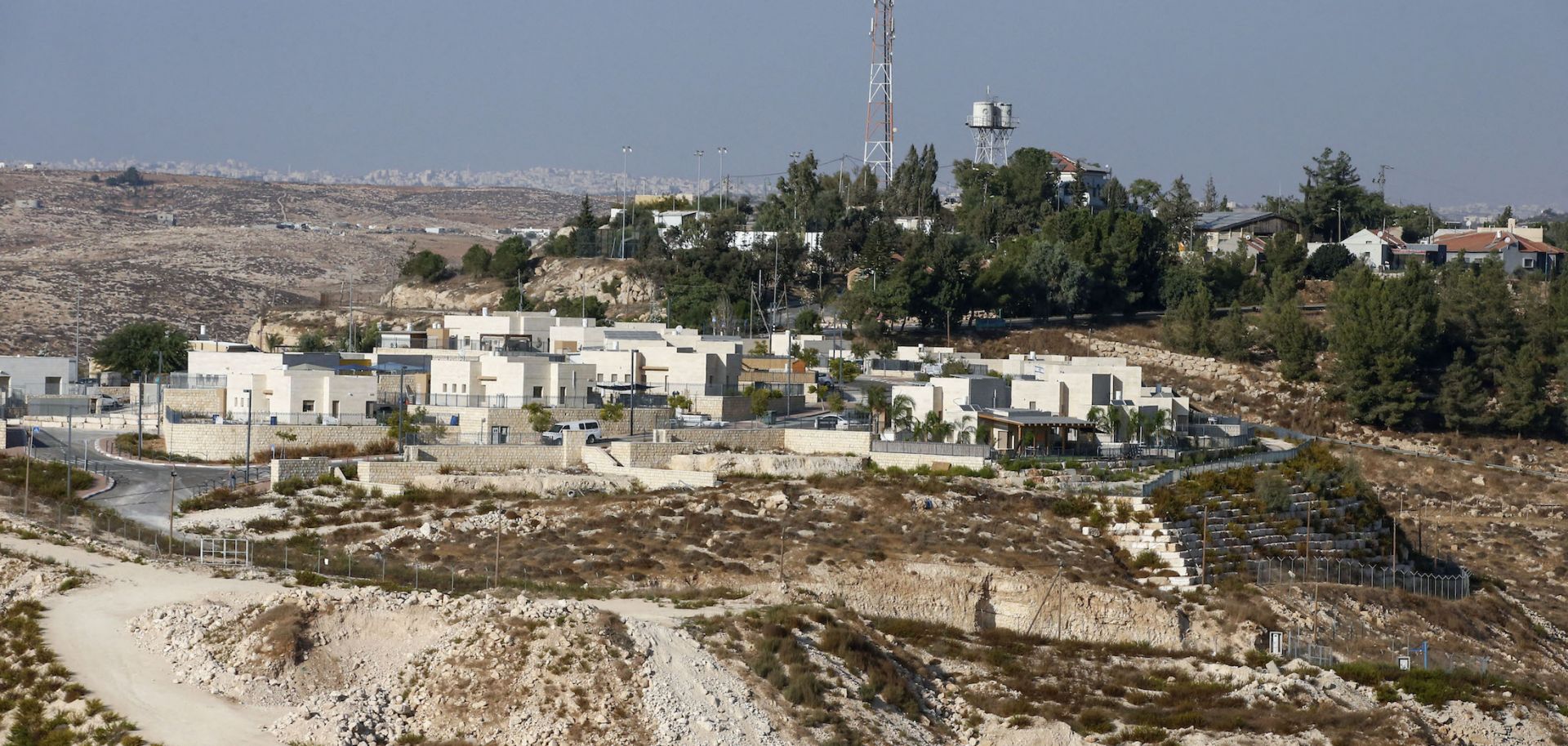
A picture taken on October 14, 2020, shows the Israeli Shimaa settlement south of the city of Hebron in the occupied West Bank, with the Palestinian village of Samua in the background.
Settlement expansion will not slow the pace of Israel's normalization with the Arab world, undermining the future of a Palestinian state. On Oct. 14-15, Israel's Defense Ministry approved the construction of almost 5,000 new homes in the West Bank, including some already built illegally but now deemed legal. There was condemnation from European powers and Jordan, but no immediate diplomatic pushback from Israel's new Gulf Arab allies, Abu Dhabi and Manama.
In the absence of any real consequence to proceeding, Israel will maintain its long-term strategy of expanding settlements despite international protest to secure parts of the West Bank and undermine a future Palestinian state. The political, economic and security drivers for settlement expansion have not changed substantially enough to influence the settlement policy of the current unity government.
- Israel's right-wing settler movement is a key bloc of the unity government, and it remains disappointed that annexation, promised in July, has yet to be implemented. Settlement expansion offsets their anger at the government.
- Settlements remain a way to ease housing shortages in Israel proper and alleviate economic stress for some Israelis. Some settlements have financial incentives to bring in settlers.
- Israel's unity government agrees on the need for a long-term presence in the controversial Jordan River Valley bordering Jordan in order to permanently anchor Israel.
States that have recently normalized ties with Israel — namely, the United Arab Emirates and Bahrain — are unlikely to downgrade relations in the face of settlement expansion. For Gulf Arabs, the benefits of new ties with Israel outweigh the advantages of championing the Palestinian cause, and settlements — unlike de jure annexation — will not give rise to a formal rebuke in Gulf Arab capitals.
- Normalization has given the United Arab Emirates and Bahrain notable political capital in the United States, their key strategic ally, from both of America's political parties, strengthening their relationship with Washington beyond the close ties they have with U.S. President Donald Trump.
- UAE-Israel business ties continue to deepen, with Emirati-based companies looking to invest in Israel's airlines and ports, Haifa port taking its first shipment from Dubai, and the two looking to set up a tax treaty.
Other states that might normalize with Israel, including Sudan, Qatar, Morocco, Oman and Saudi Arabia, are unlikely to reconsider based on settlement expansion alone. Formal annexation is also more important to these states than continued settlement expansion, with diplomatic red lines shifting away from settlements in the aftermath of normalization. The Palestinian issue remains popular throughout much of the Arab and Muslim world, but has become less of a priority in recent years as domestic concerns and regional rivalries take precedence over the decadeslong Palestinian issue.
- Many countries, including Sudan and Saudi Arabia, are coming under direct U.S. pressure to normalize in exchange for certain U.S. concessions. In Sudan, the United States is offering debt relief and to take Sudan off its list of state sponsors of terrorism in exchange for normalization. In Saudi Arabia, the United States is offering deeper arms deals, potentially including the advanced F-35 fighter system that reportedly was part of the UAE-Israel normalization deal.
