
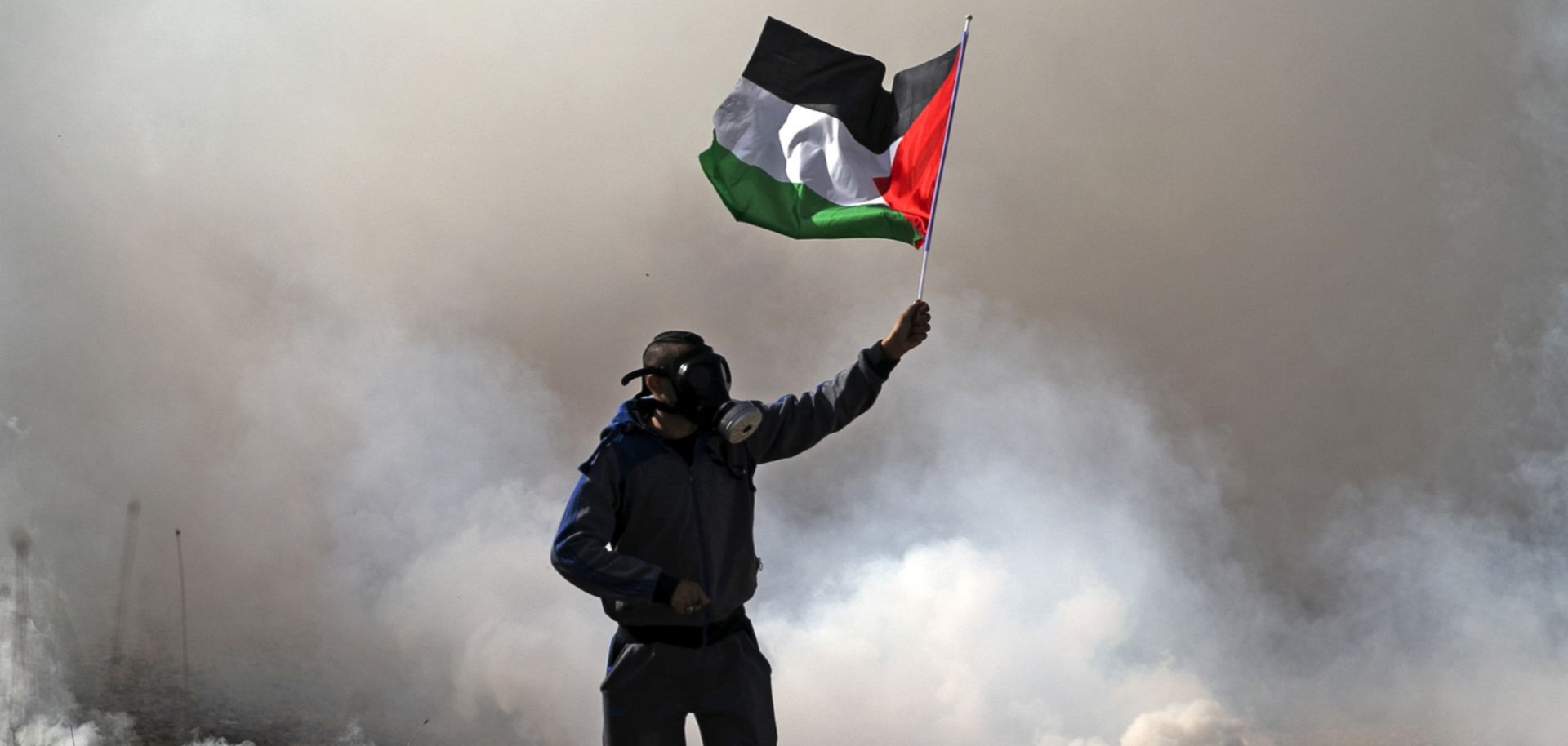
A protester waves the Palestinian flag amid smoke from tear gas fired by Israeli security forces during a demonstration near the West Bank village of Beit Dajan on Dec. 18, 2020.
The Palestinians are facing the increasingly likely prospect of Israel imposing a one-state solution at a time when the world is preoccupied with other regional priorities. Iran’s threatening behavior, as well as the growing trend of Israeli-Arab normalization, has placed Palestinian statehood on the backburner over the past year, creating space for an ever-more nationalistic Israel to enact policies with a freer hand. As the next decade unfolds, the Palestinians will be forced to choose between either shifting focus to their nationalization inside Israel, or adopting a wait-and-see approach in the hopes that their cause regains its former importance. Settling for anything less than statehood, however, will risk spurring another surge of militancy and unrest. But depending on the stabilization of the region’s geopolitical climate will also risk leaving the Palestinians’ political future to fate.
A Year of Setbacks
The tumultuous past year has caused the Palestinian cause to slide down to the bottom of regional priorities. In January, a near-miss regional war between the United States and Iran highlighted how the Middle East’s geopolitics now hinged on Tehran, not Ramallah. That same month, the administration of U.S. President Donald Trump also unveiled its “vision for peace” plan, which enabled Israeli expansionism. Then, in the latter half of the year, the United Arab Emirates, Bahrain, Morocco and Sudan all inked normalization pacts with Israel without requiring the promise of Palestinian statehood as a precondition. Even the election of a less overtly Israel-friendly U.S. administration in November has offered little solace for Palestinians, as U.S. President-elect Joe Biden has yet to signal he’ll pressure Israel to reverse its Trump-era territorial gains.
And there is little sign the trends that have usurped the Palestinian cause will change. Public opinion polls show that Arab Gulf citizens are losing interest in the issue. The Europeans, meanwhile, have proven unwilling to go beyond symbolic pushback against Israeli strategies. And no other great power — including Turkey, Russia and China — appears ready to step up on against Israeli encroachment in the Palestinian territories.
Reckoning With the One-State Trend
Given this dwindling support for statehood, the Palestinians will be less able to rely on outside powers to pressure Israeli policies. As it stands, Israel is pursuing a strategy likely to produce a one-state solution. Successive right-wing Israeli governments will continue to expand settlements via further formal or informal annexations. And these deepening networks of Israeli-controlled highways and settlements will, in turn, increasingly leave Palestinian towns and cities cut off from one another.
The question, then, is how Palestinians will react. Young Palestinians might be more open to a one-state solution, particularly as it appears a more viable option that would allow them to access Israel’s economy and travel opportunities. Some of them are more secular-minded and internationalist than their parents and grandparents, and therefore less attached to the Islamist and nationalist ideals that helped fuel the generations of struggle against the Israelis. Others will have grown up against the backdrop of multiple failed uprisings and decades of protests and unrest that have failed to reverse Israel’s control.
As the years go on and as the national project seems less viable, the next generation of Palestinians might be more willing to push for nationalization as one of their last remaining options. Yet they will come up against hard blocks among both Palestinian leaders and right-wing Israeli political parties. Palestinian factions such as Hamas will not readily abandon their principles or the privileges that come with leading the Palestinian cause. Regardless of how popular the one-state solution becomes with the Palestinian public, these factions are likely to dig in their heels against nationalization, as it would also likely also mean the end of their existence as independent political and militant forces. Moreover, Israel’s right-wing, buttressed by its own nationalist youth, will not readily accept the nationalization of the Palestinian territories either for fear of damaging their political and economic influence. Indeed, if Palestinians were fully nationalized, Israel would immediately lose its Jewish majority. And declining birthrates among secular Jewish Israelis suggest that in such a binational state, Arabs would only become an increasingly larger percentage of the Israeli population, threatening Israel’s future Jewish character.
Facing pushback to nationalization both at home and in Israel, Palestinians will become increasingly frustrated, which could raise the risk for more uprisings. But unlike the intifadas of the 1980s and 2000s, which came with a sense of heightened international sympathy for the Palestinian cause, future violent uprisings will have less international backing, particularly in the Arab world. They will also come up against an Israeli military and security apparatus that has built walls, installed widespread surveillance and upgraded their anti-insurgency tactics since the last intifada in 2000. Any new uprising is thus unlikely to move the needle on Palestinian statehood.
Waiting for a Better Day
With no viable way to push for nationalization, and with unrest unlikely to shift Israel away from further expansion, Palestinians may be relegated to the position of bystanders — watching as conditions are imposed on them by the Israelis, and awaiting for international and regional conditions to improve so that their cause may one day regain its prior global prominence.
If the region’s geopolitical climate begins to stabilize amid, for example, another nuclear deal or other comprehensive agreement with Iran, the Palestinians may again have allies to pressure Israel to resolve the conflict. Arab Gulf states, for one, could leverage their newly normalized economic and security relations with Israel to lobby on behalf of the Palestinians in the future. The United States, with its own liberal demographic drift slowly pulling it ideologically away from Israel, might also prioritize the Palestinian issue again. By helping quell the European Union’s concerns about refugees and terrorism, a more stable Middle East may also make Brussels more willing to risk its security ties with Israel to push for change in the Palestinian territories. Indeed, the Palestinians may someday be able to once again use diplomacy to settle their final status. But with so much in the region and world uncertain, so too will remain the territories’ political future.
