
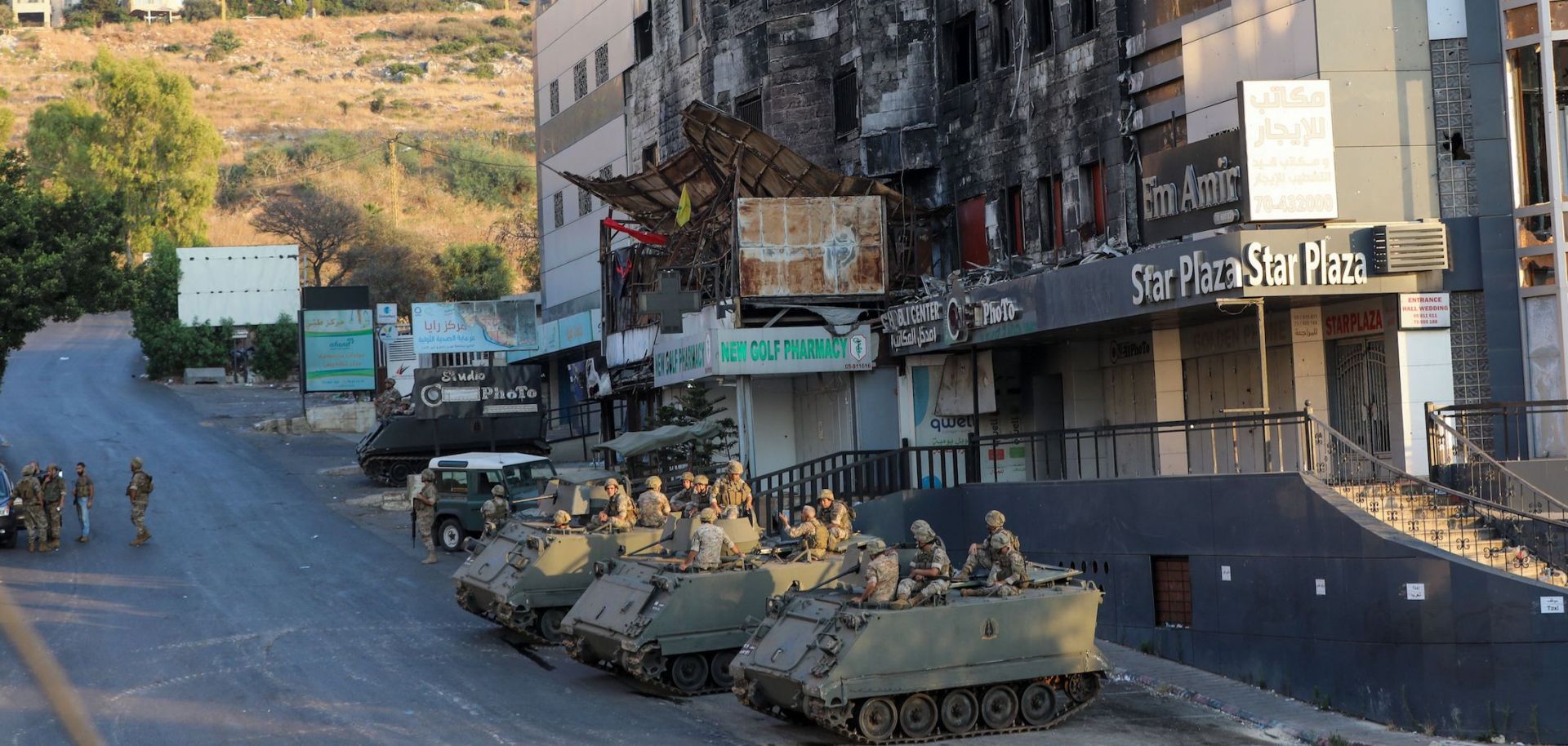
A photo shows Lebanese soldiers stationed in armored vehicles amid clashes in Khalde on Aug 1, 2021.
Sectarian fighting could place Lebanon increasingly at risk of spiraling into a larger civil conflict by spurring a cycle of deadly revenge attacks that its government and military would struggle to control. At least two people were killed in the restive Lebanese town of Khaldeh on Aug. 1 when unidentified tribal gunmen ambushed a funeral procession being held for a Hezbollah commander killed the day prior. The fighting around Khaldeh — which is located roughly 15 kilometers (or 9 miles) south of Beruit — continued for hours, prompting the deployment of the Lebanese army to restore order. On Aug. 2, the army said it had detained at least one person involved in the funeral attack.
- Ali Chebli, a member of the Shiite militant and political group Hezbollah, was shot and killed at a July 31 wedding celebration by a Sunni man reportedly seeking revenge for the murder of a family member the year prior. The following day, Chebli’s family held a funeral that drove through Khaldeh, where they were then ambushed by gunmen.
- In August 2020, violent clashes between Khaldah’s Sunni and Shiite tribes also prompted the army to send in troops. Local leaders were ultimately able to defuse the tensions that led to that flare-up.
While this latest flare-up appears to be over, additional violence between Lebanese sects is possible in the coming weeks and months. Given the country’s own 1975-1990 civil war and the ongoing Syrian conflict (which has sent 1 million Syrian refugees into Lebanon), Lebanese leaders are acutely aware of the consequences of civil discord and have called for a de-escalation of grassroots violence to prevent it from spreading. But with Lebanon’s economy in crisis and its social fabric frayed by political blame games and recurrent protests, frustrated Lebanese citizens are likely to be increasingly incentivized to act out violently to address grievances that their incapacitated government cannot. Within this context, other restive areas in Lebanon that could see similar clashes include Tripoli in the north, where Sunni and Shiite families share a bloody history. Isolated acts of violence have also occurred in the Bekaa Valley and in Beirut itself.
Sustained violent incidents, combined with the deteriorating professionalism and capacity of Lebanon’s cash-strapped armed forces, could slide the country back to a major internal conflict. Lebanon’s leaders are likely to try to mitigate the violence by using the military to control major incidents, as well as by leaning on family, tribal and sectarian connections to ease tensions. But the Lebanese military’s cohesiveness is under strain as its soldiers’ social status is undercut by hyperinflation and food insecurity, potentially reducing the military’s ability to conduct operations in the future. Sectarian militias are likely to fill any security gaps left by the military. But those local armed groups are also likely to be less professional in addressing grassroots violence and could themselves be drawn into local conflicts. Grassroots attacks could result in significant casualties, spurring a cycle of revenge attacks that Lebanese leaders and the armed forces would have difficulty controlling.
