
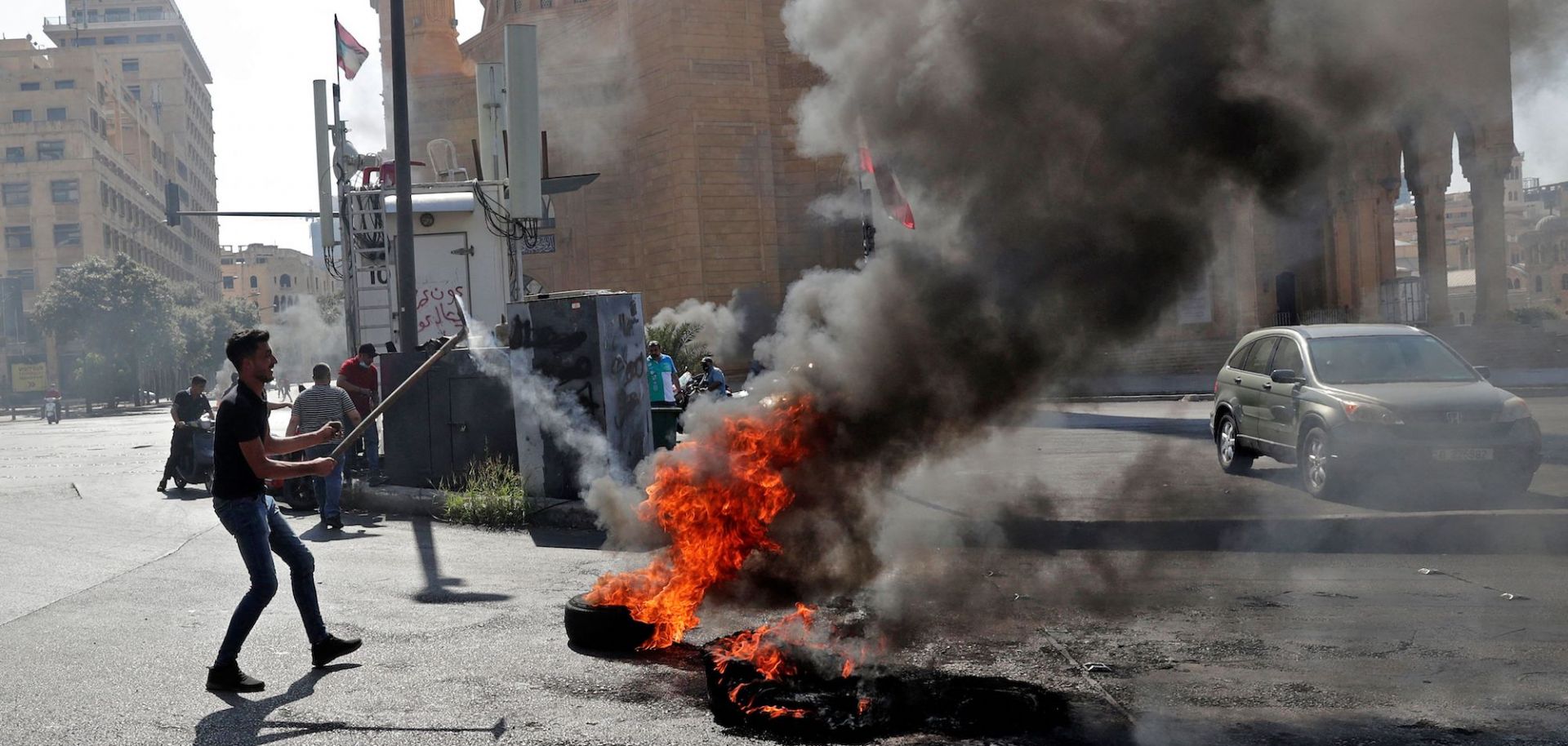
Demonstrators burn tires in Lebanon's capital of Beirut on June 26, 2021, in protest of the country’s ongoing economical and political crisis.
Hezbollah will block Israel’s recent offer of humanitarian aid for fear of weakening its domestic support, as well as promoting favor toward further Israeli normalization — a policy shift that neither the Shiite militant group nor its backer Iran can ideologically accept. On July 6, Israeli Defense Minister Benny Gantz said Israel formally offered Lebanon humanitarian aid through the U.N. peacekeeping force based in Lebanon. While it wasn’t clear what specific type of aid would be included in the offer, Lebanon is grappling with an economic crisis that has made gas, food, medicine and other basic necessities increasingly scarce. The offer came as Lebanon’s caretaker prime minister, Hassan Diab, called for urgent humanitarian aid from the international community, warning that the country could suffer a “social explosion” without new support.
Hezbollah, however, also has no other viable options for new sources of aid to supplement its traditional patronage system, which the militant group relies on to maintain loyalty in Lebanon’s Shiite community. Hezbollah has traditionally used a combination of arms and patronage to maintain its position in Lebanon. But patronage is drying up amid spending cuts and a lack of new international aid, as well as demands for sweeping structural reforms from Lebanon’s foreign donors. Hezbollah leader Hassan Nasrallah has called for Lebanon to accept oil shipments from Iran to ease its energy shortage, though doing so would violate U.S. sanctions and potentially economically isolate Beirut further. Israeli forces could also readily sabotage Iranian vessels going to Lebanon as part of Israel’s ongoing shadow war with Iran across the region. Moreover, international aid from the United States, Europe and Arab Gulf states remains contingent on deeper structural reforms of the sectarian system that would weaken Hezbollah’s domestic position.
As Lebanon’s economic crisis worsens, Hezbollah will thus increasingly have to rely on force to retain influence, weakening the country’s already frail security situation. As the fallout from Lebanon’s financial collapse, Hezbollah will be less able to provide its Shiite community — which was already one of the poorest sects in the country before the current crisis began in late 2019 — with economic and humanitarian support. As a result, some Shiite may grow more emboldened to criticize Hezbollah's role in the sectarian system that has left Lebanon economically isolated. But with a secure land route to Iran through Syria and Iraq, Hezbollah’s arsenals remain well-supplied, leaving the militant group able to project power domestically against such dissidents.
