
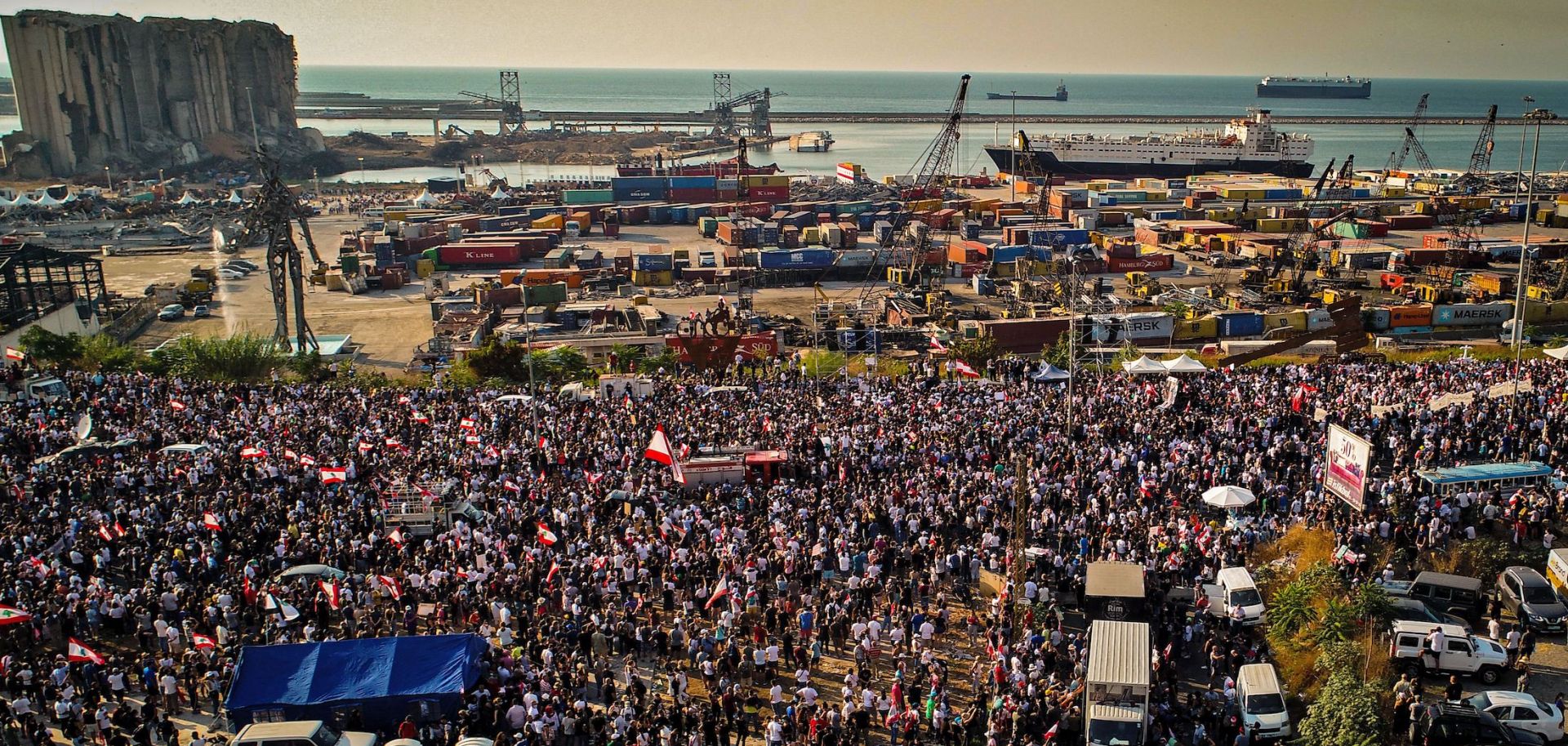
An aerial photo taken on Aug. 4, 2021, shows demonstrators gathered outside the port in Beirut, Lebanon, on the one-year anniversary of the explosion.
In Lebanon, renewed public anger sparked by the anniversary of last year’s Beirut port explosion could spiral into widespread political violence if the anti-government protests begin posing an existential threat to the country’s established parties. At least 85 people were injured on the evening of Aug. 4 in clashes between demonstrators and security forces in Beirut’s Martyrs Square during protests marking the one-year anniversary of the deadly port explosion. Riot police deployed tear gas, water cannons and rubber bullets against demonstrators, who were throwing rocks at security forces according to Al Jazeera. In addition to the main clashes, members of the Lebanese Forces (LF) political party assaulted demonstrators outside the party’s offices.
- Last summer’s port explosion — which killed 220 people and destroyed entire neighborhoods of Beirut — was caused by the accidental ignition of stored ammonium nitrate. The gross government negligence fueled public outrage against officials with any links to public security or the administration of the port, ultimately forcing then-Prime Minister Hassan Diab to resign.
- On the Aug. 4 anniversary, Human Rights Watch released a report corroborating earlier rumors that Diab and President Michel Aoun were allegedly briefed on the danger of the explosive materials stored at the port prior to the disaster, and did not take action to relocate the materials.
While localized and contained, last week’s events provide a possible road map for the future deterioration of Lebanon’s security environment, in addition to the potential for renewed sectarian violence. Developments surrounding the Beirut port explosion are especially likely to trigger demonstrations against Lebanon’s entrenched political elites, including Hezbollah and the LF. In the event of future protests over the port issue, and in particular during future anniversaries, judicial decisions and investigatory announcements, Lebanese officials will likely try to deter and intervene in protests by deploying additional security forces and supplementing with military units. But the country’s security forces are also increasingly stretched thin, suffering from both low pay and low morale, creating the prospect of security gaps.
In the medium term and with enough public support, the protest movement could evolve to challenge the establishment, either by forming viable new political parties or by radicalizing and beginning attacks on political figures and their supporters. There’s a chance, albeit slim, that the protest movement is able to coalesce and form cross-sectarian parties that could effectively challenge entrenched parties in 2022 elections. The emergence of such new parties would likely prompt the existing ones to launch campaigns of voter intimidation in the run-up to next year’s vote by assaulting campaign workers and engaging in acts of intimidation. Should the protest movement launch coordinated physical attacks on the infrastructure of existing parties and on politicians themselves and their homes, it could also spark the remilitarization of politics in the country, where militia groups tied to political parties either supplement or supplant security forces and use excessive violence to deal with demonstrations.
- Established political parties in Lebanon and their supporters have historically reacted violently to political and physical challenges to their power. During the October 2019 protests, for example, Hezbollah supporters attacked anti-corruption demonstrators.
