
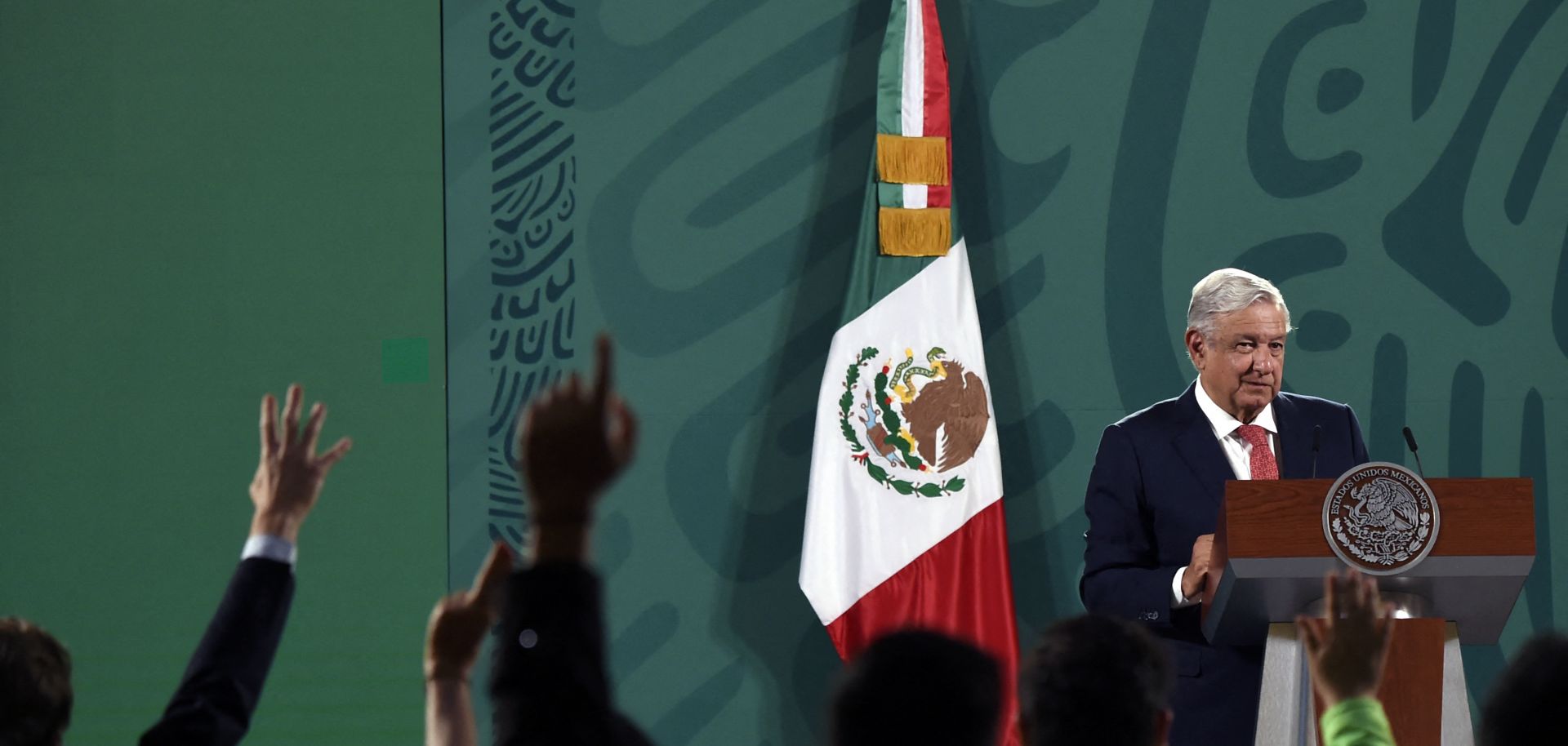
Mexican President Andres Manuel Lopez Obrador delivers a press conference about the results of Sunday's midterm election June 7, 2021, at the National Palace in Mexico City.
Midterm election results will limit the scope of Mexican President Andres Manuel Lopez Obrador's political initiatives by making it difficult to implement constitutional change. Even so, the political bloc led by his MORENA party will likely maintain control over the legislative branch, allowing Lopez Obrador to continue to achieve his policy objectives to some extent, which means existing disincentives to new energy investment will remain in place in the near term. The MORENA-led coalition fell short of winning a two-thirds majority in Mexico's lower house of Congress, but should the coalition between the Partido Verde Ecologista de Mexico (PVEM), Partido del Trabajo (PT) and MORENA hold, they together will hold a simple majority in the lower house of the Mexican congress. Things look better in state gubernatorial races for MORENA, which is projected to pick up at least nine of 15 open governorships, and perhaps even two more toss-ups, indicating continued popular support for the ruling party.
- MORENA, PVEM and PT are projected to secure a cumulative 279 seats in the lower house, garnering roughly 57% of the vote. MORENA lost 59 seats and is projected to keep 197 seats, short of the 251 needed to secure a simple majority. Allies PVEM gained 33 seats for a total of 44 and PT lost eight seats for a total of 38 seats.
- The opposition National Action Party (PAN) and the Institutional Revolutionary Party (PRI) are projected to secure 106 to 117 seats and 63 and 75 seats, respectively, for a combined one-third minority of the lower house.
- Lopez Obrador had previously stated that he would overturn the 2013 energy reforms — which opened the energy market to private investment — by changing the Mexican Constitution.
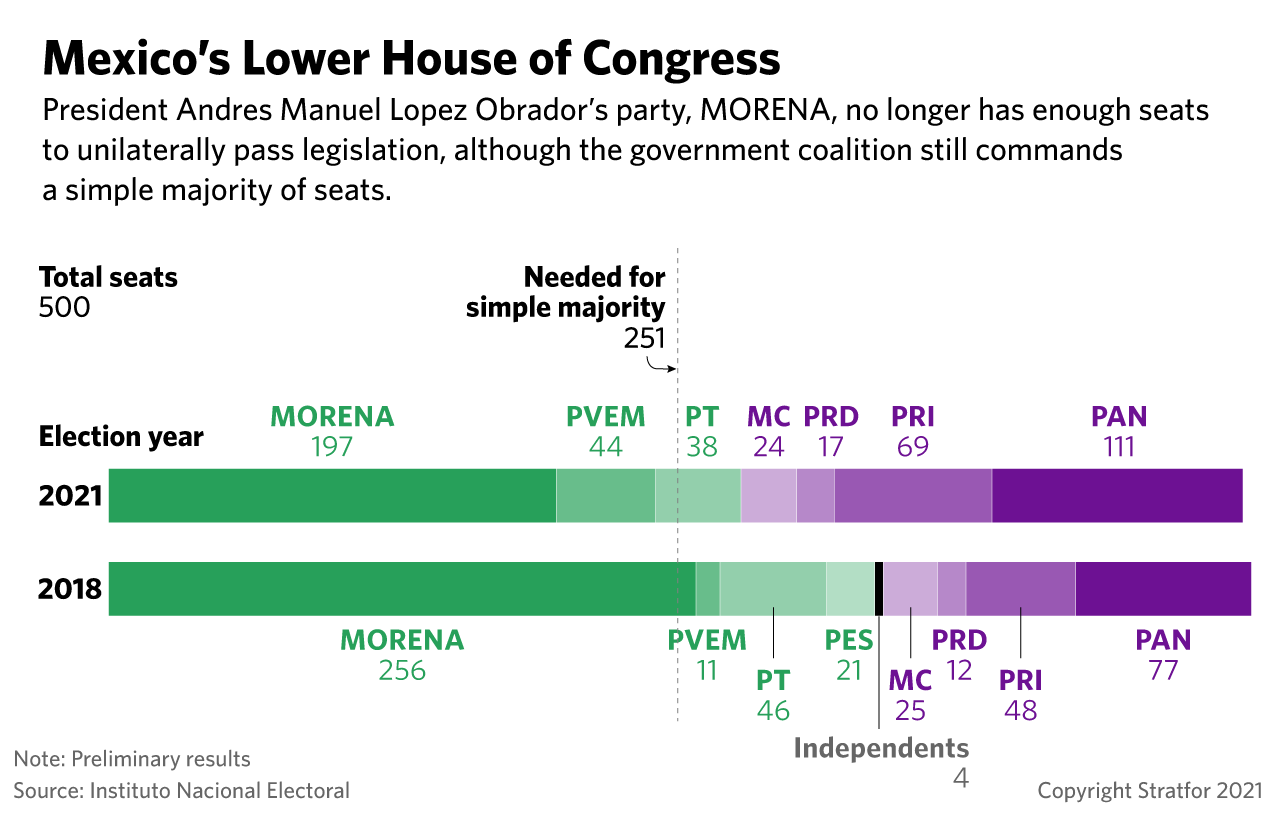
Lopez Obrador's losses highlight the organizational successes of his main opposition parties despite unfavorable economic and security conditions. Though MORENA and its coalition partners will likely maintain a simple majority in the lower house, they still lost seats overall. The opposition, a consortium of historically powerful parties — PAN, PRI and the Party of the Democratic Revolution (PRD) — maintained a united front throughout the campaign despite policy differences, offering a viable challenge to MORENA in traditional Lopez Obrador strongholds such as Mexico City. Poor security and economic conditions driven by the spread of COVID-19 likely boosted the anti-incumbent sentiment that worked against Lopez Obrador's coalition.
- Mexico's homicide rate remained high in 2020 in spite of COVID-19 social distancing measures, declining only 0.4% from 2019 to 29 homicides per 100,000 inhabitants.
- The country's GDP contracted 8.2% in 2020 as a result of a global recession brought on by the spread of COVID-19.
- The PAN-PRI-PRD's Va por Mexico coalition won nine of 15 available borough mayor positions in Mexico City, where Lopez Obrador was governor from 2000 till 2005.
Lopez Obrador will maintain his hold over the legislative branch and so still be able to act on his agenda, but will not be able to force constitutional changes, likely maintaining the current regulatory environment in the energy sector. But absent a two-thirds majority, MORENA can no longer unilaterally promote a legislative agenda, and this will see additional uncertainty for the energy sector in the medium and long term. This will hinder Lopez Obrador's push to make changes to key sectors of Mexico's economy, including further bolstering state-owned energy companies Pemex and CFE against the private sector. Existing legislative challenges to private sector involvement in oil and gas will likely remain tied up in the courts, indicating that the country's energy sector will not see a large-scale overhaul of the regulatory environment through constitutional change, though it will still remain unfavorable to foreign investment. MORENA will rely upon the other parties in its coalition, the PVEM and PT, to at least pass laws that advance its energy agenda, giving these left-wing parties greater leverage on crucial policy decisions. PVEM, the country's main environmental party, could begin to advocate for a transition to clean energy technology, running counter to Lopez Obrador's ongoing efforts to bolster the country's hydrocarbon sector against competition from renewables. Morena will likely sustain control over the fiscal budget and industry regulators. This will allow Lopez Obrador to continue to use institutional mechanisms and presidential decrees to adjust the regulatory environment and boost state-owned energy companies, though such changes will not be as dramatic as constitutional changes.
- On May 17, a Mexican lower court judge indefinitely suspended aspects of a reform to Mexico's hydrocarbons law, deeming them unconstitutional.
- Lopez Obrador will retain influence over energy regulators, which he may influence to halt new rounds of bidding for oil and gas projects.
