
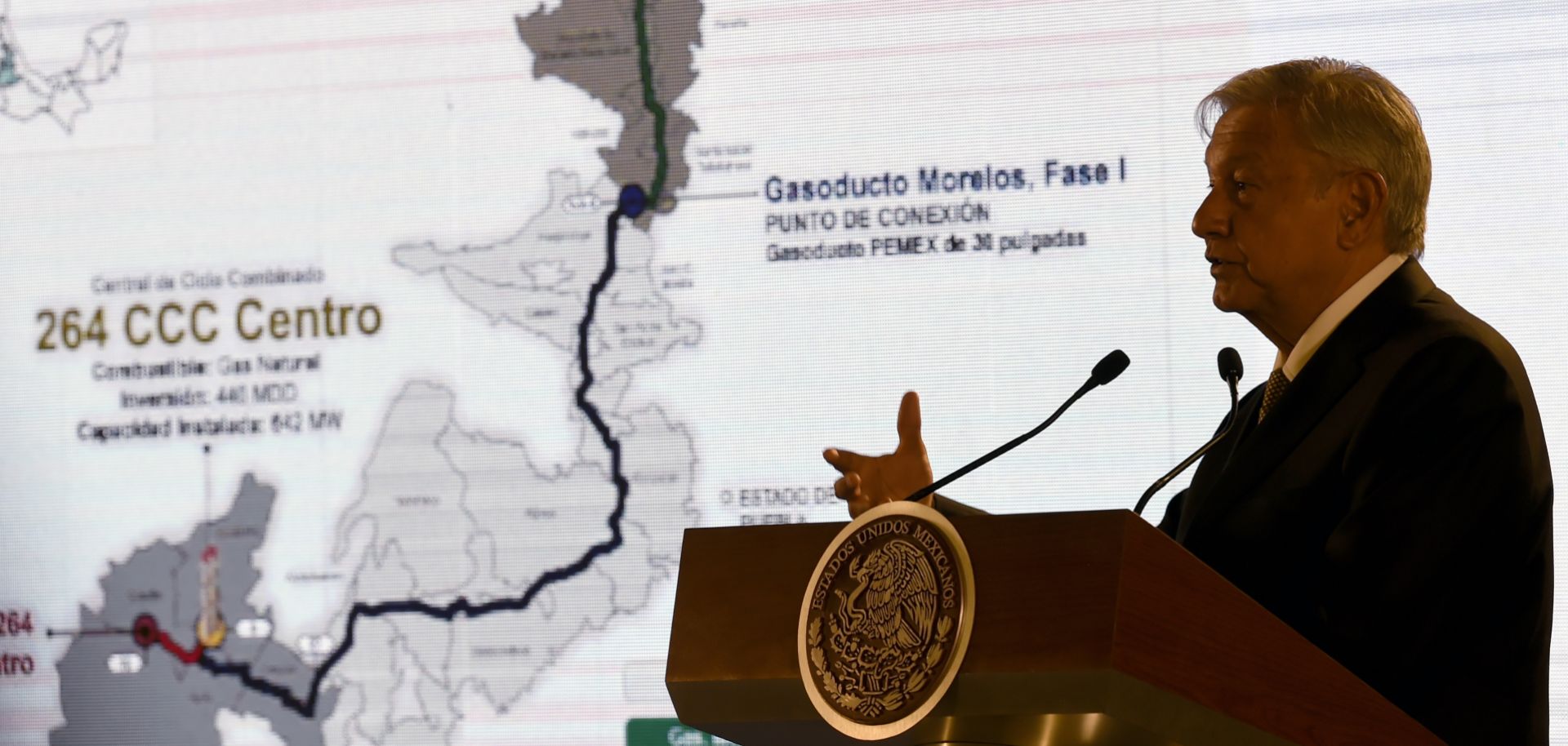
Mexican President Andres Manuel Lopez Obrador speaks during a press conference in Mexico City, Mexico, after announcing his plan to "rescue" Mexican oil company Petroleos Mexicanos (Pemex) on Feb. 8, 2019.
Mexican President Andres Manuel Lopez Obrador's reversal of certain energy policies will likely continue to have a modest impact on foreign investment and competition in Mexico's oil and gas sector. While intended to make Mexico's overall energy industry more self-reliant and state-centric, Lopez Obrador's policy shifts ultimately risk further crippling the country's state-owned oil firm Petroleos Mexicanos (Pemex), while delaying its electricity sector's shift to renewable energy sources.
Energy Policy Changes
Lopez Obrador's vision for the energy sector is predicated on a notion of self-sufficiency, in which state-owned enterprises dominate the market while private investment is reduced to marginal levels. His policies are, in turn, designed to weaken the independence of regulatory bodies, inhibit new bid rounds or contract awards for foreign firms to develop natural resources, and prevent competitive challenges to state-owned energy companies such as Pemex and the electricity firm Comision Federal de Electricidad (CFE).
One key component of this vision has been undermining the independent regulators and operators that were created and strengthened by his predecessor Enrique Pena Nieto's landmark energy reforms in 2013, which includes the Energy Regulatory Commission, the National Hydrocarbons Commission, and the National Center for Energy Control (CENACE) and the National Center for Natural Gas Control (CENEGAS).
- Lopez Obrador campaigned in favor of formally reversing up the 2013 energy reforms, but he has yet to do so for several reasons: The newly negotiated United States-Mexico-Canada-Agreement, for one, includes provisions to protect U.S. and Canadian investments in Mexico's energy sector. Lopez Obrador has also tried to limit Mexico's exposure to international arbitration, as well as any potential damage to foreign investment beyond the energy sector.
- Instead, Lopez Obrador has sought to gut important elements of the reforms through administrative actions. This has included appointing like-minded commissioners with links to Pemex and CFE, as well as forcing regulatory bodies to cut back their workforces of technicians and experts by imposing significant budget cuts. Since Lopez Obrador took office in December 2018, all new bid rounds for on- and off-shore hydrocarbon exploration have also been suspended.
The Upshot for Oil and Gas
Lopez Obrador has preserved the Pena Nieto administrations' legal framework for awarding energy contracts, which will limit the impact on existing offshore exploration and pipeline projects in Mexico by maintaining foreign investment interest.
- The most important oil companies involved in offshore exploration in Mexico — including BP, ExxonMobil, ENI, Shell, Chevron and Talos Energy — have remained committed to their projects since Lopez Obrador took office.
- Shell has actually accelerated exploration activity and spending in some of its offshore blocks. On June 11, the National Hydrocarbons Commission approved a modification to Shell's drilling plan for a block in the southeastern city of Tampico, which will allow it to build another test well in 2020.
- Repsol has also so far reported two new oil finds this year, which are both still under evaluation.
The lack of additional contract awards under Lopez Obrador has also had a limited impact on Mexico's oil sector, as the Pena Nieto administration already had put most of the country's best deepwater acreage up for bid in 2017-2018.
- From a geological standpoint, the Mexican deepwater acreage awarded to companies during this period is very similar to the Gulf Coast of the United States. Production costs are expected to be broadly similar, in the high $30s to low $40s per barrel for most projects. Expectations among most analysts that crude oil will recover above $50 per barrel in the medium-term would make these reserves deliver sufficient returns for development.
- Deepwater oil exploration is also inherently a long-term business, with development timeframes that would put the earliest possible commercial production around 2024, toward the end of Lopez Obrador's term.
Lopez Obrador had initially pledged to nix several government contracts awarded to private companies to construct natural gas pipelines, but he has since backed off from these threats as well.
- After an initial conflict with international and domestic companies surrounding contracts for the construction of pipelines, Mexico's imports of U.S. natural gas has continued to increase as additional pipeline capacity becomes available, including the pipeline linking Mexico City to U.S. gas supplies completed by the Mexican company Fermaca in June.
- U.S. investors in the existing cross-border pipelines are still seeing the expected levels of financial returns from those projects, though U.S. natural gas exports will plateau soon if additional pipelines and infrastructure are not built.
Pemex will fail to see much benefit from Lopez Obrador's push to build a self-reliant energy sector, as the implications of his energy policies are relatively benign for foreign investors involved in existing oil and gas projects in Mexico.
- Pemex lacks the experience and capability to rapidly move forward with deepwater exploration. Most of the deepwater blocks Pemex holds have seen no drilling activity due to the company's need to spend capital on propping up production at aging shallow-water and onshore fields, as well as the Lopez Obrador administration's push to have Pemex upgrade its refineries to reduce dependency on refined product imports from the United States.
- If Lopez Obrador were to lift the current moratorium on new contract awards, Mexico would probably see successful new bid rounds — that is, if his administration maintains the legal framework for the Production Sharing Contracts (PSCs) and continue to treat foreign companies reasonably. Projects in the deepwater acreage already awarded will see production start to ramp up in the mid-2020s, partially offsetting declines in onshore and shallow water offshore legacy fields, which Pemex is trying (unsuccessfully) to stabilize.
- Investment in increased refining capacity will also fail to generate returns for Pemex in an era of slim refining margins amid global overcapacity and consolidation.
The Upshot for Electricity
Lopez Obrador's policies will have a more profound and longer-lasting impact on Mexico's electricity sector by pushing the country to rely more on fossil fuels for power generation instead of more cost-competitive renewable resources.
- In May, Mexico's energy secretary issued an administrative agreement to halt the start of operation of several renewable power plants in the country, citing the need to first stabilize Mexico's electricity grid, which is operated and regulated by the Centro Nacional de Control de Energia (CENACE). The move sparked tensions with Mexico's international partners, who argued it violated CENACES's operational autonomy. In July, Mexican courts ruled to temporarily suspend the agreements.
- The state-owned utility company, CFE, has significantly increased prices and fees for foreign and domestic firms operating private electricity generators, arguing (without any proof) that they had benefited from low fees through corruption. Mexican courts have so far upheld these fee hikes.
- The Mexican government has taken deliberate actions to prioritize coal and crude oil for electricity generation over natural gas and other cleaner energies. To keep electricity prices low, Pemex also sells fuel oil to CFE at reduced rates, generating even larger losses for the embattled state-owned oil giant.
The Lopez Obrador administration's actions in the electricity sector will negatively impact private investment and regulatory bodies in the industry, as well as Mexico's carbon emissions reduction goals.
- In addition to creating uncertainty in the market, the government's favoring of the CFE over both old and new private competitors risks prompting the governments of Canada, Spain and European nations — who are home to companies with significant investments in Mexico's electricity sector — to lodge formal complaints against Mexico.
- The halting and potential derailment of renewable energy projects will also make it all the more unlikely that Mexico will fulfill its international pledge to increase the amount of electricity generated from clean energy sources to 35 percent by 2024.
- By not taking advantage of declining prices in solar and wind energy and forcing Pemex to subsidize fuel oil sales to CFE, Lopez Obrador's electricity policies will ultimately harm Mexico's public finances and overall economic competitiveness as well.
