
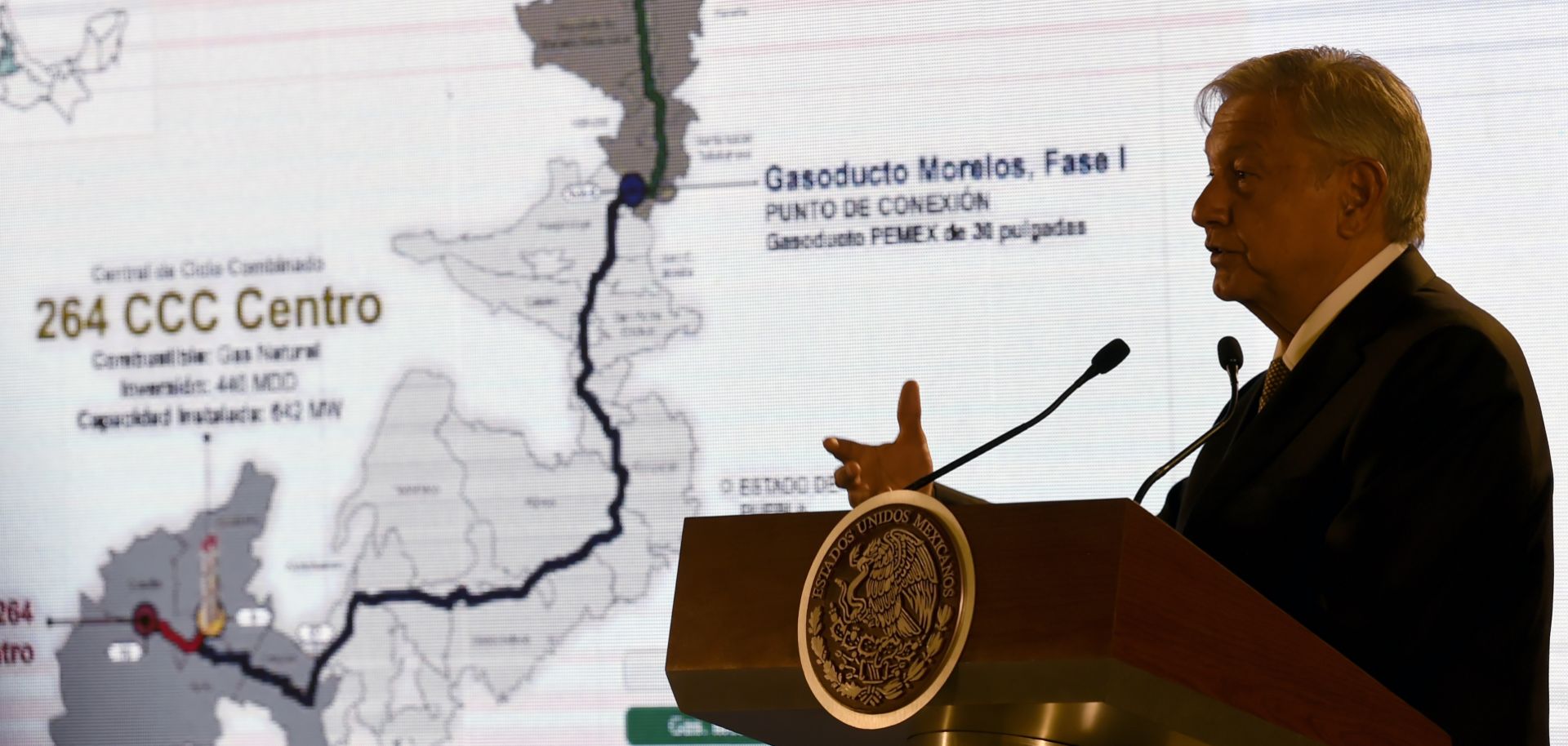
Mexican President Andres Manuel Lopez Obrador speaks during a press conference in February 2019.
A new law that prioritizes Mexico’s state-owned electricity utility over private competitors risks undermining the country’s investment climate and weakening incentives to transition to renewable energy by hiking prices for multinational companies and other large electricity consumers. On March 9, Mexican President Andres Manuel Lopez Obrador signed an amendment to the Electricity Industry Law that favors state-owned energy company Federal Electricity Commission (CFE) over industry competitors by reversing parts of Mexico’s 2013 energy reforms, which permitted foreign and private investment throughout the country’s energy sector for the first time in over 75 years. If enforced, the law would change the order of dispatch from first using the most economical energy per node, which typically favors more cost-effective sources, to requiring that nodes from CFE be prioritized regardless of the cost — marking the most aggressive tactic yet in Lopez Obrador’s push to limit private energy production and bolster the state utility against competitors.
- Since taking office, Lopez Obrador has sought to make Mexico's overall energy industry more self-reliant and state-centric. This has included weakening the independent regulators and operators established by his predecessor Enrique Pena Nieto's landmark energy reforms in 2013.
- In May 2020, Mexico’s energy ministry imposed restrictions on more cost-effective energy production methods that have already chipped away at private investors’ ability to participate in the energy grid. Grid trials for 28 renewables projects have so far been suspended due to the restrictions.
The upcoming June legislative election may give Lopez Obrador the ability to use constitutional changes to implement the energy bill without incurring challenges from the courts. The bill has already been suspended by a lower-level Mexico City court for its unconstitutionality, and Mexico’s Supreme Court will also likely review the legislation in the coming weeks. In response to the legal hurdles, Lopez Obrador warned on March 17 that if the courts deemed his electricity law unconstitutional, he would send a bill to Congress to change the constitution because he could not “be an accomplice to robbery,” alluding to his claims that the pro-business 2013 reforms allowed private and foreign companies to “steal” from Mexico’s energy sector. The legislative coalition led by Lopez Obrador’s Morena party is just six votes short of having a supermajority in parliament, which would enable the president to implement such constitutional changes. And given his 65% approval rating, there is a significant chance he will be able to secure the seats needed to do so in this summer’s election.
- Lopez Obrador’s electricity law was widely expected to face legal challenges given its potential to harm competition, as well as damage Mexico’s environment by deprioritizing renewable energy resources. Mexican citizens, however, are generally supportive of the president’s wider push for state ownership of natural resources. Many Mexicans still celebrate a 1938 government buyout of international energy companies operating in the country, which was largely crowdsourced by households, furthering the concept that Mexico’s energy resources belong to the people.
If enacted, the bill is unlikely to financially affect Mexican residential consumers due to heavy subsidies aimed at keeping prices low. Currently, 78% of subsidies go to the residential sector with smaller subsidies available for the agricultural, manufacturing and transportation sectors. The government is not expected to raise subsidies for these sectors as well. But the Mexican state will have to further subsidize the higher cost of energy for households, which will likely strain the country’s fiscal capacity. Higher energy prices in the residential sector would require more government-funded electricity subsidies to keep prices low for consumers, a promise Lopez Obrador made when drafting the new electricity law.
The new law would, however, likely increase prices for the largest consumers of Mexican electricity, which would disproportionately affect foreign companies, as well as foreign direct investment (FDI) flows into the country. Large power consumers operating in Mexico stand to lose the most given the increased cost of operations, including food manufacturing plants, automobile manufacturing and other industrial sectors. Medium- and large-sized businesses will likely defer the added cost of energy consumption onto the end-consumer. While those operating in these sectors may initially be incentivized to marginally lower consumption, they may eventually halt investment into Mexican operations in favor of countries offering cheaper operational costs. Increased operational costs may also dampen FDI flows into the country’s energy sector, along with the subsequent demand for labor and capital — pushing down real wages and hours worked, while leading to lower consumption and decreased demand for investment.
If deemed legal, the new regulations favoring CFE would also put current clean energy projects in Mexico at a significant disadvantage. Prioritizing electricity nodes from CFE and other state-owned energy projects in the dispatch order means nodes generated by private wind and solar projects would be the last to be sold to the electricity grid. This discrimination on the grid may jeopardize the financial feasibility of the energy projects. The added financial burden of the regulatory changes may, in turn, force private sector companies that have already invested in clean energy projects in Mexico to either close the project or divest.
An energy reform favoring CFE could put Mexico in violation of several international agreements as well. First, the bill could violate antitrust clauses written into the United States-Mexico-Canada Agreement (USMCA), which would likely trigger a dispute settlement. Given the heavy emphasis placed on blocking renewable energies and the potential lack of renewables projects, this bill would likely also directly cause Mexico to fail to meet its carbon emissions commitments under the Paris Climate Accord. This may put Mexico at odds with the international community, which could result in economic repercussions such as a carbon tax on some Mexican goods, as international actors begin to pressure one another to adhere to global climate standards.
