
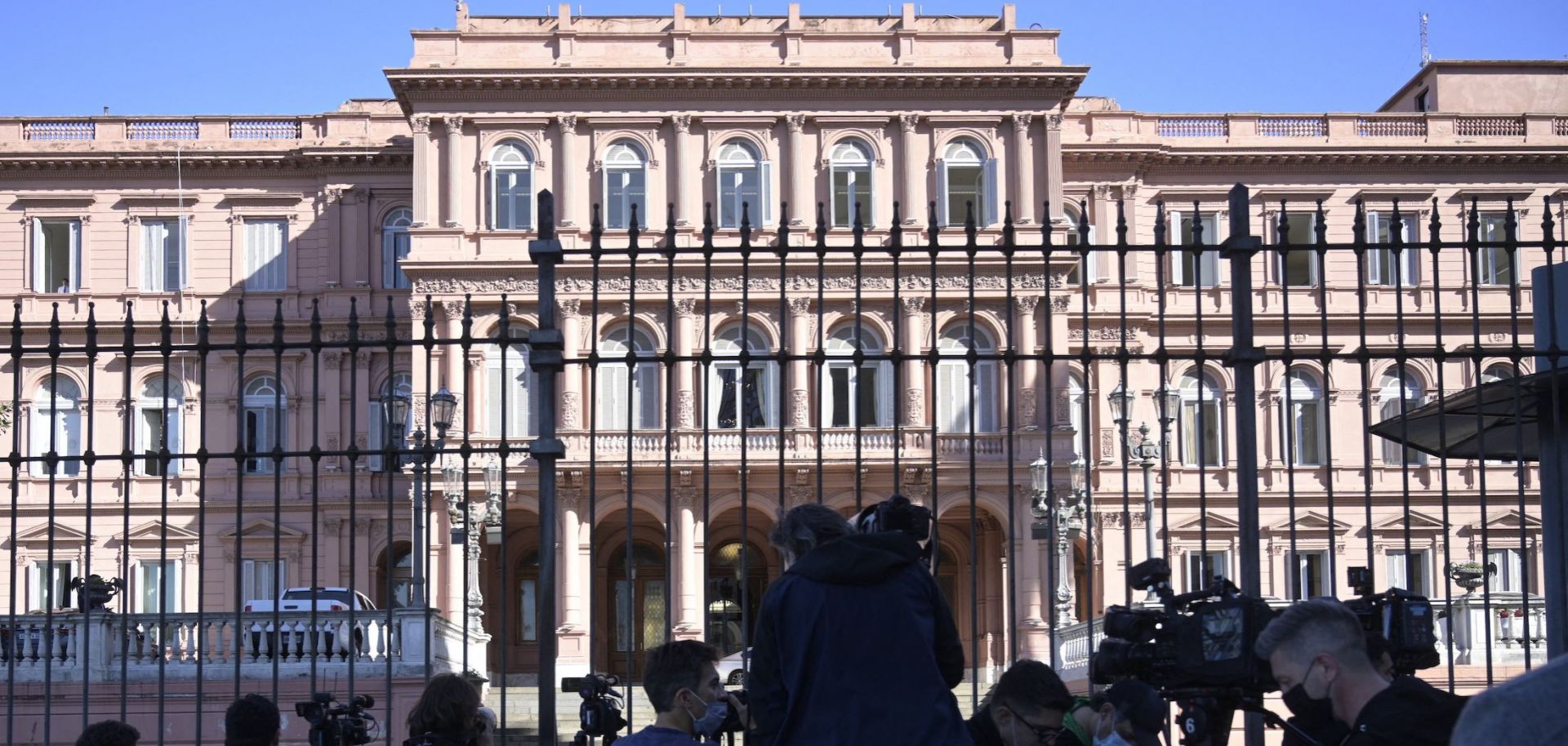
Argentina's ongoing political crisis will result in an expansion of populist measures that will make it harder for the country to reduce its massive inflation, improve the business climate or renegotiate its deal with the International Monetary Fund. Argentina has been in a deep political crisis since Sept. 12, when the Frente de Todos (a coalition of Peronist and Kirchnerist political parties that support President Alberto Fernandez) performed poorly in countrywide primary elections ahead of the midterm election Nov. 21. Fernandez's candidates won fewer votes than their conservative rivals in most districts, suggesting the government and its allies could lose a significant number of seats in Congress if the November vote produces similar results. After the election, Cabinet members and other high-ranking officials close to Vice President Cristina Fernandez de Kirchner presented their resignation to weaken the president, while Fernandez de Kirchner wrote an open letter blaming Fernandez's handling of the economy for the poor electoral results. Fernandez announced a new Cabinet on Sept. 17 with an increased presence of ministers close to Fernandez de Kirchner. This suggests that the vice president will gain more influence over government policy in the coming weeks.
- Cristina Fernandez de Kirchner was Argentina's president between 2007 and 2015. In the 2019 presidential election, she opted to be a vice presidential candidate and supported Fernandez's presidential candidacy in an effort to attract moderate voters. While this strategy allowed Fernandez and Fernandez de Kirchner to win the election, their relationship is tense, marked by constant disputes for influence over policy.
In part due to the detente between the president and vice president, the Argentine government will increase welfare spending ahead of the November elections, worsening inflation and deepening Buenos Aires' fiscal deficit. Argentina's fiscal deficit reached 6.5% of GDP in 2020 as the country increased welfare spending and other measures to support households during the early stages of the COVID-19 pandemic. While the government pledged to reduce the deficit to 4.2% of GDP in 2021 and 3.3% in 2022, Fernandez de Kirchner is critical of the plan, arguing that it is one of the reasons behind the government's drop in popularity. As a part of the truce between Fernandez and Fernandez de Kirchner, the Argentine government will implement measures such as introducing a higher minimum wage, granting a bonus to retirees and increasing direct payments to low-income families. While these measures could temporarily boost domestic consumption, they are likely to worsen Argentina's already high inflation rate and derail the government's efforts to reduce its fiscal deficit. Moreover, the government is also likely to look for additional ways to increase state revenue to pay for these expanded welfare programs. This increases the chances the government will increase tax pressure on agricultural exporters and large companies, negatively impacting exports and reducing Argentina's ability to generate hard currency (especially dollars). In the meantime, capital controls meant to protect an ever-weakening peso and allow the state to stockpile dollars will remain in place, and could be tightened even more.
- Argentina's GDP contracted by 10% in 2020 as the country imposed strict lockdown measures that negatively impacted the economy. According to the IMF, Argentina will grow by less than 6% in 2021, which means that its economy will not return to pre-pandemic levels this year.
- Even with price controls in place, Argentina's official inflation rate in 2020 was 36.6%, one of the highest in the world; private analysts believe the real inflation rate is around 50%. To a large extent, high inflation is a consequence of the government constantly printing money to pay for generous social welfare programs.
- The Argentine peso is one of the worst performing currencies in the world. While the government maintains an official exchange rate with the dollar and only allows nationals to purchase up to $200 a month, Argentines often purchase dollars in parallel markets at much higher exchange rates.
- According to the IMF, Argentina's general government gross debt rose from 90% of GDP to 103% of GDP between 2019 and 2020.
Fernandez de Kirchner's growing influence on economic policy and a potential defeat in the midterm elections will reduce the prospect of Buenos Aires reaching a deal with the IMF and increase the probability of another default. While Buenos Aires is unlikely to abandon negotiations with the IMF, Fernandez de Kirchner's immediate goal will be to increase popular support for the government as much as possible before the November elections. This means that reaching a deal with the IMF will not be a priority, especially as the institution is likely to demand unpopular fiscal adjustments in exchange for restructuring debt. Moreover, Fernandez de Kirchner's very vocal criticism of Economy Minister Martin Guzman (who leads the negotiations with the IMF) will reduce his credibility as an interlocutor between the institution and the Argentine government. Should the government lose the elections in November, the political crisis within the Argentine executive branch could deteriorate to the point of making the dispute between Fernandez de Kirchner and Fernandez irreconcilable. This would severely reduce the government's room to implement a coherent and enforceable economic program that both the IMF and international investors can trust.
- Negotiations between Argentina and the IMF over the future of its $45 billion debt to the institution have moved slowly since Fernandez took over. Argentina has repeatedly demanded longer repayment periods and has rejected measures to accelerate a reduction of its fiscal deficit.
- In early 2021, Argentina promised the Paris Club (which represents wealthy creditor countries) to reach a deal with the IMF in early 2022.
The disputes within Argentina's executive branch will make the government increasingly fragile and create significant political risk over the next two years. The conflict between Fernandez and Fernandez de Kirchner will worsen if the Frente de Todos loses the midterm elections. The situation will be particularly serious if the government continues to lose popular support despite its populist measures and the Frente de Todos does worse than it did in the primaries. In such a scenario, a formal break between the president and the vice president is possible, which could include large demonstrations in favor of each of them and eventual episodes of small-scale violence between the Fernandez and the Fernandez de Kirchner camps. On the contrary, a victory by Frente de Todos in the midterm elections would mean two years without any other elections before the presidential vote in 2023, which would reduce tensions within the executive and give the government enough confidence to resume negotiations with the IMF. But even in this scenario, Buenos Aires would continue to push for a slow implementation of deficit-reducing measures.
- If despite the increase in populist measures in September and October the government loses the midterm elections in November and Fernandez de Kirchner resigns to gain distance from Fernandez’s administration, Fernandez will be left with a severely weakened government with little room to implement policy on its own. In this scenario, Fernandez could seek to move to the political center and reach deals with both the IMF and the conservative opposition to try and stay in power until the end of his term in late 2023, but his authority would be considerably weaker and would depend on Congress' willingness to rescue his government.
- If, on the contrary, a defeat in the November elections results in Fernandez’s resignation, Fernandez de Kirchner would become president. In this scenario, the government is likely to deepen its populist measures, including policies such as increasing fiscal pressure on the rich and productive sectors of the economy and printing more money to sustain public spending. Depending on the severity of the economic crisis, the expropriation of some private companies cannot be ruled out. In this scenario, Argentina would likely face hyperinflation and capital flight would accelerate even as currency controls are tightened. There would also be a significant rise in the emigration of wealthy Argentines (and their capital) to the United States and Europe while poor and middle class Argentines migrate to regional countries like Chile, Colombia, Brazil and Peru.
