
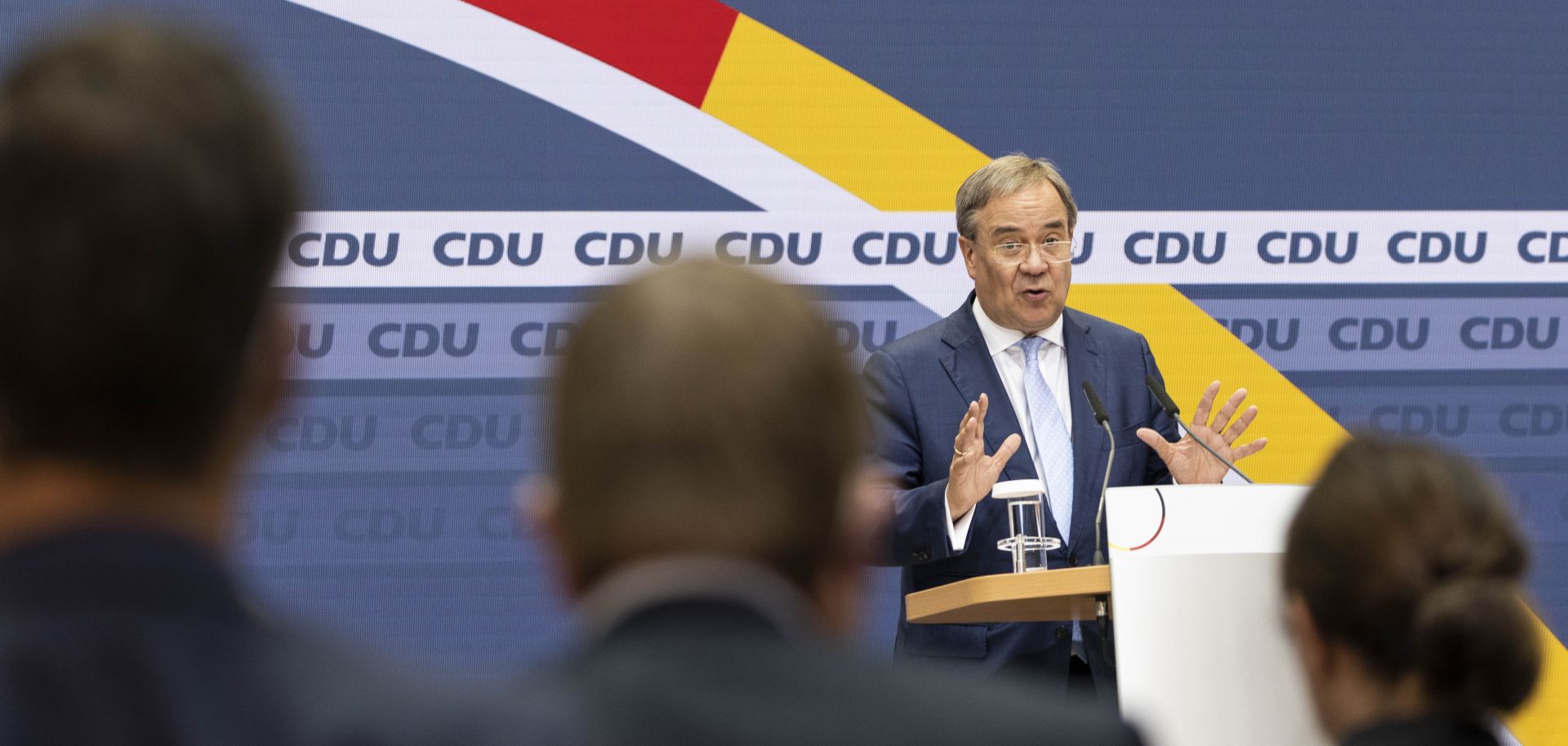
Armin Laschet, the Christian Democratic Union (CDU)’s chancellor candidate, speaks at the press conference in Berlin on Sept. 27, 2021, the day after Germany's federal election.
Upcoming German coalition talks will likely result in a moderate government that ensures continuity on fundamental issues like EU and NATO membership. Disagreements over fiscal and environmental policy, however, will slow down the negotiations and risk their collapse. Germany’s Sept. 26 federal election has produced a fragmented Bundestag where an agreement between three parties will be needed to form a government. According to preliminary results released on Sept. 27, the progressive Social Democratic Party (SPD) won 25.7% of the vote, followed by the conservative Christian Democratic Union (CDU) with 24.1%, the environmentalist Greens with 14.8%, and the pro-business Free Democratic Party (FDP) with 11.5%.
- The SPD’s chancellor candidate, Olaf Scholz, and the CDU’s chancellor candidate, Armin Laschet, both said on Sept. 26 that they want to lead Germany’s next government. Both have suggested that an alliance with the Greens and the FDP was possible.
- The leaders of the Greens and the FDP — Annalena Baerbock and Christian Lindner, respectively — said on Sept. 26 and 27 that it was too early to talk about coalitions. They also said they are considering negotiating with each other before reaching out to Scholz or Laschet.
- A repetition of the current “grand coalition” between the SPD and the CDU that excludes the Greens and the FDP is mathematically possible but politically improbable, considering that Scholz and Laschet ruled it out during the campaign and after the election.
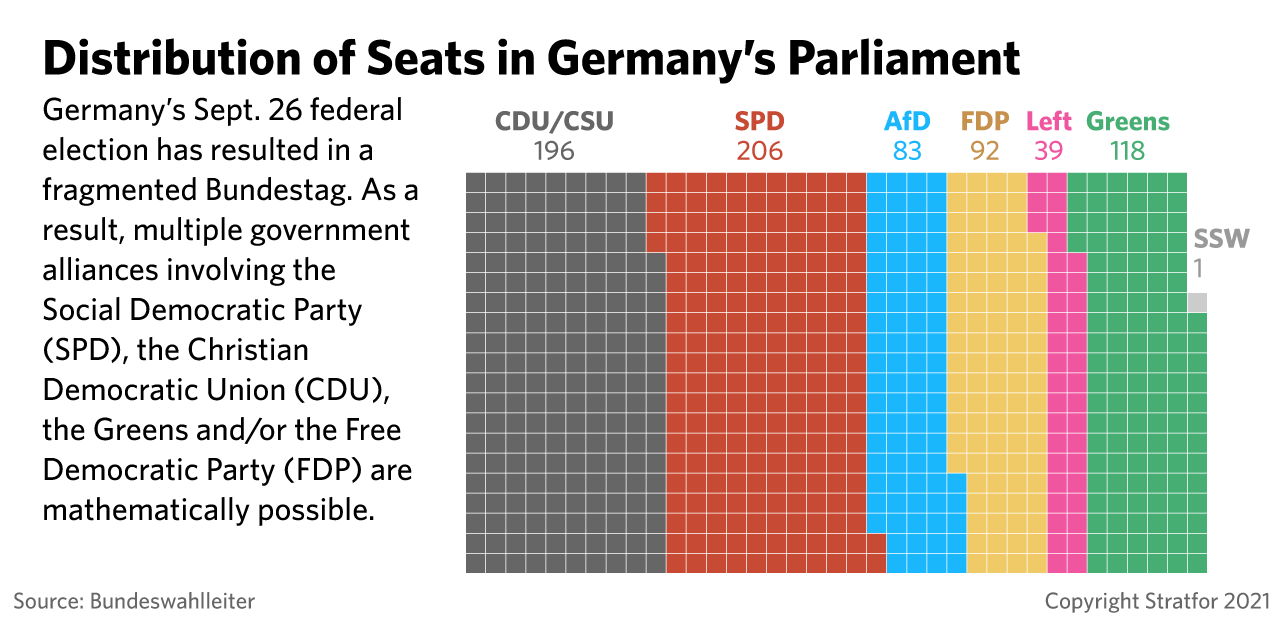
While the Greens and the FDP will be the kingmakers in the coalition talks, they have significant differences on fiscal and environmental policy that could slow down, and potentially derail, the negotiations. In the coming days, the SPD and the CDU will reach out to the Greens and the FDP to offer them concessions about the issues they care about (environmental policy in the case of the Greens and fiscal policy in the case of the FDP). But in addition to their ideological differences with the SPD and the CDU, the Greens and the FDP may clash with each other over whether they can be in the same coalition. The Greens are ideologically close to the SPD when it comes to fiscal policy, as they both support higher taxes for the rich, higher public spending (in part to pay for environmental policies), and deeper financial integration in the European Union. The FDP is close to the CDU on issues such as preserving Germany’s constitutional debt brake and reducing the country’s fiscal deficit, as well as opposing tax hikes in Germany or granting the European Commission the permanent power to borrow on financial markets on behalf of EU member states.
- FDP leader Christian Lindner has stated that he wants to be Germany’s next finance minister in order to make sure that the country reduces its fiscal deficit and opposes further fiscal integration in the European Union. This could result in domestic disputes with the Greens and the SPD, as well as clashes with southern European governments such as France and Italy, which want to soften the bloc’s rules on debt and deficit.
- While the Greens are likely to request cabinet positions that will allow them to implement their environmental agenda, many of their policy proposals will clash directly with the FDP’s fiscal conservatism. Moreover, the FDP defends an environmental policy that is based on innovation and a reduction of red tape in the German economy, as opposed to the Greens’ significant focus on regulation and a fast energy transition.
- The FDP and the Greens have both spoken in favor of a values-based foreign policy that puts human rights issues at its core. This means that if either party gets the foreign ministry position, it could result in tenser ties with the likes of China and Russia.
- The SPD and the Greens are skeptical of increasing Germany’s defense spending, while the CDU and the FDP are more willing to meet NATO’s target of spending at least 2% of GDP on defense. But there is a broad consensus among all four parties about Germany’s membership in the military alliance.
The election confirmed Germany’s ongoing political fragmentation, which will make it hard for the next government to implement a cohesive policy and will increase the risk of political crises. The complexity of Germany’s current political landscape means that the coalition talks will last into late 2021 or early 2022, and that Angela Merkel will remain in power as acting Chancellor for several more weeks. This, in turn, will slow down policymaking in the European Union, as Brussels is likely to delay any meaningful reforms until the new government in Berlin takes over. After a government is formed, the three members of the coalition may find it hard to coordinate their policies and come up with shared decisions because of their ideological heterogeneity. As a result, the risk of the German government collapsing and calling for an early election (which has been very low for decades) will increase under the next coalition.
- After the 2017 federal election, it took six months for German parties to form a government. Initial coalition talks between the CDU, the Greens and the FDP collapsed because of policy disagreements between the Greens and the FDP. As a result, the CDU had to form a “grand coalition” with the SPD.
- While Germany’s political landscape is becoming more fragmented, the far-right Alternative for Germany (AfD) and especially the far-left Die Linke lost seats in the Bundestag compared to the previous election, illustrating widespread support for centrist parties in Germany.
