
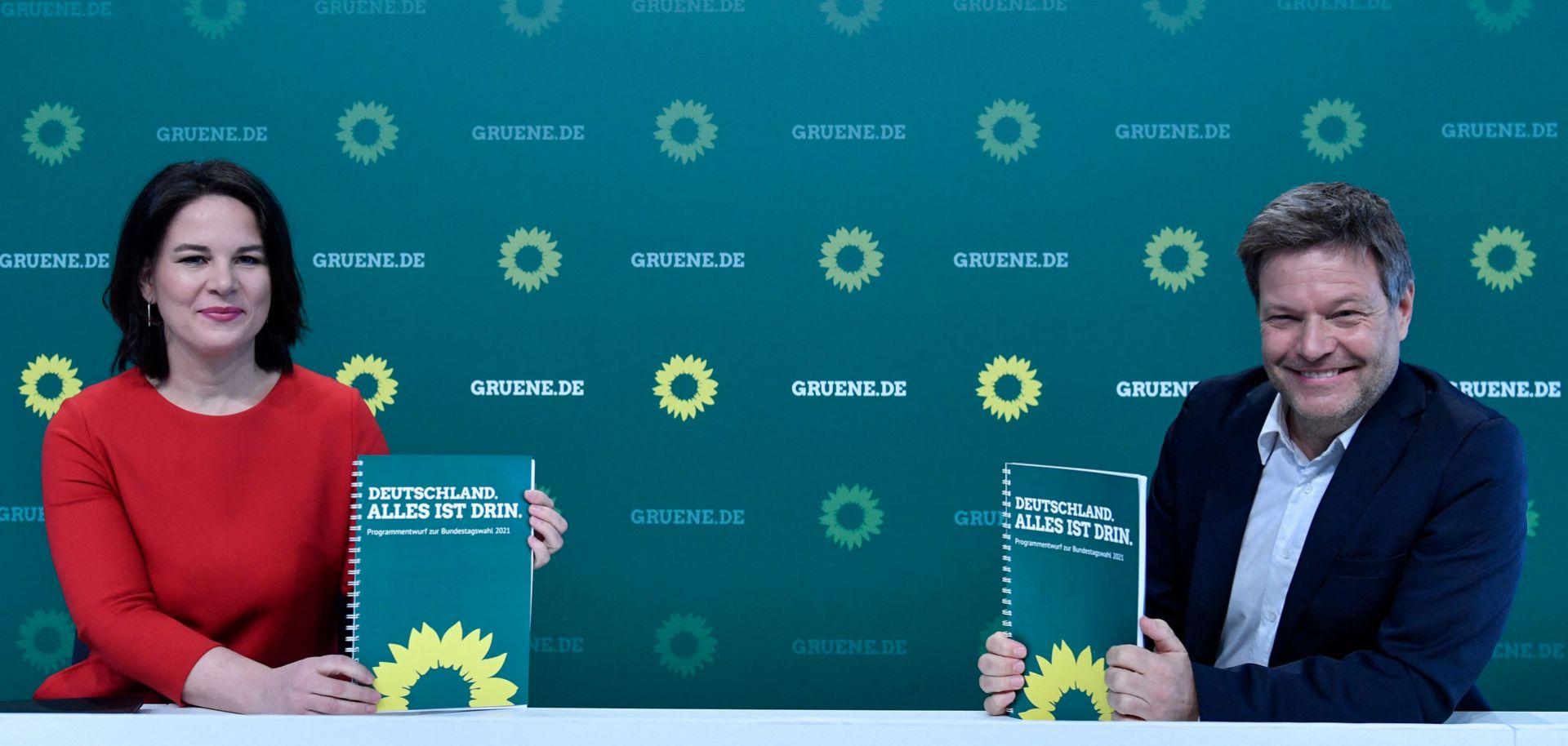
The increasing popularity of pro-environment policies makes the Green party a viable coalition partner for both the center-right CDU and center-left SPD.
The rising popularity of Germany’s Green party is increasing the possibility of it becoming a central player in the formation of the next German government. If the party enters the government, would increase Berlin’s focus on environmental policies and higher fiscal spending, though the depth of those policies and how fast they are implemented will depend on the ideological composition of the coalition. The Greens’ internal divisions and position on issues such as foreign policy could also create political instability and impede the policymaking process in Berlin. Germany will hold a federal election on Sept. 26, the first in two decades where Chancellor Angela Merkel won’t be a candidate. Because of Germany’s proportional electoral system, the election will be followed by long negotiations to form a government, which will be a coalition of two or more parties. Polls still put Merkel’s conservative Christian Democratic Union (CDU) in the first position, but the Greens are polling in the second position, followed by the center-left Social Democratic Party (SPD). The Greens emerged in the 1980s as a counterculture movement with a radical pro-environment agenda, but over time, the party’s leadership has moved toward more moderate positions. This makes them a viable coalition partner for both center-right and center-left parties and a potential kingmaker after the federal election.
- Two decades in power and anger over a recent face mask procurement scandal has compounded frustration with the CDU, which has seen its polling numbers fall in recent months. The CDU’s preferred coalition partner is the pro-business FDP, but a CDU-FDP alliance may not control a majority of seats in the Bundestag.
- The Greens are on the rise. The party won the regional election in Baden-Wuerttemberg on March 14, where it received 32.6% of the vote.
- Alliances between parties with different ideologies are common in Germany. The Greens have shared regional governments with both the CDU and the SPD, which means that the party will consider center-right and center-left alliances at the federal level after the September election.
A coalition that includes the CDU and the Greens would result in a more balanced approach between environmental policies and business interests, but the parties would likely clash over the issue of fiscal spending. The CDU’s pro-business faction has traditionally been skeptical of an alliance with the Greens for fear of harming Germany’s industrial competitiveness. But in recent years, the CDU has given a greater importance to climate change to reflect the general shift in favor of pro-environment policies among German voters. The Greens’ policy influence in a potential coalition with the CDU would depend on the number of seats in the Bundestag they control. While the CDU could accept to push for a faster energy transition through taxation, emissions trading and financing of certain activities, it would resist the Greens’ push to over-regulate the economy and significantly increase state intervention to make that transition faster. The CDU is also likely to resist any significant expansions in welfare spending that would result in a high fiscal deficit.
- CDU leader Armin Laschet has promised that the party’s campaign platform for the Sept. 26 federal election will prioritize the fight against climate change, which opens the door to coalition talks with the Greens after the vote.
- After the 2017 federal election, coalition talks between the CDU, the Greens and the FDP collapsed, in part because the Greens pushed for a much faster phasing out of coal power plants and internal combustion automobiles, as well as a softer immigration policy than the CDU and FDP wanted. Similar issues could disrupt coalition talks again between the CDU and the Greens after the next federal election.
- Even if the CDU and the Greens agree on a government program, public spending could become a source of friction between them. Some voices within the CDU have recently spoken in favor of getting rid of Germany’s constitutional debt brake (which limits the federal government’s room to borrow from financial markets), as well as abandoning the party’s traditional position in defense of a balanced budget. But the CDU’s official position remains supportive of reducing Germany’s debt and keeping the fiscal deficit at zero, which goes against the Greens’ agenda.
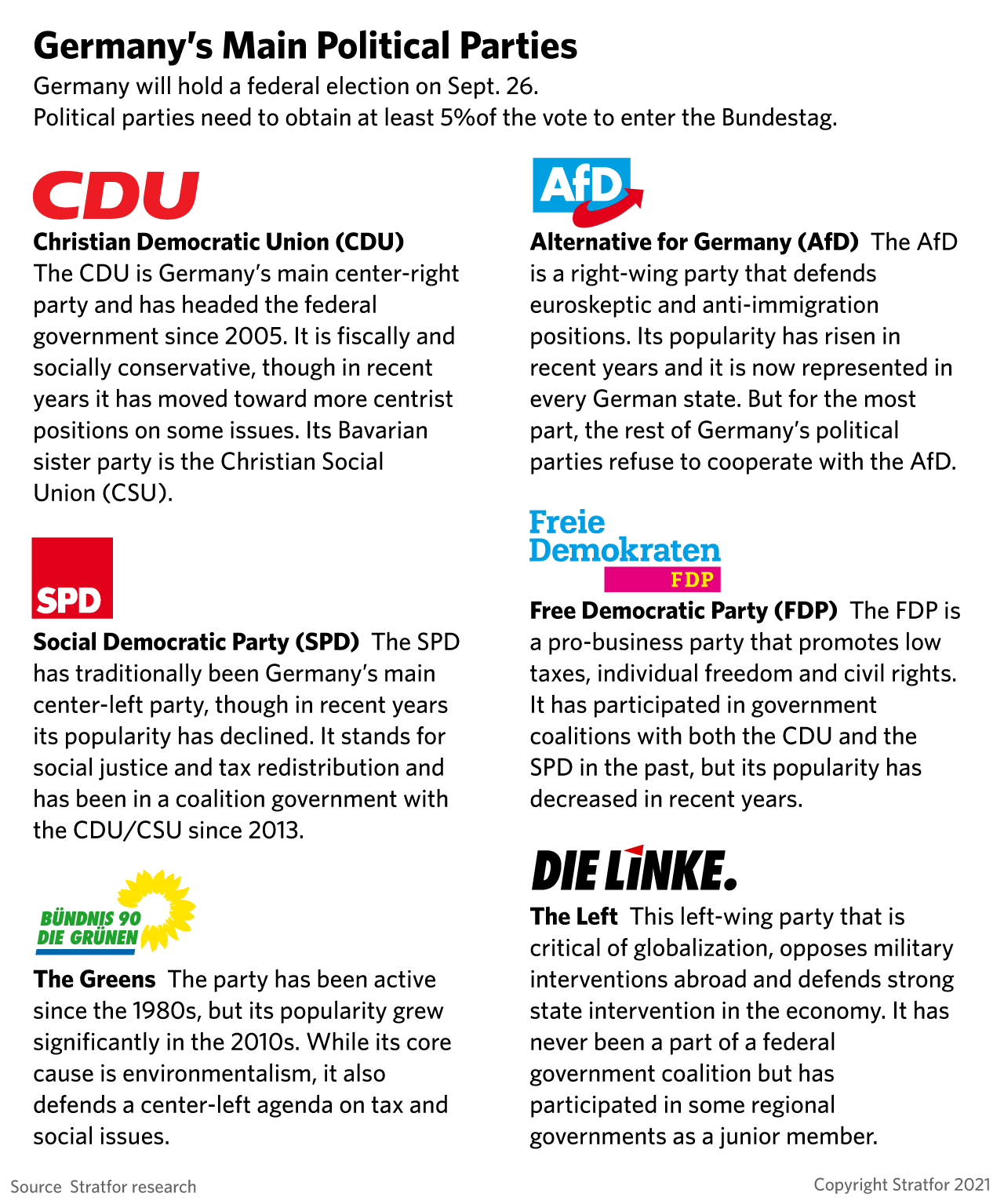
A coalition that includes the Greens and the SPD would result in a stronger push for the energy transition and a significant increase in public spending to expand the welfare state, which would come at the cost of higher taxes for large companies. The Greens are ideologically close to the SPD on several issues, but an alliance between the two parties may not be enough to appoint a left-leaning government. But if it is, a substantial share of government spending would go to subsidies for environmentally-friendly activities and mitigating the social impact of a quicker energy transition. Such a government would also push for a higher minimum wage, a lower retirement age and higher welfare contributions by companies. As a result, there would probably not be significant tax cuts in Germany while large corporations and wealthy households would actually see higher taxes. Compared with a coalition that includes the Greens and the CDU, a coalition with the Greens and the SPD would also be more willing to accelerate Germany’s economic integration in the European Union and increase EU spending across Europe.
- The SPD supports the European Union’s goal of taking carbon emissions to zero by 2050 (LINK: What the EU Green Deal Means For Governments and Companies) and reducing them by 55% from 1990 levels by 2030.
- In February, the SPD promised to put the reduction in carbon emissions at the center of its 2021 electoral campaign. Some of the party’s proposals include expanding the use of public transportation and increasing the use of renewable energy.
- While the SPD’s has pledged to also fight against climate change, the core of its platform is focused on other issues, such as increasing welfare spending, introducing higher taxes for high earners, raising pensions and the minimum wage, and building affordable housing.
The Greens’ internal divisions, limited experience in the federal government and positions on issues such as foreign policy and defense could make any coalition that it joins unstable. The Greens hold seats in 14 of Germany's 16 state legislatures and is a member of regional coalition governments in 11 states, which reflects the party’s pragmatism and ideological flexibility. But the party also has two leaders, and some of its members have criticized the current moderate and pragmatic political strategy. This means that the party’s unity could break over controversial votes in the Bundestag and that issues that are outside the party’s “traditional” platform (such as foreign policy or military spending) could create internal divisions. Some Green members of parliament and ministers could also exit a coalition government if they consider that the energy transition is not happening fast enough. These issues are likely to be particularly problematic in a center-right coalition, where the ideological alignment would be weaker, and could severely slow down the policymaking process in Germany.
- The Greens were in a coalition government at the federal level with the SPD between 1998 and 2005. During that period, the party had several internal crises and disputes with the SPD over Germany’s involvement in NATO missions and former Chancellor Gerhard Schroder’s push to reform the German welfare system and labor market.
- The Greens want the United States to remove the nuclear warheads it has stationed in Germany. Some factions of the party also oppose meeting NATO’s target of spending at least 2% of the country’s GDP on defense.
