
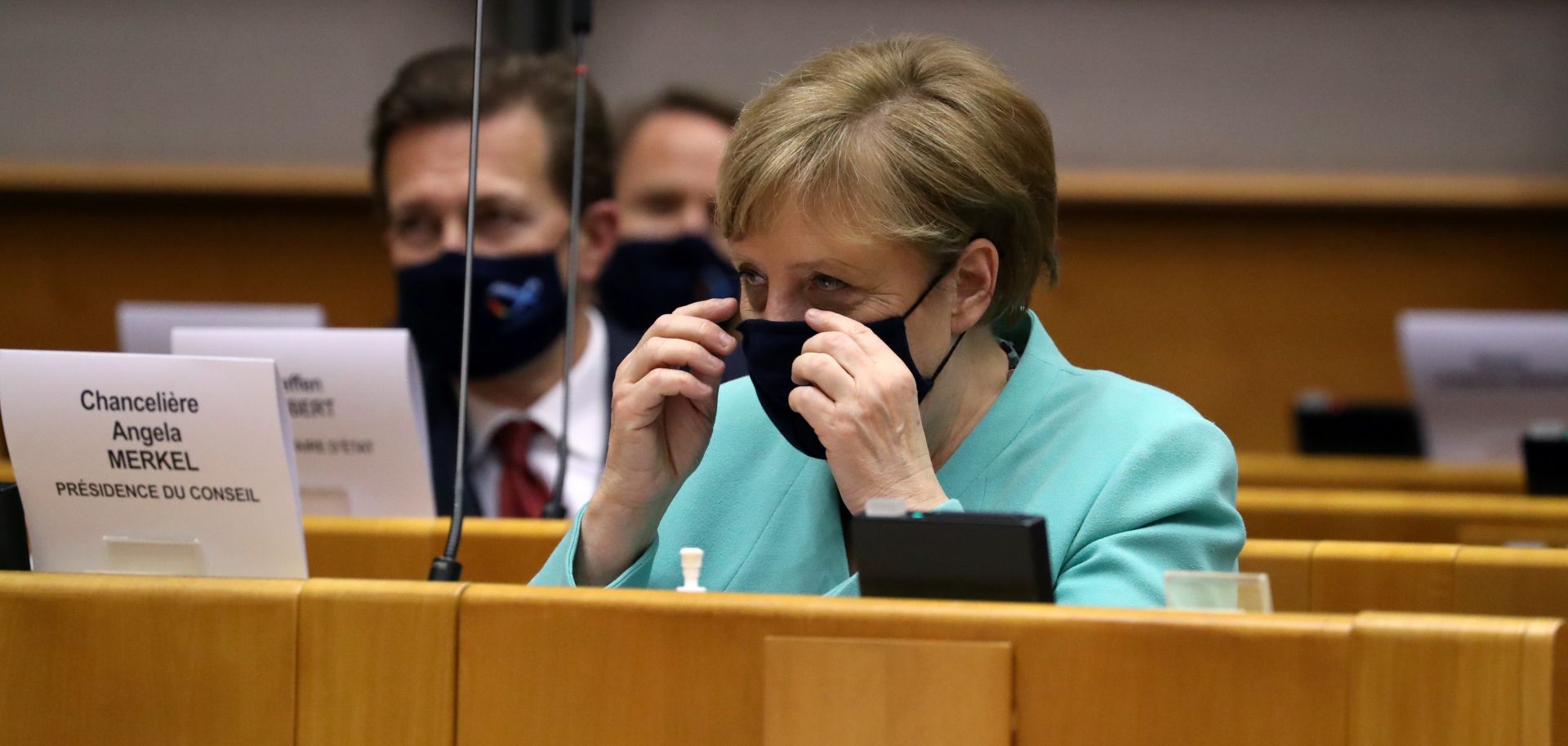
German Chancellor Angela Merkel wears a protective face mask as she attends a plenary session at the European Parliament in Brussels, Belgium, on July 8, 2020.
Disputes between outgoing German Chancellor Angela Merkel and her potential successor will likely lead to an ineffective government ahead of Germany's next parliamentary election, which will take place in late 2021 and could result in the collapse of the country's ruling coalition. In addition to reducing Berlin's ability to manage the economic fallout from COVID-19, this period of political turbulence will also slow the European Union's policymaking process as the rest of the bloc refrains from making meaningful decisions until its largest economy appoints a new government.
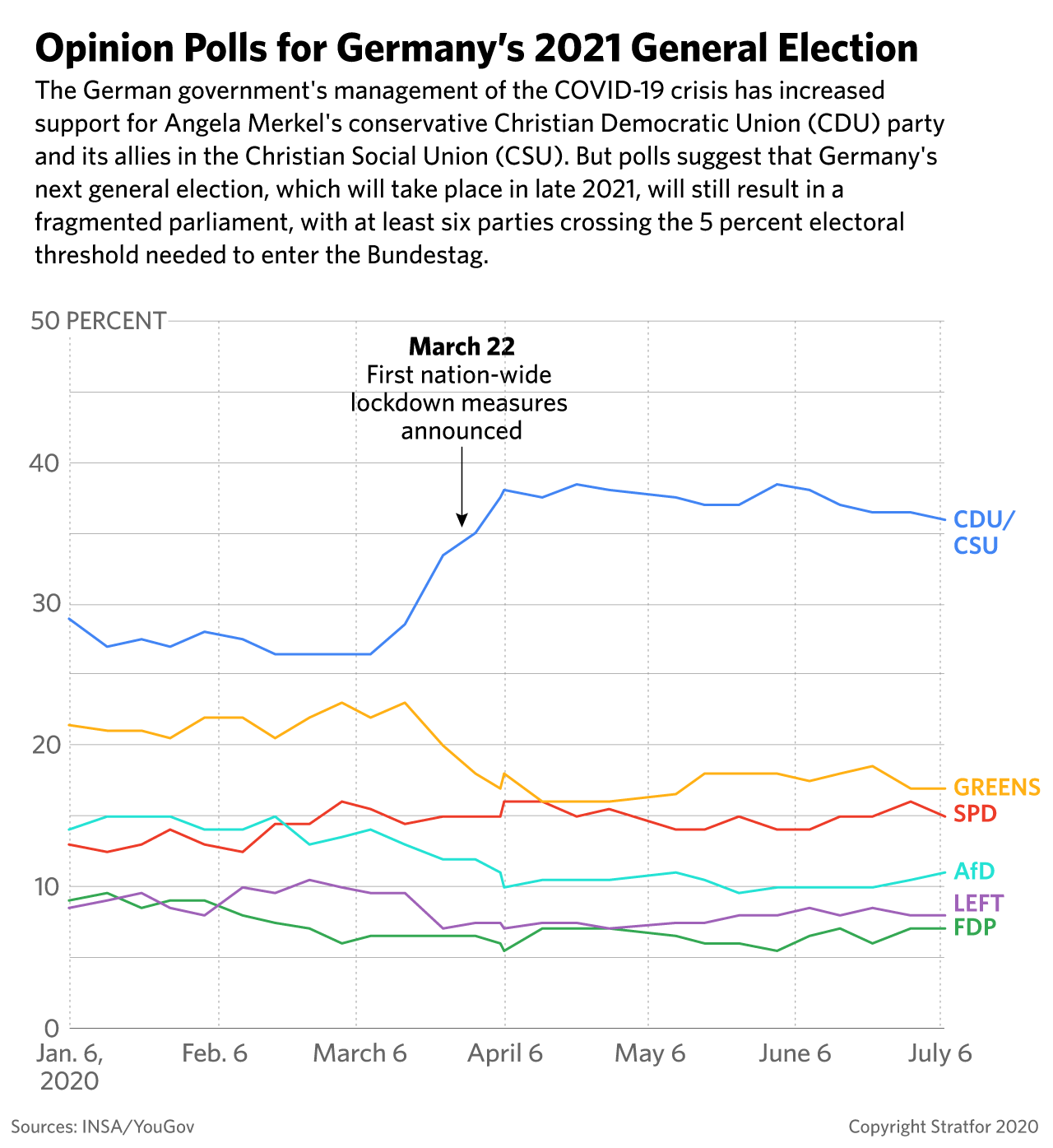
The COVID-19 outbreak has strengthened Merkel's popularity and reduced disputes within Germany's governing coalition between her conservative Christian Democratic Union (CDU) party and the center-left Social Democratic Party (SPD).
- Prior to the emergence of the outbreak, Merkel's popularity had been declining after 15 years in power. Constant internal disputes over fiscal policy — with the CDU wanting to keep a balanced fiscal deficit and low debt levels, while the SPD pushed for higher public spending — had also made Merkel's coalition government increasingly fragile.
- But the German government's relative success in handling the country's COVID-19 crisis has since renewed support for Merkel and reduced tensions between the CDU and the SPD by forcing them to quickly agree on economic relief measures.
Merkel's decision not to seek re-election in the next parliamentary election in late 2021, however, will likely end this period of political calm.
- In 2018, Merkel resigned from her position as CDU leader and announced she would not seek re-election when her current term ends in 2021 (the next general election must take place between August and October of 2021).
- The CDU must now appoint another leader, who will also probably serve as the party's candidate for the chancellorship in the next parliamentary election.
The cohabitation between Merkel and a newly appointed CDU leader between January and the 2021 general election could reduce the effectiveness of the German government by spurring internal party disputes.
- The appointment of a new leader is a risky electoral move for the CDU because none of the current candidates are as popular as Merkel, who has been the face of German politics for the past 20 years.
- The new CDU leader will likely try to differentiate themselves from Merkel on certain policy areas in order to develop their own political identity ahead of the election.
- Some CDU factions may pressure Merkel to change her mind and seek re-election, which would only increase intraparty divisions. While Merkel is unlikely to run again in 2021, this scenario cannot be ruled out if the CDU's popularity decreases significantly under the new leader.
If intraparty disputes become unsustainable, the new CDU leader could pressure Merkel to resign and hold an early general election, which she may agree to in order to reduce the time she would spend as a weakening leader.
- An early general election would reduce the cohabitation period between Merkel and the new CDU leader and accelerate the process to appoint a new government. This would also somewhat concentrate political uncertainty and shorten the amount of time Germany would spend under an ineffective government.
- Merkel's resignation, however, may not immediately lead to an early election, as there's a chance German President Frank-Walter Steinmeier could first present a chancellor candidate for the Bundestag to approve.
Germany's next general election will likely result in a fragmented Bundestag and long negotiations between parties to appoint a new government regardless, freezing the policy process for months.
- The last general election in 2017 produced the most fragmented parliament since Germany's reunification in 1990, and opinion polls suggest this trend will continue in 2021.
- Merkel's personal popularity is higher than that of the CDU, which means that the new party leader may struggle to win a clear victory in the next general election.
A more ineffective German government would reduce Berlin's ability to introduce the reforms needed to reactivate economic growth amid the country's pandemic-induced recession.
- According to the European Commission, the German economy will contract by 6.3 percent in 2020, with a recovery of only 5.3 percent in 2021.
- Internal disputes within the CDU about whether to introduce fiscal reforms and new stimulus measures, in addition to renewed frictions with the SPD in an electoral year, could slow down the policy process in Germany.
Germany's focus on domestic politics could also slow down the policymaking process at the EU level, as the bloc's institutions and member states many postpone any meaningful decisions until a new German government is in place.
- The COVID-19 crisis has already caused the European Union to postpone several policy decisions for 2021 in areas ranging from climate change to competition rules.
- The European Commission will push to move forward with its policy plans in 2021, but a power vacuum in Germany will complicate Brussels' strategy.
- This will also reduce the bloc's ability to elevate its role on global affairs regarding slow economic growth, escalating trade disputes and greater competition between the United States, China and Russia.
- France will try to take advantage of Germany's distraction from EU affairs, but President Emmanuel Macron's own increasingly unpopular and ineffective government will limit its room for influencing the direction of EU policy.
