
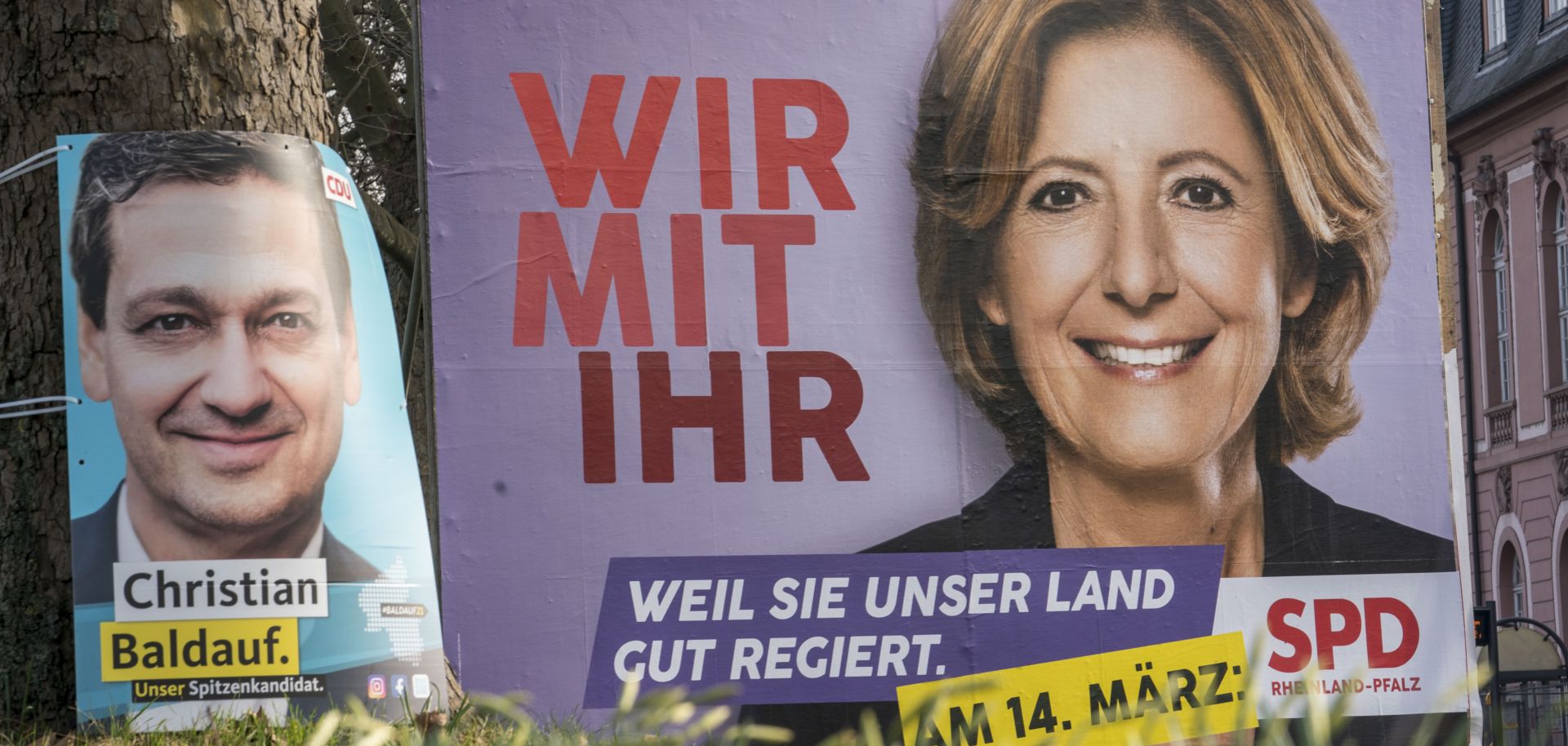
Campaign billboards featuring candidates from Germany’s Social Democratic Party (right) and Christian Democratic Union (left) are seen in the German city of Mainz on March 3, 2021, ahead of state elections.
billboards in Mainz on March ahead of Rhineland-Palatinate state elections.
Two regional elections on March 14 will test the popularity of Germany’s political parties ahead of the country’s first federal election in two decades where Chancellor Angela Merkel won’t be on the ballot. The outcome will also influence the decision on who Merkel’s governing Christian Democratic Union (CDU) picks as its chancellor candidate. Germany’s Sept. 26 federal election will likely result in a fragmented parliament and months of negotiations to form a coalition government. Though voters make their choices based on a combination of national, regional and local issues, regional elections tend to have an impact at the federal level, which makes the upcoming votes in Baden-Wuerttemberg and Rhineland-Palatinate worth watching to get a read on Germany’s political landscape before the federal election.
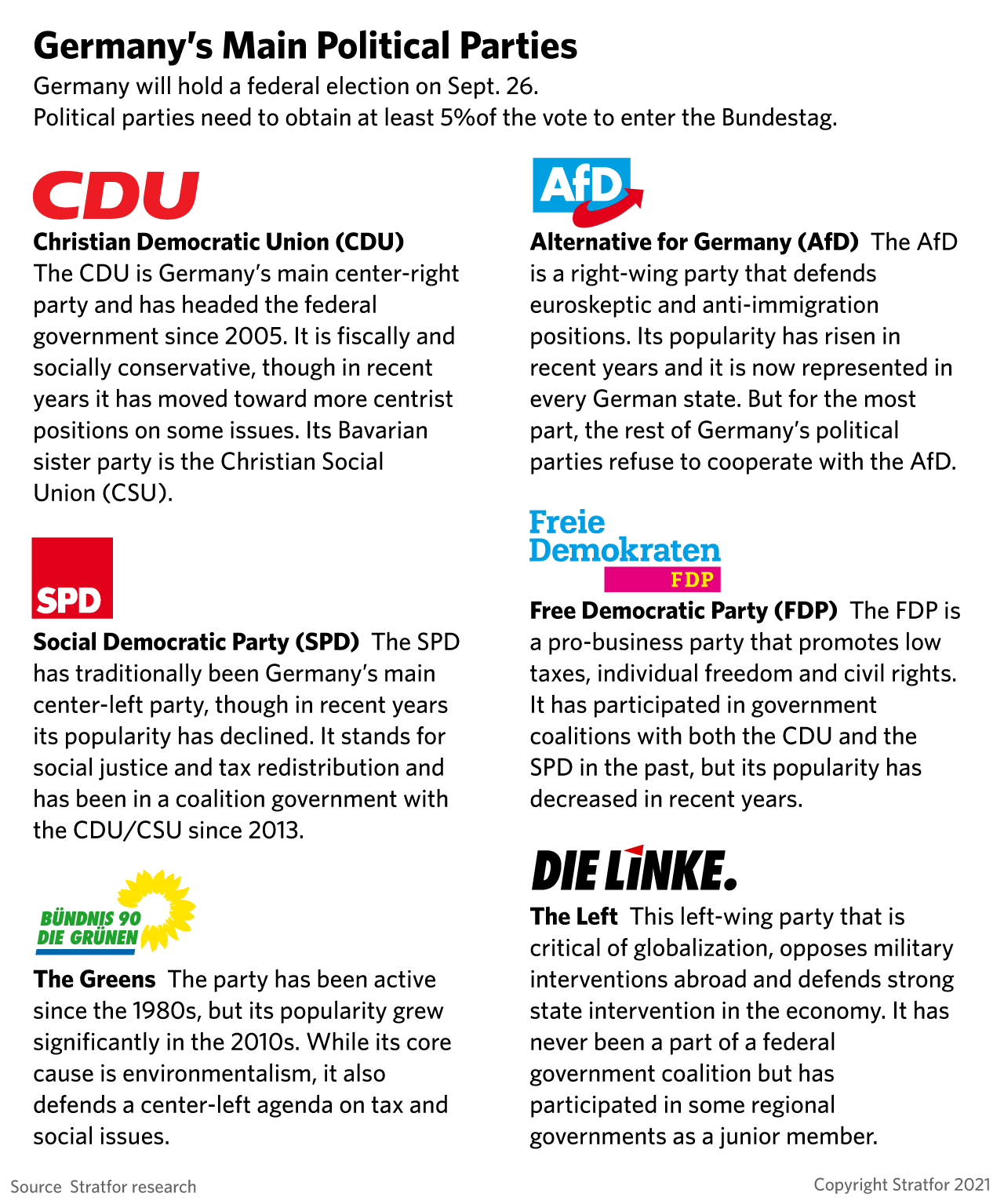
- Opinion polls suggest that Merkel’s center-right CDU party and its Bavarian sister party, the Christian Social Union (CSU) will win the next federal election, followed by the pro-environment Greens and the center-left Social Democratic Party (SPD).
- Smaller parties including the far-right Alternative for Germany (AfD), the left-wing Die Linke and the pro-business Free Democratic Party (FDP) are also expected to enter the Bundestag.
- After the 2013 federal election, the negotiations to form a coalition government took three months, while after the 2017 election they took six months.
A strong performance by the Greens in their Baden-Wuerttemberg stronghold would confirm their ambitions of entering the German government after the federal election. The Greens’ national popularity has grown significantly in recent years, to the point that they stand a significant chance of entering the next federal government. With more than 11 million people, Baden-Wuerttemberg is the third-largest of Germany’s 16 states by population and a significant electoral battleground. As a result, a victory in this state would confirm the Greens’ strong chances at the federal level. The Greens also have their only minister-president, Winfried Kretschmann, in this state, which further enhances the political importance of the regional election. Moreover, the Greens govern Baden-Wuerttemberg in an alliance with the CDU, something that has never happened at the federal level but could happen after the September vote.
- Opinion polls suggest that the Greens will receive between 31 and 33% of the vote in Baden-Wuerttemberg, an improvement from the already strong 30.3% they received in the 2016 regional election.
- Though improbable, any regional governments that do not include the Greens would represent a significant political defeat for the party that could have national repercussions.
A weak performance by the SPD in the Rhineland-Palatinate regional election would further weaken the party’s leader and Germany’s current finance minister, Olaf Scholz, at a time when the SPD is already struggling at the federal level. Rhineland-Palatinate is the sixth-largest of Germany’s 16 states by population, with more than 4 million people. The SPD governs the state in a coalition with the Greens and the FDP. The SPD is particularly popular in this state, but polls suggest the party could struggle to repeat its results in the 2016 regional election. A weaker SPD may result in Scholz pushing for additional rounds of fiscal stimulus at the federal level, which could lead to frictions with the fiscally conservative CDU/CSU.
- The SPD received 36.2% of the vote in the Rhineland-Palatinate regional election in 2016. By contrast, in the 2017 federal election, it only received 20.5% of the vote.
- Recent opinion polls suggest that the SPD could receive between 30-33% of the vote in the Rhineland-Palatinate regional election.
- Polls also suggest that the Greens could receive around 12% of the vote in Rhineland-Palatinate, up from 5.3% in 2016. This makes a continuation of the Greens’ alliance with the SPD in the regional government likely, while also cementing the Greens’ already strong popularity at the federal level.
The regional elections in Baden-Wuerttemberg and Rhineland-Palatinate will influence the CDU/CSU’s decision on who should be their chancellor candidate in September. Considering that the CDU/CSU stands a strong chance of leading the next German government, this decision could ultimately impact the country’s future policy direction. The CDU appointed the moderate Armin Laschet as party leader in January. According to CDU tradition, the party leader is also the chancellor candidate. But some party members believe the CDU should appoint somebody else as chancellor candidate if that increases the probability of winning the election. Bavaria’s popular prime minister, Markus Soder, is seen by some conservatives as a better candidate than Laschet. A weaker-than-expected CDU performance in the March 14 regional elections will strengthen the anti-Laschet camp. The Baden-Wuerttemberg and Rhineland-Palatinate votes will also show the extent to which the recent corruption scandals involving conservative members of parliament have affected the CDU’s popularity.
- If Laschet is the CDU/CSU candidate in the federal election, his centrist positions will make a government coalition with the Greens more likely than if the center-right Soder is the candidate.
- If Soder or somebody closer to the more conservative sectors of the CDU/CSU is the chancellor candidate, they may opt to form a coalition with the CDU/CSU’s natural partners, the pro-business FDP. But this will depend on the FDP’s performance in the federal election, as the party may not win enough seats in the Bundestag to be a realistic coalition candidate.
- On March 8, Nikolas Lobel, a lawmaker from the CDU, announced his resignation from the Bundestag with immediate effect. Georg Nuesslein, a lawmaker from the CSU, also recently announced plans to step down from his seat in parliament after the federal election in September. Both politicians have been accused of getting large commissions for acting as middlemen on deals to procure face masks during the first wave of the COVID-19 pandemic.
