
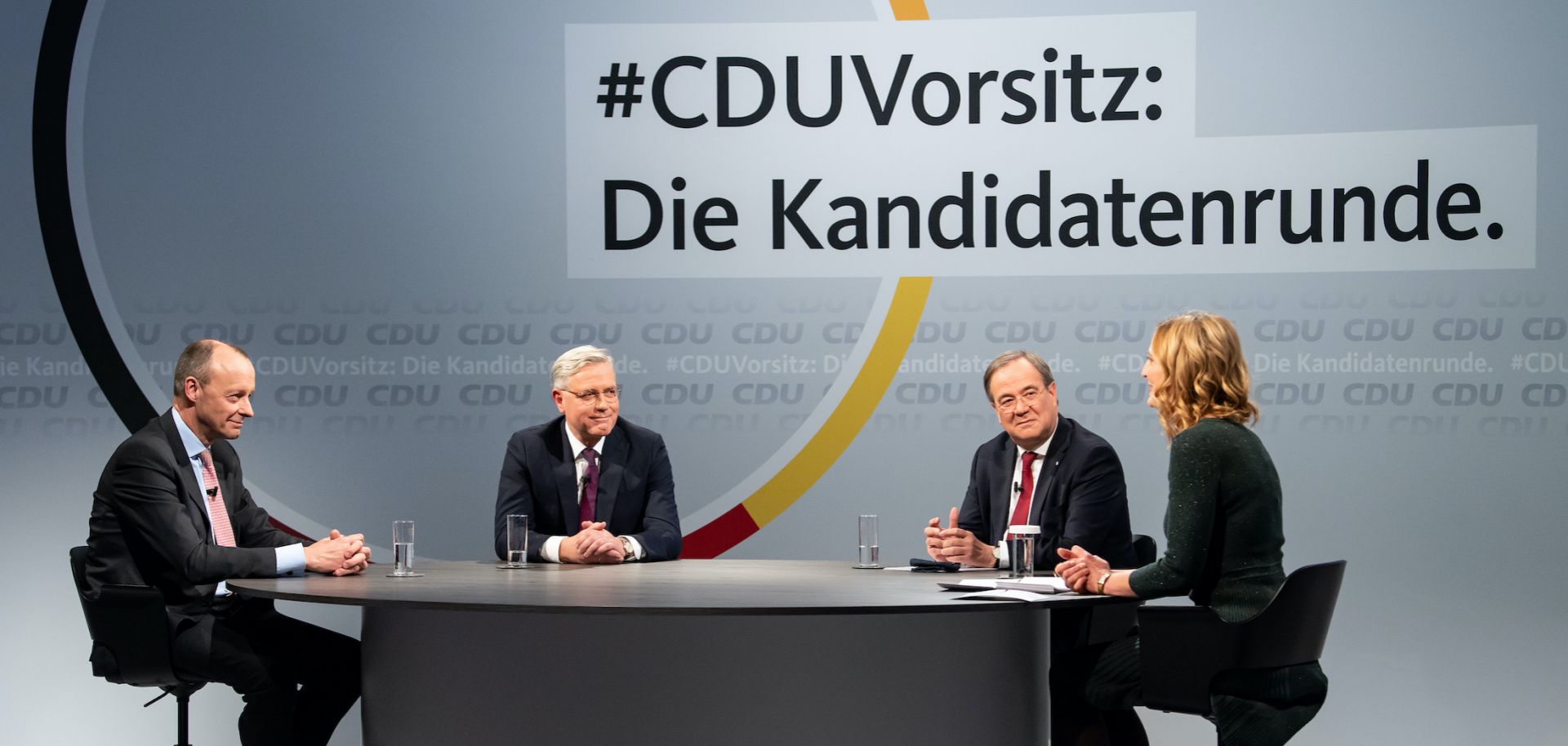
German journalist Tanja Samrotzki (right) moderates a panel with the candidates vying for the leadership post of Chancellor Angela Merkel’s Christian Democratic Union (CDU) party -- Friedrich Merz, Norbert Roettgen and Armin Laschet (from left to right) -- on Dec. 14, 2020, in Berlin, Germany.
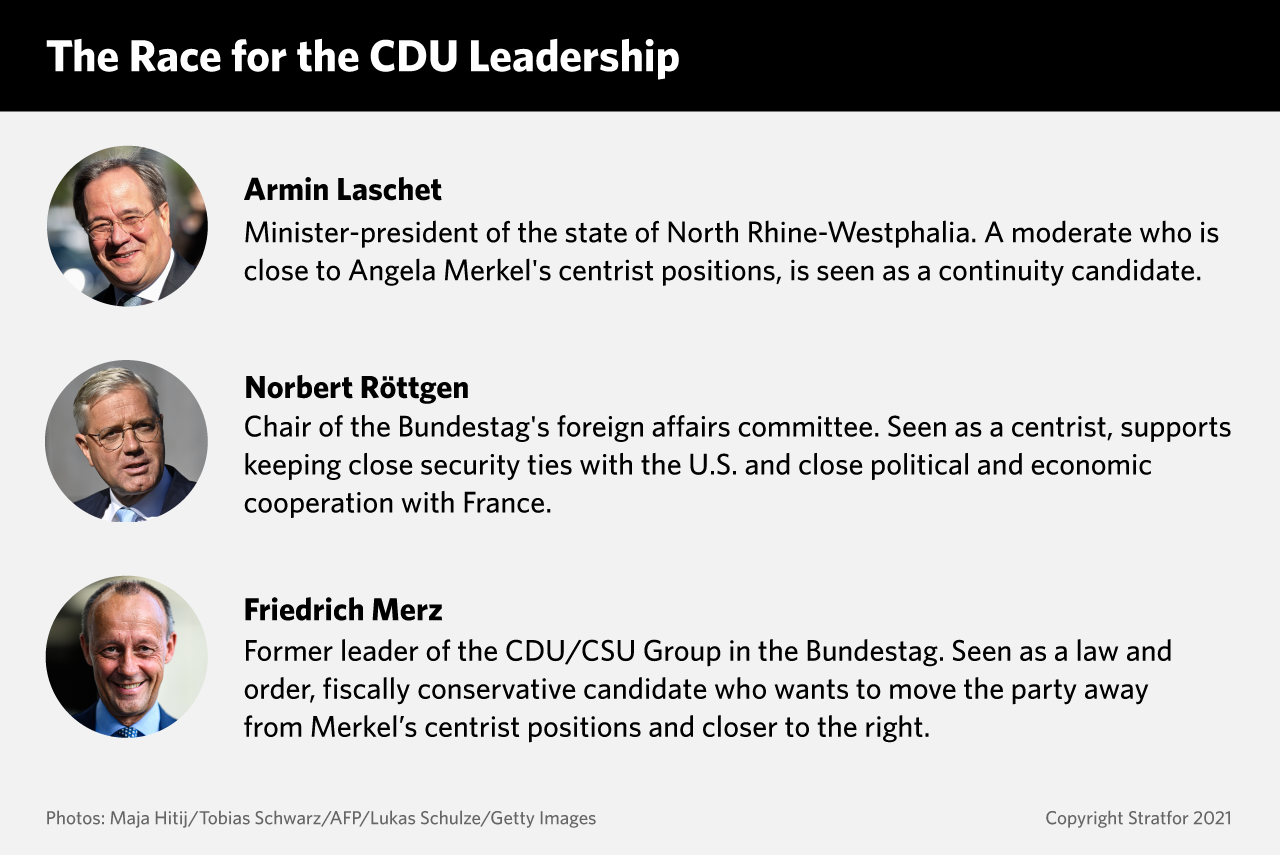
German Chancellor Angela Merkel’s conservative Christian Democratic Union (CDU) party will elect a new leader on Jan. 15-16. The ideological orientation of the new CDU leader could influence Germany’s domestic politics, as well as its relations with the European Union. The CDU is Germany’s most popular party and its leader stands a strong chance of becoming the country’s next chancellor after the Sept. 26 general election. In 2018, Merkel resigned as CDU leader and announced she would not seek another term as chancellor in 2021. There are three candidates vying to lead the CDU next — Armin Laschet, Norbert Rottgen and Friedrich Merz — with polls suggesting that the election could be close.
According to CDU tradition, the next party leader should also be the candidate for chancellor. But some members of the party are questioning this principle, which could open the door for politicians including Jens Spahn, Germany’s popular health minister, and Markus Soder, Bavaria’s Minister-president, to run for the chancellorship. The CDU and its Bavarian sister party, the Christian Social Union (CSU), will decide on their joint chancellor candidate by mid-2021. Of the three candidates to lead the CDU, Merz is the least likely to accept somebody else being the chancellor candidate in September.
Opinion polls suggest that the September general election will result in a fragmented Bundestag and complex negotiations to form a coalition government. The ideological orientation of the CDU candidate will influence those negotiations. Polls currently put the CDU/CSU at 36-37%, followed by the Greens at 18-20% and the center-left Social Democratic Party (SPD) at 14-15%. Should Merz become the CDU candidate for chancellor, the probability of a coalition agreement with the SPD or the Greens will be low. Lengthy negotiations to appoint a new government would result in political paralysis in Germany at a time when the economy will be still be reeling from the repercussions of the COVID-19 crisis. It would also slow down the policy-making process in the European Union, as no significant decisions would be made in Brussels before knowing what the German government looks like.
- After Germany’s 2013 general election, it took almost three months to form a coalition government between the CDU and the SPD. And after the 2017 general election, it took almost six months to form a coalition government, with the CDU ultimately forming another coalition with the SPD after its negotiations to form one with the Greens and the Free Democratic Party failed to produce an agreement.
- Opinion polls suggest that a coalition of center-left parties (such as the SPD, the Greens and The Left) is currently improbable. But an unpopular CDU chancellor candidate could improve the chances of the center-left forming a coalition to exclude the CDU. A center-left government would be more willing to increase public spending and deepen financial integration in the eurozone.
- Regional elections in the states of Baden-Wurttemberg and Rhineland-Palatinate on March 14 will test the popularity of Germany’s parties ahead of the general election in September.
The CDU is broadly supportive of the European Union, but if Merz becomes chancellor, his skepticism about deeper eurozone integration and his conservative fiscal policy views could make cooperation with the bloc more difficult. In her 16 years in power, Merkel brought the conservative CDU more to the center through moves such as the introduction of a minimum wage, the promotion of environmentally-friendly policies, the opening of Germany’s borders to roughly a million Syrian asylum seekers, and the temporary suspension of the “black zero” fiscal policy to allow for higher public spending. Merkel was also supportive of eurozone integration, authorizing large bailout programs for southern European countries and, more recently, defending an ambitious program of grants and loans to boost economic growth in the bloc amid the ongoing COVID-19 pandemic. Merz, however, believes these more centrist policies have resulted in CDU voters migrating to the far-right Alternative for Germany party, and has pushed for a return to fiscal discipline and a more cautious approach to eurozone integration, as well as tougher positions on issues like immigration and security.
- In June, Germany introduced a 130 billion euro package to boost economic activity in the middle of the COVID-19 pandemic. In July, Germany then supported a 750 billion euro COVID-19 relief fund in the European Union, including the authorization for the European Commission to borrow from debt markets.
- In the coming years, the European Union will discuss issues including the completion of the banking union and the introduction of a capital markets union. Germany’s position on both issues will be crucial for the implementation of both of those plans.
