
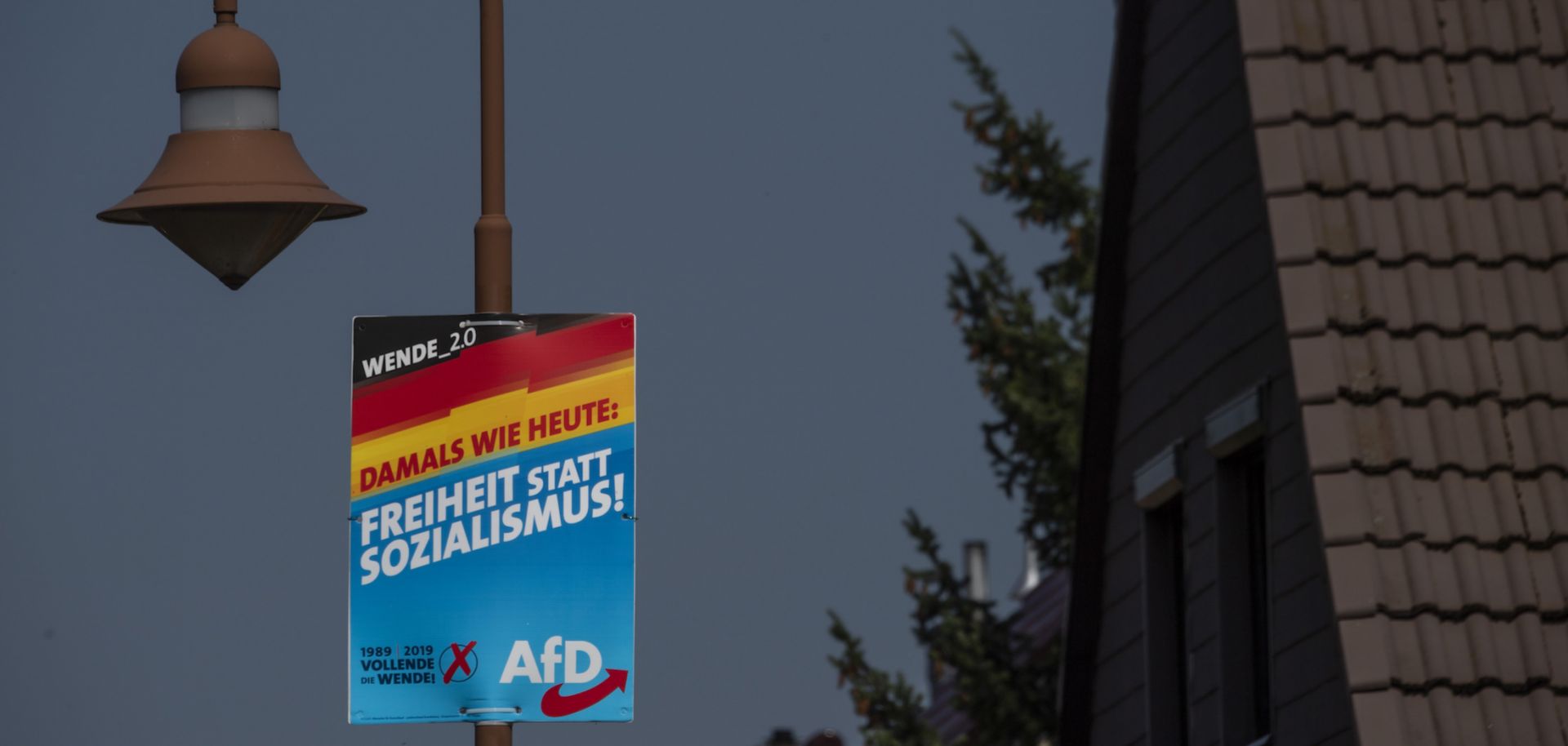
A campaign poster for the far-right Alternative for Germany (AfD) reads "Freedom instead of socialism" in Krewelin, Germany, ahead of state elections on Sept. 1, 2019.
The far-right Alternative for Germany (AfD) party may soon be designated as a “suspected case” of extremism, which would do short-term harm to the AfD’s electoral chances, while amplifying broader disputes on regulating speech that the party could then exploit to sustain long-term relevance. According to press reports, Germany’s domestic intelligence service, the Federal Office for the Protection of the Constitution (BfV), is preparing to announce whether it will treat the whole AfD as a threat to the country due to the growing influence of right-wing extremism (RWE) within the party. Doing so would allow the BfV to covertly surveil the AfD and its members, after a two-year investigation and a series of escalating measures. The BfV reportedly has identified numerous instances in which AfD politicians have used inflammatory, hateful language — often against immigrants and racial, ethnic or religious minorities — to promote RWE narratives that the BfV considers pose a national security threat, suggesting that the spy agency may take the unprecedented step.
- The BfV’s designation would enable it to conduct more intrusive surveillance, including hiring informants and, with parliamentary approval, monitoring communications to evaluate the AfD and consider whether to upgrade it from a “suspected case” to “proven extremist,” its severest designation.
- In January 2019, the BfV first publicly called the party a “test case,” the mildest in a three-tiered system. This designation enabled the spy agency to temporarily collect open-source information about the AfD, but a month later, the AfD won a legal challenge for defamation to overturn it.
- In the past two years, the BfV has successfully labeled certain AfD factions and regional parties as “suspected cases.” In March 2020, it classified a wing of the party as “proven extremist,” leading to its dissolution later in the year. Until now, however, the BfV has not considered applying the “suspected case” tag to the entire party.
The BfV’s classification would reinforce Germany’s resolve to combat RWE, particularly in government-linked entities, after a series of highly publicized violent attacks and threats. Since 2019, Germany has witnessed three deadly right-wing terrorist attacks, a string of violent but non-lethal attacks and many more disrupted plots. The country has also stepped up efforts to root out RWEs from its security forces amid growing concerns about insider threats.
- Last year, the head of the BfV and Germany’s interior minister, who oversees the spy agency, labeled RWE the biggest threat to German security, citing increases in the scale and scope of RWE activity. They expressed particular concern that the risk of violence was increasing as RWE narratives proliferated in mainstream society.
- Last summer, Germany’s defense minister dissolved one of the country’s four special operations forces units and began a complete overhaul of the other three following reports of a toxic leadership and culture that promoted RWE. Her decision accompanied the disclosure that more than 600 soldiers were being investigated for suspected RWE sympathies.
- In October 2020, the BfV released a report, based on a survey of police and intelligence agencies in the country’s 16 states and at the federal level, which revealed that nearly 380 officers in Germany had been investigated for RWE sympathies in the past three years.
The “suspected case” label would add to the AfD’s immediate challenges in upcoming elections. In 2017, the AfD capitalized on a wave of anti-immigrant and anti-Islam sentiment to become the third-largest overall and biggest opposition party in parliament, but since then, has struggled to overcome fading popularity during the COVID-19 pandemic and longstanding infighting that was amplified last year. This year, Germany will hold six state elections, starting with two states in the southwest of the country in March, before a general election in September.
- After polling around 15% nationally for most of the second half of 2019 and the start of 2020, support for the AfD fell as the pandemic set in and the latest surveys show it’s currently hovering around 10%. The party continues to poll best in central and eastern states, where the latter four of six state elections will occur, but has seen its support slip in those areas, too. In Thuringia, which will vote in April, the AfD made headlines last year after it helped to form a state government, breaking a national taboo on mainstream parties relying on far-right support. Being labeled as a “suspected case,” however, would severely reduce the possibility of future political pacts.
- Despite general popular support for the government’s strict measures to combat the pandemic, the AfD positioned itself in opposition to lockdowns and aligned itself with the controversial Querdenken movement, a diverse collection of right-wing groups that has attracted attention for its provocative and conspiracy-driven protests.
- The AfD has also suffered from its embrace of former U.S. President Donald Trump and broader populist-nationalist ideology. AfD leaders were hesitant to acknowledge Trump’s defeat in the November election. The same month, some AfD deputies were accused of inviting protesters into the German parliament building who went on to harass lawmakers, which later drew comparisons to the violent siege of the U.S. Capitol on Jan. 6.
- In the past year, internal AfD debates over how to respond to the pandemic magnified existing tensions between more extremist and moderate wings of the party. These burst into public view at a party conference in November when the AfD’s co-leader criticized its more extremist faction, leading the party’s parliamentary leader to claim that he had rejected half the party during his speech.
A move to declare the AfD a “suspected case” would also heighten ongoing debates over censoring speech, which the party could leverage to promote its cause beyond the 2021 elections. Labeling the AfD as such would add momentum to existing calls for social media firms to remove the party and its members’ accounts. This, however, would likely provoke pushback from an unlikely alliance across Germany’s political spectrum that is concerned about online censorship and the power of technology companies, even if many of those concerned do not support the AfD. In light of the AfD’s potential labeling, proposed legislation to combat online hate speech, which updates a 2017 law requiring social networks to provide police data on users who post threats or incite hatred, would likely also receive fresh scrutiny and ignite controversy.
- In advance of the BfV’s announcement, multiple AfD members have already accused the government of playing politics with the spy agency by staffing it with members of the ruling coalition and seeking to stigmatize the AfD before this year’s elections.
- The AfD can be expected to immediately challenge the BfV’s potential designation — as it successfully did in 2019 — which would enable the party to portray itself as a political martyr. It would also redirect public attention to itself and away from the recent selection of Chancellor Angela Merkel’s successor as leader of the Christian Democratic Union party.
- The AfD’s more moderate leaders could seek to take advantage of the designation to justify pushing out more extremist members and adopt an agenda that, though similar to its current one, is seen as more practical and less rhetorically inflammatory, thereby positioning the party to have greater long-term popular appeal and influence. On Jan. 18, seeking to avert the “suspected case” designation, the AfD published an online statement reinforcing its commitment to democratic principles, suggesting it may already be considering certain changes.
