
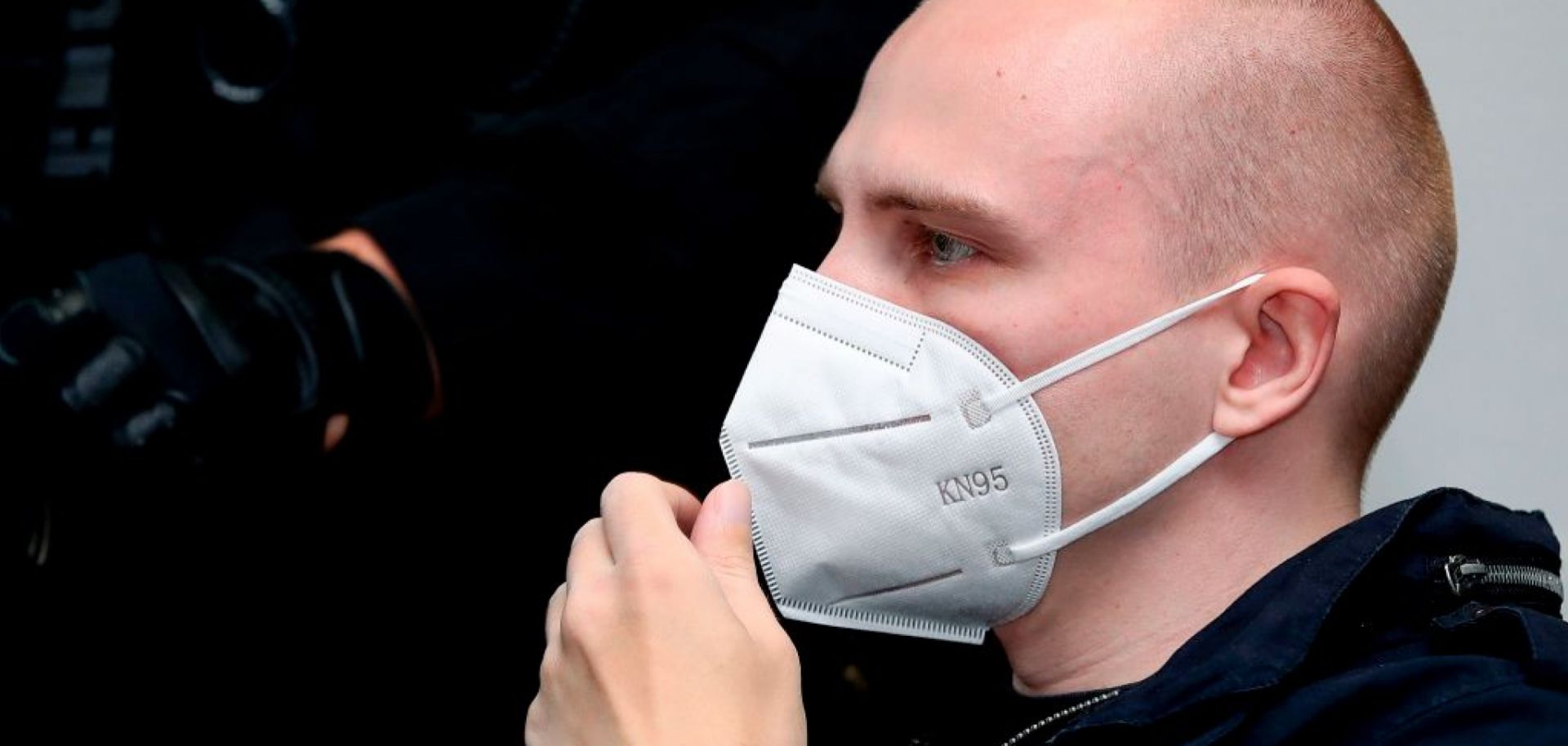
Stephan Balliet, who is accused of shooting two people dead after an attempt to storm a synagogue in Halle an der Saale, eastern Germany, wears a face mask as he waits for the start of the 18th day of his trial on Nov. 3, 2020, at the district court in Magdeburg, eastern Germany.
The violent right-wing threat in Europe is growing as terrorists exploit ongoing political, economic, and social tensions to expand their activities, including plotting attacks. The threat from terrorists who believe they must trigger a civil war to save society will challenge security services and further polarize societies. Right-wing terrorists (RWTs) inhabit a small space in a much larger right-wing ecosystem, but distinguish themselves by actively conducting or advocating premeditated, politically motivated attacks against an array of perceived enemies. RWTs comprise a variety of people, including those who contest government authority, single-issue terrorists who oppose specific policies like abortion, and involuntary celibates (aka "incels") angry at women. Recent attacks, plot disruptions, and security assessments, however, indicate that the largest and most immediate threat comes from RWTs who act on behalf of what they perceive as a superior but besieged "white identity." Often designated with different labels, they have been a persistent threat to Europe since World War II — at times perpetrating highly lethal, still resonant attacks, such as in Norway in 2011 — but have generated significantly more concern and attention since the shootings in Christchurch, New Zealand, in March 2019. That incident incited a wave of similar attacks and plots by geographically disparate RWTs who shared a common set of beliefs and grievances.
- Since 2019, white identity RWTs in Europe perpetrated high-profile lethal attacks in Germany and Norway, and many more violent, though non-lethal, attacks in other countries, including France and the United Kingdom. In the same timeframe, dozens of people in these and other countries were arrested for plotting premeditated, often copycat, attacks. The vast majority of these individuals subscribed to the same ideology as the shooter in Christchurch and in many cases were directly inspired by his violence, as indicated by language in their manifestos and other propaganda and statements to authorities.
- Multiple European security chiefs, including from Europol and major states like Germany and the United Kingdom, describe white identity RWTs as a rapidly growing concern. Authorities in other countries, including several Nordic states, have raised their threat levels as they assess a growing likelihood of attacks. Data from the United Kingdom, one of the few countries to release such information, reveals a steadily increasing number of disrupted plots and referrals to government-backed programs to deter, disrupt and disengage individuals seen as potential extremist risks — some of which may be due to better awareness and reporting, but probably reflect genuine growth. These trends led the British counterterrorism chief to say in September 2019 that RWT is his "fastest growing problem."
- Although many white identity RWTs probably paused attack plotting amid pandemic lockdowns, partly as they joined right-wing extremists with other motivations in redirecting their anger toward governments, they are likely to resume their violent activities against their perceived nonwhite enemies as restrictions ease in 2021.
- According to multiple security services and monitoring groups, white identity RWTs used 2020 to disseminate violent propaganda, conduct outreach to like-minded individuals, and incite others to their cause, suggesting they are preparing for future attacks.
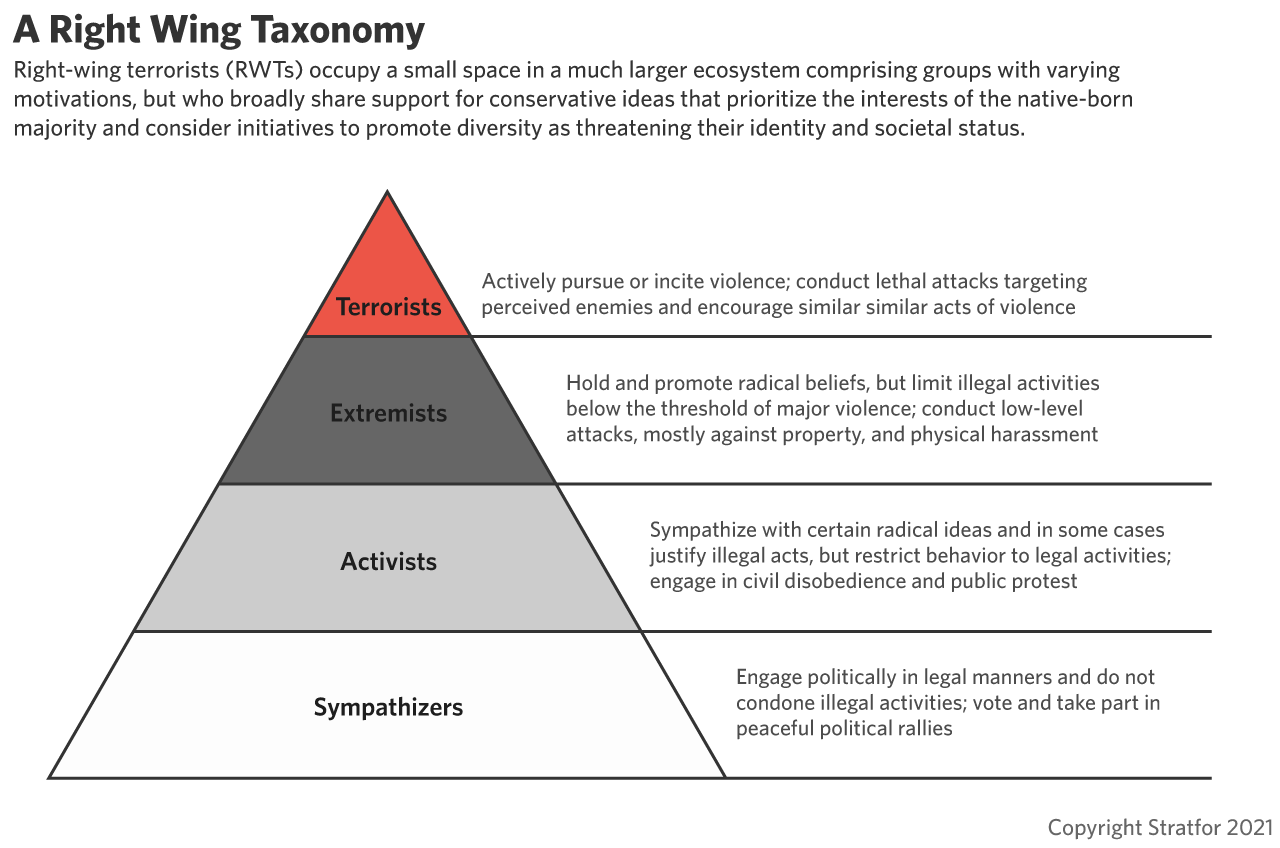
European white identity RWTs are increasingly connecting across national borders to take advantage of common beliefs and grievances to promote and engage in violence. The current crop of white identity RWTs developed, but are distinct, from previous generations of neo-Nazis and racist skinheads who largely operated as organized groups within individual countries and often engaged in criminality. Today's white identity RWTs use mobile chat apps like Telegram and fringe online websites like 8kun (formerly 8chan) to communicate across borders. Moreover, unlike previous generations, they mostly plot violence on their own and do not have criminal connections; even when they join groups, membership is typically fluid and mainly online. Their transnational links have been growing and their ideological precepts converging since the mid-2010s, probably as a reaction to a wave of nonwhite immigration and jihadist attacks. Since then, white identity RWTs have deprioritized previous nationality-based disagreements in favor of a consensus that the only way to save the white race is through cooperation to target common enemies. To this end, they share three key convictions, which they portray as a justified response to growing racial tensions and frustration with the dominant political, economic and social systems:
- Perceived enemies pose an existential threat to what is seen as a superior white identity: RWTs believe that an array of enemies, broadly representative of multicultural forces, threaten their conception of white racial and cultural superiority. They most often target immigrants and racial, ethnic or religious minorities, although they also consider members of the LGBTQ community, left-wing activists and similar groups as enemies.
- Societal elites and the systems of democracy and globalization they serve are complicit: RWTs view the West's largely open and interconnected political-economic system as abetting the displacement of white identity. They consider some societal elites, such as liberal politicians and business leaders, as legitimate targets because such actors are seen as diminishing the influence of white identity and promoting diversity to replace it.
- A race war that transforms society is the inevitable and necessary response: RWTs believe the only way to save white identity is to accelerate societal polarization and spark an unavoidable conflict to confront their perceived multicultural enemies and elite collaborators. Through individual acts of violence, they hope to set off a chain reaction of unrest to force people to choose sides and replace the allegedly anti-white system.
White identity RWTs present different operational and ideological threats than jihadists, which will reveal security services' shortcomings and exacerbate political polarization. Judging from the number of recent arrests and investigations, white identity RWTs pose a bigger insider threat than jihadists to security services, in part because they can more easily operate inside organizations whose cultures and leaders may be more receptive to some of their ideas. More broadly, certain white identity RWT beliefs and grievances — such as that immigrants and minorities threaten traditional European identity and values — resonate in some form in mainstream society, even if most people who hold such opinions disavow violence. This ensures that there will be some political cover for white identity RWTs and that security services in at least some countries, particularly those led by right-wing governments, will have to tread carefully to avoid being accused of political bias.
- Partly because it has invested the most resources to identify insider threats, Germany has repeatedly uncovered white identity RWTs in its police and military ranks, although other big European countries — such as France, Spain and the United Kingdom — have seen similar cases of infiltration in recent years. In summer 2020, Germany's defense minister announced that one of the country's four special operations forces units would be disbanded and the other three overhauled following a dramatic rise in internal investigations of soldiers for suspected right-wing extremist sympathies and accusations of a toxic culture and leadership.
- In 2019, a leaked British army document demonstrated the challenges security services face in tackling sympathy for white identity RWTs within their ranks. The chart, which was created in 2017 after four soldiers were arrested for links to a banned neo-Nazi group, told servicemembers to be on the lookout for a variety of behaviors; these included individuals calling themselves "patriots" and making "inaccurate generalizations about 'the Left' or Government." These recommendations were widely portrayed as unhelpful absent greater context, politically biased and possible infringements on free-speech rights.
- Leading right-wing European politicians and activist groups routinely refer to the "great replacement," a conspiracy theory that white Europeans are being deliberately replaced with nonwhite migrants and that societal elites are complicit. This is a prominent narrative that white identity RWTs, including many attackers in the past two years, also subscribe to and highlight in their propaganda. Further demonstrating how politicians can provide cover for RWTs, in March 2020, Germany's domestic intelligence agency labeled a division of the right-wing Alternative for Germany party as an extremist group because of its leaders' rhetoric seen as supportive of radicalism and violence.
The threat of white identity RWTs provides opportunities for closer cooperation between Europe and the incoming Biden administration to address a common threat, but these will face political and legal obstacles. European leaders, who have lamented the Trump administration's alleged lack of concern with the issue despite lethal attacks on each side of the Atlantic and growing connections between European and U.S. white identity RWTs, will likely press the new administration to take action on multiple fronts. Europeans note that white identity RWTs have caused even more fatalities in the United States than Europe, and are concerned by reports of links between U.S. and European white identity RWTs. They also accuse U.S. tech firms of failing to do enough to remove white identity RWT content on their platforms. President-elect Joe Biden has signaled that he plans to focus on RWT, which he routinely denounced on the campaign trail, but he will have to overcome political and legal constraints on more aggressive policy responses.
- Biden could press Congress to enact a law against "domestic terrorism" as a way to tackle the transnational influence of U.S. white identity RWTs, but would likely face political pushback and constitutionality questions. There is no federal crime against acts of terrorism inside the United States unconnected to officially designated, almost exclusively jihadist, foreign terrorist organizations (FTOs), leading white identity RWTs to be prosecuted under a patchwork of state or non-terrorism federal laws. A "domestic terrorism" law would likely send a powerful signal and give authorities greater powers. However, it could face political debates and lawsuits over its scope if it is seen as being so broad to encompass constitutionally protected activity or, on the opposite end of the spectrum, overly narrow such that it targets only certain groups or ideologies.
- The State and Treasury departments, which designate and sanction FTOs and a related category of specially designated global terrorists (SDGTs) face legal limits to adding white identity RWT groups to these lists, which would enable more law enforcement and intelligence activities against them. In April, the U.S. labeled the Russian Imperial Movement (RIM), a racist ultranationalist paramilitary group, and three of its leaders as SDGTs, the first designation for an RWT organization. Nonetheless, the action revealed constraints on further designations. Unlike more prominent and arguably more immediately concerning groups, such as The Base or the Atomwaffen Division — neo-Nazi groups based in the United States with foreign offshoots — RIM has no U.S. presence, one of the key requirements for FTOs or SDGTs. Further designations will suffer from this need for "foreignness" and the reality that most attackers operate as lone actors detached from clear organizational structures that can be targeted.
- The new administration will pressure U.S. tech firms to do more to remove content linked to white identity RWTs, which is widely seen as crucial to connecting disparate members of the diffuse movement. Even so, the Biden administration will grapple with various free-speech considerations. Since the Christchurch attacks, companies have made significant strides in removing obviously illegal content, yet white identity RWTs have proven adept at using coded language, memes and other forms of communication that stay within legal limits, thus challenging their removal from online platforms. Moreover, at least some white identity RWT beliefs and grievances resonate in mainstream political discourse on both sides of the Atlantic; removing such content inevitably leads to charges of censorship and political bias. Finally, while white identity RWTs use big platforms like Facebook and YouTube for conducting mass outreach, they rely on more niche apps that explicitly promote themselves as free-speech havens and refuse to police their platforms to conduct more nefarious activities, like discussing violence.
