
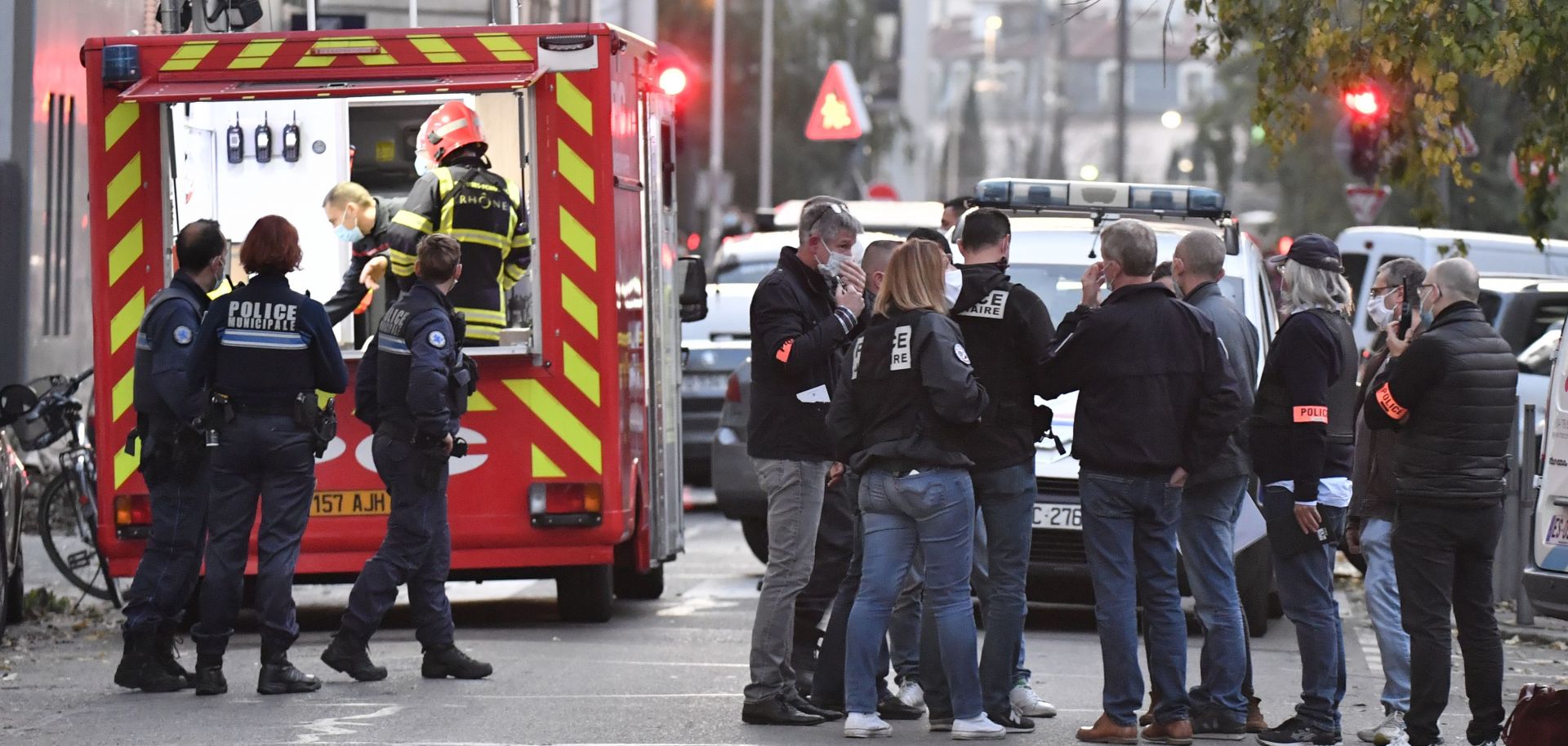
Emergency personnel on Oct. 31, 2020, in Lyon, France, at the scene of an attack on a Greek Orthodox priest.
Recent attacks and unrest in Europe and across the Muslim world are part of a pattern of violence associated with the Mohamed cartoon controversy that has recently flared up due to an ongoing trial in Paris. Attacks in September and early October focused on individuals and symbols directly linked to the cartoons, but the target set expanded as initial attacks spawned more violence, along with apparent retaliation to the initial attacks. In Europe, the return of the cartoon controversy comes amid rising concerns over Islamophobia and associated attacks. Verdicts in the trial that began the latest chapter of the controversy are expected in December, potentially providing motivation for even more attacks.
The Sept. 1 republication by French satirical magazine Charlie Hebdo of a controversial series of cartoons depicting the Prophet Mohammed to mark the beginning of a trial over a 2015 attack on the magazine's offices in Paris sparked the current round of violence. The decision to republish the cartoons was typical of the magazine's unapologetic insistence on lampooning any and every public figure, regardless of cultural or religious sensitivities.
Islam forbids visual representations of the Prophet Mohammed. The risks of publishing such cartoons were well established: The January 2015 attacks on Charlie Hebdo's Paris offices after the first publication of the cartoons left 12 dead and 11 injured. Backlash to the Sept. 1, 2020, republication quickly emerged. On Sept. 11, al Qaeda in the Arabian Peninsula — which has claimed the 2015 attack — called for more violence against the publication and other "blasphemers." On Sept. 25, an 18-year-old stabbed two people with no connection to the magazine, but who happened to be outside the publication's former offices.
The Mohamed cartoon controversy has been an enduring point of conflict between free speech advocates in Europe and North America on one side and Muslim communities worldwide on the other who argue that the cartoons are not only blasphemous, but promote Islamophobia and harassment of Muslims. The controversy began in Denmark, where the Jyllands-Posten newspaper published a series of cartoons depicting Mohamed in 2005 in an effort to explore the limits of free speech. The publication triggered worldwide protests and terrorist plots targeting the newspaper and its staff, including a near escape for one of the paper's primary cartoonists, Kurt Westergaard, in 2010. In 2006, Charlie Hebdo published a series of cartoons that similarly triggered protests and an arson attack against its offices in 2011. In 2012, the magazine revisited the cartoons, leading French diplomatic missions, cultural centers and schools to close down across the Muslim world to mitigate the risk of retaliatory threats that followed. France avoided additional attacks until January 2015, when two brothers carried out an armed attack against the Charlie Hebdo offices in Paris that primarily targeted cartoonists and editors in retaliation for the cartoons. The issue had remained mostly dormant since 2015, but the start of the trial of the 2015 attackers in September has refocused public attention on the controversy — and increased the terrorism threat across Europe.
The latest iteration of the threat really gained traction in October 2020, when a primary school teacher in Conflans-Sainte-Honorine, a commune just north of Paris, showed his class the controversial cartoons in an effort to discuss the ongoing trial and concepts of freedom of expression. His lesson caused a controversy in the town, with parents complaining about his apparent discrimination against Muslim students. The controversy caught the attention of an 18-year-old refugee from Chechnya who had recently displayed signs of radicalization in online posts. On Oct. 16, the teenager got a ride to the primary school in Conflans-Sainte-Honorine where he paid two students to point out the teacher who had shown the cartoons. Later that day, the suspect stabbed and decapitated the teacher, posting images of the killing on social media along with claims that he had avenged insults to Mohammed.
The brutal slaying accelerated the public debate over free speech and deference to religious sensibilities. In France, the response was an overwhelming affirmation of the former: Cities projected images of the controversial cartoons on public buildings and rallies across the country celebrated the teacher, who posthumously received the Legion of Honor. Security reactions included preparations to deport 231 people on a terrorist watch list as a preemptive measure to prevent follow-on attacks, and authorities charged seven people in connection with the killing, including the two teenagers who pointed the teacher out to the killer. The state also targeted the Collective Against Islamophobia in France, a nongovernmental organization that recorded acts of Islamophobia in the country and had received several complaints regarding teachers' decision to show the cartoons. Meanwhile, French President Emmanuel Macron defended the decision to publish the cartoons and said Islam was "a religion that is in crisis all over the world."
France's reaction to the teacher's death in turn set off a series of protests, boycotts and eventually acts of violence across the Muslim world. From Senegal to Indonesia, protesters rallied outside of French diplomatic missions burning French flags and effigies of Macron over the second half of October. Some supermarkets in the Middle East pulled French products off of the shelves to avoid being targeted by boycotts. Turkish President Recep Tayyip Erdogan took the lead in criticizing Macron, telling him to get a "mental check" and accusing him of mistreating "millions of members from different faith groups."
The political and social tensions that prevailed in late October following the high-profile teacher decapitation culminated in another cluster of attacks from Oct. 29 through Nov. 1:
- French authorities determined that an Oct. 29 knife attack at the Notre-Dame Basilica in Nice that killed three people was motivated by terrorism.
- Within hours of the Nice attack, a man attacked and injured a security guard with a knife on Oct. 29 outside the French Consulate in Jeddah, Saudi Arabia.
- A man opened fire Nov. 2 with an automatic weapon on bars and cafes in central Vienna, killing four people and injuring over 20 others before police shot and killed him.
These attacks marked an ideological and geographic expansion of the threat while demonstrating that arrests and round-ups of suspects do not necessarily prevent future attacks. The Nice attacker was not previously known to French security services, even though he had recently immigrated from Tunisia via Italy a month prior. The attack in Jeddah demonstrated the international scope of the threat; two weeks later, an explosion in Jeddah injured several participants at a ceremony organized by the French Consulate. The Vienna attack underscored the international scope of the threat, but also appears to have expanded the scope. Unlike previous attacks, the Vienna attack did not target French interests. And while the perpetrator had known connections to, and an affinity for, the Islamic State, so far no explicit links between his attack and the cartoon controversy have emerged. In fact, he appears to have been plotting an attack long before the cartoon controversy reemerged in September and October: In July 2020, the attacker and an accomplice attempted to purchase ammunition illegally in neighboring Slovakia. Rather than being a direct response to the Mohammed cartoon controversy, the Vienna attack appears to be a product of it: Violent attacks tend to cluster, and jihadist messaging seeks to exploit violent acts as inspiration for others to conduct violence. In this regard, the Vienna attack appears to be a successful expansion of the violent campaign from narrowly targeted French interests to a more general public space in a different European capital.
The current round of the Mohammed cartoon controversy also comes at a time when Europe is grappling with rising concerns over the right-wing extremist threat. Indeed, at least two recent apparent Islamophobic attacks appear linked to the escalation in Mohammed cartoon-related violence:
- Two days after the killing of the French teacher, two white women attacked and injured two French women of Algerian descent while yelling racial slurs Oct. 18 near the Eiffel Tower in Paris.
- A man opened fire Nov. 12 on the Saudi Embassy in The Hague a day after the attack on several European diplomats during a ceremony in Jeddah. Police charged the man with terrorism, and Saudi authorities cautioned their citizens to exercise caution in the Netherlands.
Neither attack included an explicit reference to the Mohammed cartoon controversy, but the timing and targeting of the incidents again suggest that previous acts of violence played a role.
The Islamophobic threat is more pronounced in Europe in 2020 compared to the last time the Mohammed cartoon controversy flared up in 2015. Conflicts in North Africa and the Middle East have driven a rise in migrants from Muslim majority countries since 2014 and 2015, triggering public anger that has given rise to anti-immigrant parties such as the Alternative for Germany or Vox in Spain.
Violent attacks have underscored the anti-immigrant sentiment. A gunman killed 10 people in the German town of Hanau in February 2020 when he opened fire on several cafes and bars popular with the local Turkish community. Shootings at the Al-Noor Islamic center just outside of Oslo, Norway, in August 2019 and at a mosque in Bayonne, France, in October 2019 by a former right-wing political candidate preceded the Hanau incident. Germany meanwhile has seen hundreds of attacks on refugee shelters since 2016 according to a 2019 Organization of Islamic Cooperation annual report, while British-based Measuring Anti-Muslim Attacks reported a near-sevenfold increase in Islamophobic activity in the United Kingdom following the 2019 Christchurch, New Zealand, mosque attacks. While Islamophobia is by no means a new phenomenon in Europe, it does seem to have intensified since the last time the Mohammed cartoon controversy flared up in 2015. In the current context, the violence is more likely to go both ways, targeting groups or individuals at all associated with the cartoons as well as mosques, Islamic cultural centers or even cafes with a predominantly Muslim clientele.
The verdicts on the 14 people charged with assisting the two attackers behind the 2015 attack on Charlie Hebdo's offices will likely come over the next month; they have the potential to keep the current wave of violence and social unrest going. A verdict was expected in early November, but the COVID-19 pandemic has delayed the process. The outcome of the trial will bring the issue back to the fore, providing another opportunity to republish the controversial images and incentives to gather in defiance or support of the verdict depending on restrictions in France surrounding COVID-19. Politicization of the verdict through high-profile statements or taunts could internationalize the issue again, too, putting French interests under additional threat. Beyond the trial, the continual reemergence of the Mohammed cartoon controversy over the years suggests that this issue will remain an issue that motivates violence for years to come.
