
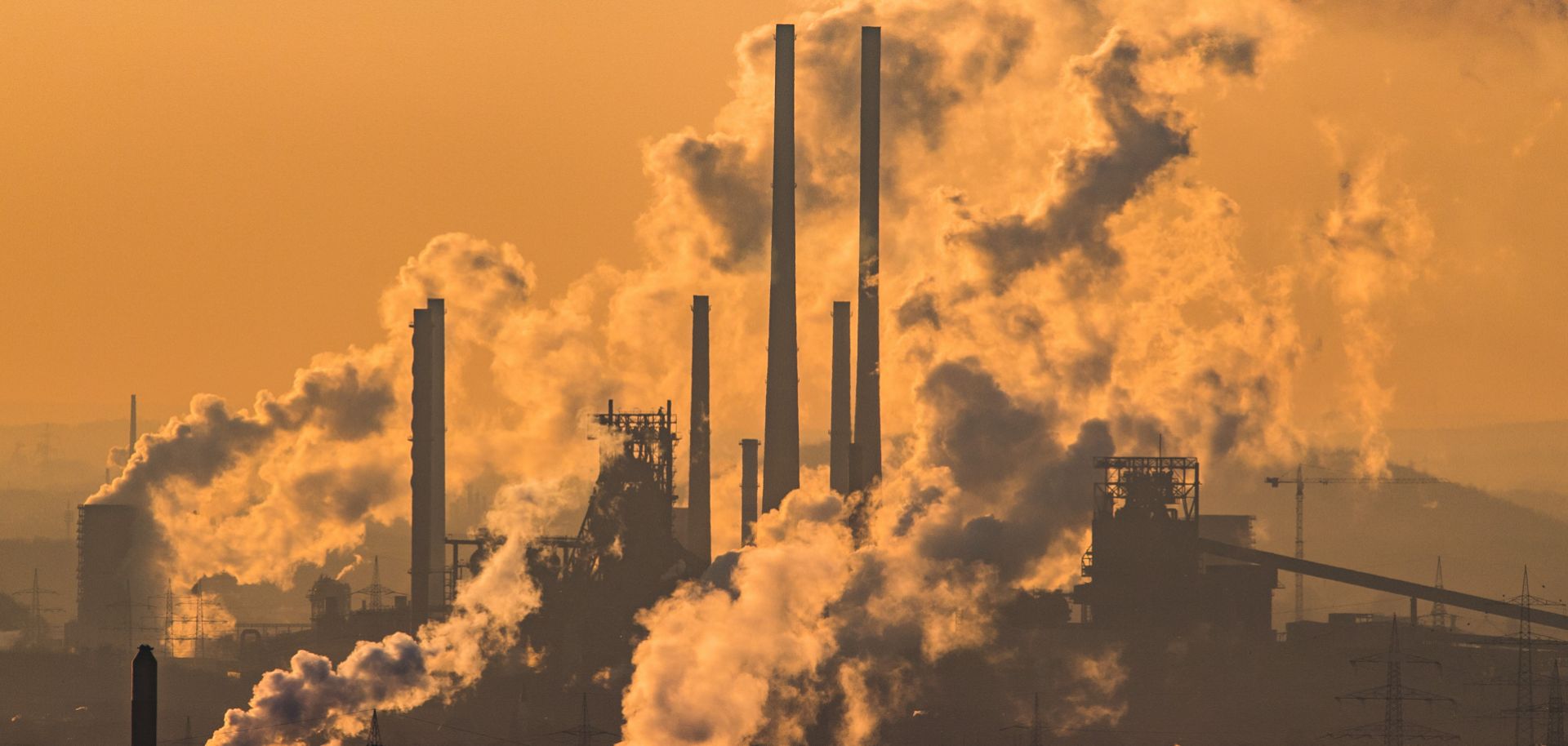
Steam and exhaust rise from a chemical company's coking plant on a cold winter day in Oberhausen, Germany.
The European Union will increase pressure on private and public companies to reduce their carbon emissions in the coming years, and will also make significant funds available to help member states transition to cleaner energy. The actual implementation of the ambitious policies laid out in Brussels' Green Deal, however, will be slow and uneven due to the bloc's current pandemic-induced economic crisis, insufficient funding, internal political divisions, and limited access to the technologies needed to create more eco-friendly European economies.
- The European Union's Green Deal consists of a series of legislative proposals and regulatory reforms to reduce the bloc's carbon emissions to zero by 2050. It includes modernizing industries such as steel, chemicals and cement, the decarbonization of the electricity sector, the construction of "smart" and eco-friendly infrastructure, a shift from road freight to rail and waterway freight, making the agri-food sector more environmentally friendly, and the overall construction of an economic system that produces little waste.
- The European Commission has invested significant political capital on the plan, which means that Brussels will support it even if its implementation faces delays and obstacles.
- Germany and France, the largest economies in Europe, have also expressed their support for the Green Deal.
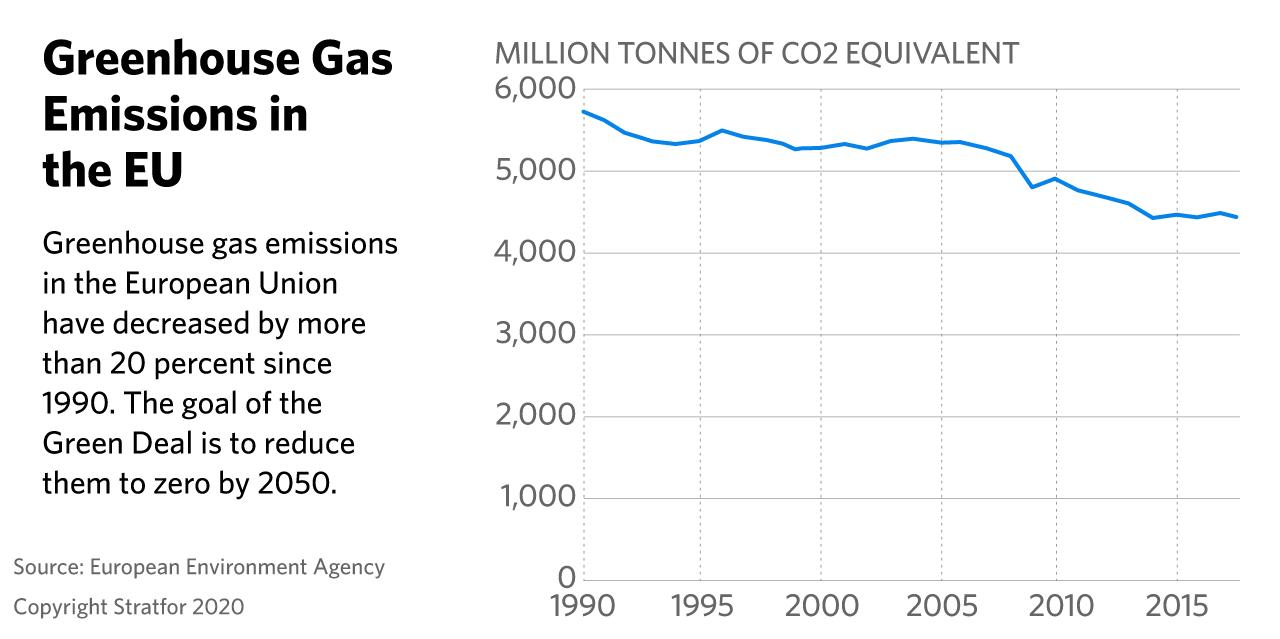
The Green Deal will face obstacles, including insufficient funding and reluctance from Central and Eastern European countries to undergo a speedy transformation in their economies. The European Commission has admitted that there could be an investment gap of 260 billion euros ($307 billion) per year on Green Deal-related initiatives by 2030, which means that Brussels and national governments will have to look for ways to incentivize private investment on green initiatives. Access to Green Deal funding will likely also be uneven across the European Union. Countries in Central and Eastern Europe tend to be less effective than those in the west and the North when it comes to absorbing EU funds due to both their lack of experience with applying for EU funding, and inefficient cooperation between the public and the private sectors.
- In July, EU member states decided that 30 percent of the bloc's 1.8 trillion euro ($2.13 trillion) budget for 2021-2027 would be spent on Green Deal-related projects, marking the bloc's highest-ever expenditure on energy transition. The definition of what represents such a project is vague, however, which means that national governments could spend the money on areas that are labeled as "green" but do not contribute to reducing carbon emissions. Countries also could decide to use EU money to increase public spending and promote economic growth without meeting the Green Deal targets.
- EU governments also decided in July to reduce the money allocated to the bloc's fund aimed at helping Central and Eastern European countries that are more reliant on polluting energy sources transition to cleaner energy. The "Just Transition Fund" will receive 17 billion euros ($20 billion) for the 2021-2027 period, down from the commission's original proposal of 40 billion euros ($47 billion). As a result, countries such as Poland and Romania could ask for more time to implement Green Deal reforms, arguing that they do not have enough funding.
National governments, particularly in Southern and Eastern Europe, will also be reluctant to accelerate their industrial sectors' transition to "greener" technologies at a time of weak economic growth and rising unemployment due to the COVID-19 pandemic, which will be exacerbated by weak oversight from EU institutions and ideological disputes between EU institutions. The European Commission has the power to sanction non-compliant countries, but the process is lengthy. Because of this, many EU governments will feel that they have time to delay those aspects of the Green Deal that are not a priority for them.
- While the Green Deal proposes regulations at the EU level, it will be up to each of the bloc's 27 governments to implement the reforms on the ground. This will open the door to discrepancies between member states regarding the speed and the scope of the transition to less-polluting economies, which will force Brussels to modify some of its original Green Deal ideas and delay the commission's initial timeline for implementation.
- Most of the European Commission's Green Deal policies also require approval from the European Council (which represents the bloc's national governments) and the European Parliament, leaving room for more discrepancies and delays.
The Green Deal will award companies operating in Europe that are willing to transition to greener activities with more financing opportunities, though this will come at the cost of higher fiscal and regulatory pressure. The European Union's main financial institutions and the private sector will become more supportive of "green" initiatives in the coming years, which means that there will be more financing available for companies taking advantage of the "green trend" in Europe. However, the Green Deal will also include new taxes and tariffs for high-carbon products, as well as greater regulatory pressure for companies to transition to more environmentally-friendly operations, meaning companies that fall behind in the transition will face rising operating costs. That said, such fiscal and regulatory pressure from Brussels and national governments will probably be uneven, as Northern European governments are more likely to quickly and decisively enforce Green Deal regulations compared with their counterparts Southern and Eastern Europe.
- Public institutions, such as the European Investment Bank, and private banks, such as the Deutsche Bank and BNP Paribas, have already announced plans to allocate a higher percentage of their credit lines to "green" projects.
- The European Central Bank is also considering issuing "green bonds" to finance environmentally-friendly projects.
The European Union's push to introduce new "green" taxes and tariffs, however, could ultimately create rifts with the bloc's trading partners and reduce non-EU companies' access to Green Deal-related grants, loans and subsidies. The European Commission is considering a border tax on imports of selected emissions-intensive products, as well as a value-added tax (VAT) on carbon-intensive products sold in Europe. The commission has also proposed extending the bloc's emissions trading system (ETS) to imports, which would force foreign companies to buy carbon permits. Such measures, however, would risk creating trade disputes with countries with weaker environmental standards, including large countries such as China and India, as well as smaller developing countries whose economies depend on exports to the European Union. The sectors most affected by the new taxes and tariffs under the European Commission's Green Deal, such as airlines and maritime freight, will lobby against them and try to weaken Brussels' plans. Growing geopolitical competition between the European Union, the United States and China will prompt France and other EU member states to demand Brussels privilege European companies when it comes to Green Deal-related subsidies and financing. This could result in discrimination against non-EU companies that could reduce their access to Green Deal-related money and put them in a weaker position to compete with their European rivals.
Geopolitical disputes between the world's largest economies (namely, the United States, European Union and China), will also constrain the availability and advancement of technology crucial to reach the goals of the Green Deal. Greater scrutiny of Chinese companies (and, to some extent, U.S. companies) will limit European markets' access to partnerships in technologies where EU members lack in domestic development. The transportation and power generation sectors, in particular, could see some of the largest setbacks in terms of energy storage technologies.
