
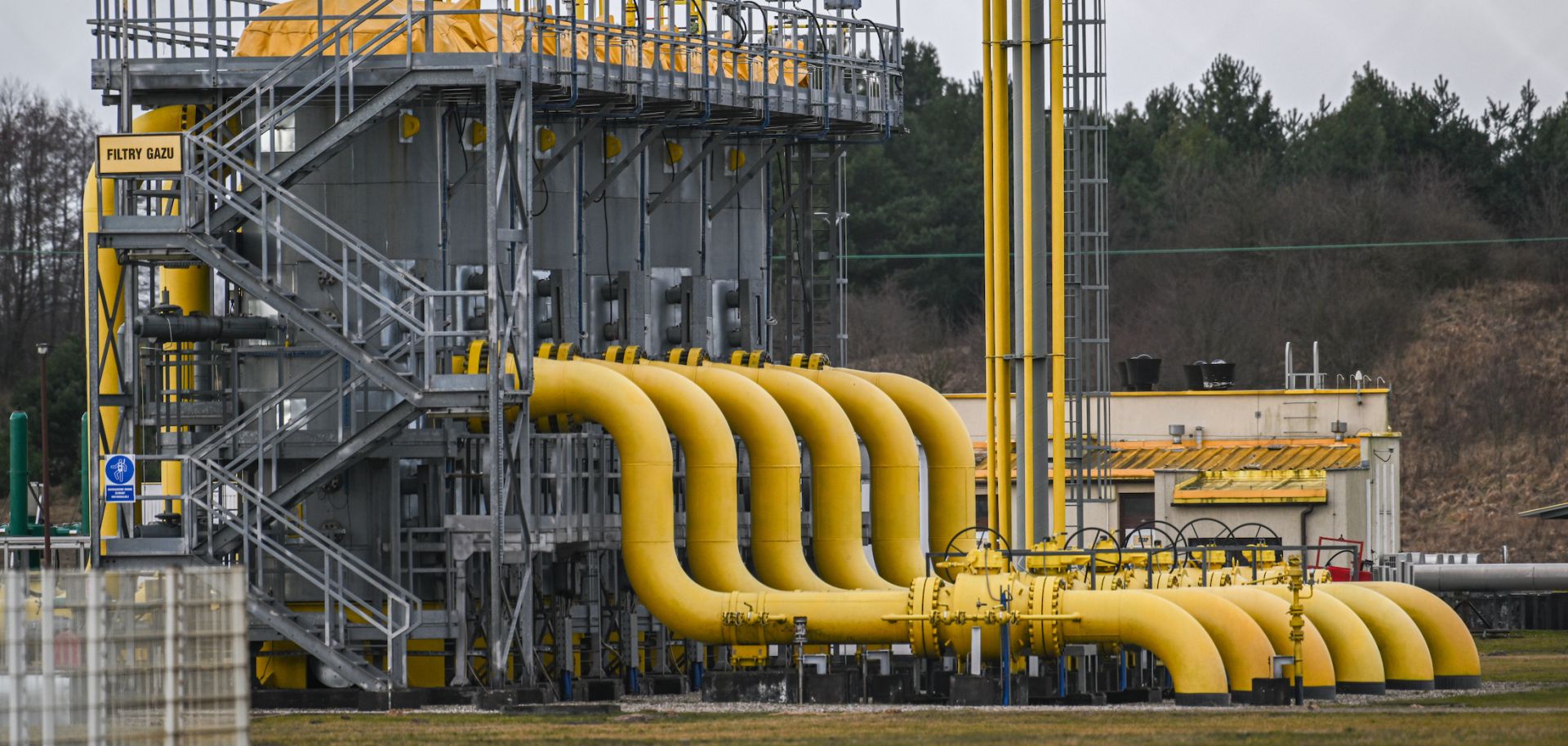
A compressor station is seen at the Yamal-Europe pipeline -- which connects Germany and Poland to the natural gas fields in Russia’s Yamal Peninsula -- in the Polish city of Wloclawek on Feb. 19, 2022.
Russia’s invasion of Ukraine and subsequent Western sanctions will contribute to high oil and natural gas prices in the coming months, which will undermine major oil-consuming countries’ economic recoveries from COVID-19 and exacerbate high inflation levels that hit the poorer segments of society the hardest. Global energy prices skyrocketed just hours after news broke of Russia’s Feb. 24 invasion of Ukraine. European light sweet benchmark Brent crude futures initially surged as much as 9%, reaching $105 per barrel for the first time since 2014, before falling back below $100 per barrel later in the day. Western European natural gas benchmark Dutch TTF futures, meanwhile, increased as much as 60%. The European Union, the United Kingdom and the United States are all expected to announce significant sanctions against Russia over the next few days. But the sanctions package U.S. President Joe Biden unveiled on Feb. 24 is not designed to directly target Russian oil and gas exports.
- Russia is one of the world’s largest exporters of oil and natural gas. The country exports roughly 4.9 million barrels per day (bpd) of crude oil and condensate, along with about 240 billion cubic meters of natural gas each year. Roughly half of Russia’s oil exports go to Europe or North America, and more than 70% of Russia’s natural gas exports go to Europe.
- In response to the Ukraine invasion, the United Kingdom, Ukraine, Estonia, Latvia and Lithuania have demanded that major Russian banks be disconnected from the Belgium-based SWIFT global payments system (which is crucial for international transactions involving Russia). But the West appears unlikely to take such action, as any move to cut off Russia’s access to SWIFT would make it difficult or impossible for Western countries to conclude transactions to import Russian energy. Targeting Russia’s access to SWIFT could also result in Russia cutting off its energy exports to the West in retaliation.
- An EU diplomat said on Feb. 24 that sanctions will include a component targeting the energy sector. Leaks to the Financial Times earlier this year suggest that the European Union and the United Kingdom were considering sanctioning investment into new Russian natural gas projects.
Crude oil prices may remain near $100 per barrel and could spike above $120 per barrel for weeks if Russian oil exports are disrupted, as there is limited spare capacity and commercial stockpiles globally. In the coming days, the United States and other International Energy Agency (IEA) members will probably announce a release of oil supplies from their strategic stockpiles to help temper markets; a coordinated release of 60 to 70 million barrels of crude oil (equivalent to roughly two weeks of Russian oil exports) is reportedly under consideration among IEA members. But such strategic releases typically only have a short-term impact on oil prices. Major oil producers like Saudi Arabia also have extremely limited spare capacity compared with the global size of oil markets. Commercial crude oil inventories in the West are at low levels as well, with commercial crude oil inventories in the United States sitting 10% below their five-year seasonal average for this time of year.
- Saudi Arabia, Kuwait and the United Arab Emirates have about 3 to 4 million bpd of spare capacity that they can use to offset Russian supplies. It seems unlikely that Saudi Arabia, in particular, will fully open up the taps to bring oil prices back below $100 per barrel, given the kingdom’s conservative approach to bringing oil back online amid the COVID-19 pandemic and its poor relationship with the current U.S. administration.
- Beyond the Arabian Peninsula, Iran is the biggest source of spare oil production capacity, with about 1.3 million barrels of spare capacity that it can bring back online within a few months. But an increase in Iranian crude oil exports will depend on whether negotiators in Vienna can ink a new nuclear deal that sees the United States suspend sanctions on Iran’s energy sector.
- The United States has 638 million barrels of oil in its Strategic Petroleum Reserve and can draw down a maximum of 4.4 million barrels a day from that stockpile. Republican lawmakers in Washington will point to domestic U.S. oil production as an alternative to Russian oil, though U.S. producers cannot realistically surge output overnight.
Global natural gas market conditions are even tighter than oil market conditions. And while seasonal demand in the northern hemisphere will decline as temperatures rise in the coming months, the lingering effects of sanctions and any supply disruptions will affect the 2022-23 winter season due to the need to fill storage in the summer and autumn months. Alternative natural gas producers simply cannot offset Russian natural gas in a meaningful fashion if Russian natural gas exports to Europe are disrupted. Russia exported 185 billion cubic meters of natural gas to Europe in 2020, which was equivalent to 38% of the global liquified natural gas (LNG) market. While some LNG cargoes can be diverted from one buyer to another, at the end of the day, the global market will be strapped. Unlike oil markets, countries also do not have strategic stockpiles of natural gas that they can draw upon. Moreover, if the conflict in Ukraine becomes bogged down, it's entirely possible that Ukrainian pipelines that deliver gas to Europe are either sabotaged by Russia or damaged in battle. A tight market through September will also ensure that natural gas storage levels in Europe will go into December at low levels, making high natural gas price spikes next winter more likely.
Higher energy prices will exacerbate global inflation rates by further driving up the cost of shipping, food production, electricity and other industries that consume oil and gas. This could produce political ramifications across the globe as more people feel the pinch of higher prices and increase pressure on their governments to implement relief programs. This winter’s increase in European natural gas prices may ultimately offer a preview of what is likely to happen in Europe again next winter and in many other countries as rising natural gas prices led to increased electricity prices during cold months.
- Over this past winter, France forced utility giant EDF to take an 8.4 billion euro ($9.64 billion) hit in order to stop increasing prices for consumers. The U.K. government also searched for ways to alleviate the pressure on its households and at one point considered bailing out gas companies as well. Many other European governments implemented subsidies to help low-income households face rising energy prices, which came at a high fiscal price for the states.
- It is hard to directly project the impact of inflation on GDP growth levels for industrialized countries. But higher prices will hit working-class and poorer segments of their populations hardest, exacerbating inequality and the political repercussions that come with it. In the United States, the rising cost of living will make it even more difficult for the Democratic Party to retain control of Congress in upcoming elections.
- Among emerging markets and developing countries, major oil importers like India and Turkey will see their import bills continue to rise, driving more economic challenges for those countries. In Turkey, this will translate to a worsening of the country’s financial crisis that its government is already struggling to handle.
In the high impact but low probability scenario in which Russia cuts off energy exports to Europe, rampant oil and gas inflation would follow, as would likely widespread shortages in Europe. Given tight conditions in global oil and gas markets, such a scenario could see oil and natural gas prices reach new heights — potentially as much as $120-$150 per barrel of oil. And energy prices could remain at those record levels for an extended period of time. Such a dramatic and potentially sustained price surge would have an immediate impact on European buyers of Russian crude oil via the Druzhba pipeline, as refiners typically only keep limited stockpiles on hand and it will take time to secure alternative supplies. Natural gas shortages in Europe could also become a problem for countries like Hungary that are highly dependent on Russian gas and have limited infrastructure to import alternative supplies. The economic consequences of a gas cutoff will probably destabilize those governments that are unable to implement effective relief policies and/or produce electoral losses by some parties in power. Against this backdrop, economically motivated protests in countries prone to fuel price and subsidy protests would also be likely.
