
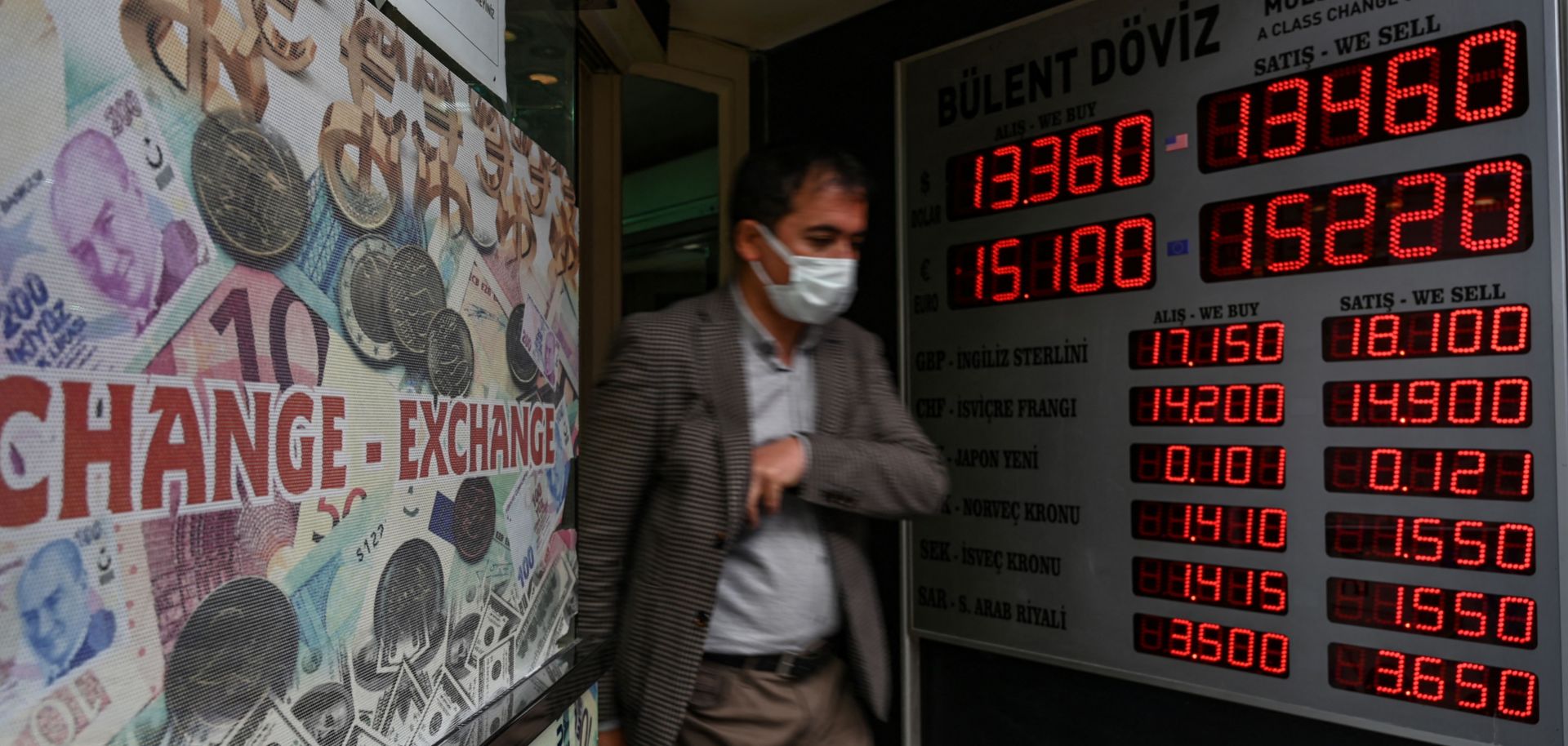
A customer leaves a currency exchange agency in Istanbul, Turkey, on Dec. 2, 2021.
To reduce inflation, Turkey has focused on cutting interest rates to stimulate investment while hoping to raise exports to a level that would override the country’s dependence on external financing and produce a current account surplus in the balance of payments. But recent data points suggest this strategy is backfiring — badly. Failure to address macroeconomic problems and resulting economic instability will increase political pressure on Turkey’s ruling Justice and Development Party (AKP) to reverse course, lest risk further eroding the party’s popularity ahead of the scheduled 2023 elections.
- Inflation in Turkey was 48.69% (y-o-y) in January, a 20-year high. Energy and food prices increased and exchange rate depreciation passed through to core inflation, which was 39.45% in January compared with 31.88% the previous month. On a monthly basis, inflation accelerated to 11.1% in December, which annualizes to a 354% rate if sustained over a year. Producer prices were up even more dramatically, increasing by 93.5% (y-o-y) and 10.45% (m-o-m), which annualizes to 330%.
- Turkey’s trade deficit increased by 241% (y-o-y) in January, with a 55% increase in imports offsetting a 17% increase in exports. The country’s current account deficit for 2021 is estimated at $15-20 billion after a cumulative $15 billion as of the end of November, equivalent to 1.9% of GDP. The country’s gross external financing needs, in addition to the current account, were $193 billion (or 24.1% of GDP), leaving Turkey with a strongly net negative international investment position of -55% GDP.
- In addition, business sentiment is declining, with the January manufacturing Purchasing Managers’ Index falling to 50.5 from 52.1 in December — just above the 50 level that shows businesses expect an economic contraction. Input cost inflation and lira depreciation were the main factors.
Turkey’s growth model and politicized economic policies have left the country’s economy in a pervasive crisis by failing to address long-standing structural problems that predate the COVID-19 pandemic. Turkey has aimed for export-driven fast growth, built on cheap domestic credit that, while inflationary, would raise the standard of living faster than inflation could erode it. The tradeoff has been instability in the price level and the currency. The government’s stated goals are to make Turkey one of the 10 largest economies in the world by 2023 (from a current ranking of 21st) with a $2 trillion GDP and a per capita income of $25,000. However, 2021 GDP was about $800 million and per capita income declined from $12,600 in 2013 to $8,500 in 2020 (latest data available).
- Turkey’s policy tools focused on short-term growth include rapid money growth and credit provision by state-owned banks that are aimed at stimulating domestic investment but are financed by foreign savings and imported capital via chronic current account deficits in the balance of payments.
- Consumption accounts for 70% of Turkey’s GDP and is also debt-driven. Central bank data shows the ratio of household liabilities to disposable income is just under 50%, which means a high degree of leverage that leaves financial institutions vulnerable to losses.
- Competition strategy has been export-oriented growth by suppressing real wages. To that extent, high inflation has accomplished the task, but at the expense of high inequality and poverty.
- Turks' preferred savings instrument is buying gold rather than domestic savings in lira, which has negative real returns and could otherwise be used to fund investment.
- Turkish President Recep Tayyip Erdogan has a counterintuitive belief that high interest rates are the cause of inflation rather than a cure. The president vowed on Jan. 29 that interest rate cutting would continue despite a January pause by Turkey’s central bank.
Those policies are stimulating a recurring cycle of interest rate cuts, inflation and currency depreciation, which drives high rates of dollarization and, in turn, undermines the exchange rate and contributes to rising prices. The government is seeking to break that cycle, but dollarization has barely declined since Ankara announced a December scheme to reduce foreign exchange risk and guarantee returns on lira deposits by making up for losses if lira depreciation exceeded bank-offered interest rates on deposits.
- From September to December, the Central Bank of the Republic of Turkey (CBRT) cut its main policy rate by a cumulative 500 basis points to 14% in late 2021. The cuts sent the lira into a tailspin that accelerated consumer price rises as Turks diversified away from lira assets.
- The government’s Dec. 20 effort to stem lira depreciation was intended to incentivize conversion of foreign exchange deposits held by retail investors (Turkish savers) into short-term (three-, six- and 12-month) lira-denominated deposits. The CBRT is expected to make up for losses incurred by holders if the lira’s decline against the U.S. dollar, euro or U.K. pound exceeds interest rates offered on deposits. Accounts must be held to maturity to receive the payment.
- Turkey’s currency has since stabilized in the range of 13-14 lira to one U.S. dollar, based mainly (it’s believed) on CBRT and state-owned bank intervention. But the lira has still lost around 35% of its value against the dollar since rate cuts began. Should the central bank decide to resume interest rate cuts during its next policy-setting meeting on Feb. 17, it would probably sink the currency further and accelerate capital flight.
- But between the end of December and the end of January, Turkey’s foreign exchange deposits as a share of total bank deposits only declined from 63.4% to 62.1%, which indicates the scheme does not seem to be working overall. Partially reversing lira depreciation came at the expense of foreign exchange reserves, with declared CBRT sales of foreign exchange of $7.3 billion December 2021. Gross international reserves are $111 billion, but include $39 billion of illiquid gold and net reserves are -$36.1 billion as a result of contingent liabilities, foreign exchange derivatives and swaps.
Turkey’s exports have increased, but the country’s heavy dependence on energy imports and a high import content to domestic production and exports mean the trade balance and the current account of the balance of payments are not especially sensitive to exchange rate movements. (A falling lira theoretically makes exports more competitive, but by also increasing the price of imported inputs the effect is largely offset.) The failure to generate net new capital inflows to finance the current account, rollover large short-term liabilities, and rebuild foreign exchange reserves leaves the economy vulnerable to shocks like shifting investor global risk sentiment.
- Oil imports jumped by 241% in value terms to $8.96 billion in January, according to preliminary data from Turkey’s trade ministry.
- While exports were up by 17% in value in January, detailed data will not be released from Turkey’s statistics agency until the end of February. The Turkish government’s statistics agency reported that overall trade volume increased by nearly 23% in 2021, but it did not disaggregate exports and imports, making it hard to judge the impact of lira depreciation on export volume and competitiveness. The International Monetary Fund projected in June (before the lira’s recent plunge) that Turkey’s gross external financing needs would reach $210 billion in 2022, or more than one-fourth of the country’s GDP, with a current account deficit of $14 billion showing a slight reduction in GDP terms. Foreign direct investment, forecast at only $7.3 billion in 2022, finances only a small part of those needs, with short-term debt of government and banks (including domestic deposits by nonresidents, which are subject to capital flight) of $147 billion and short-term trade finance needs of $66.5 billion.
Moreover, either as inflation rises or the CBRT cuts interest rates further, the lira will be one of the first emerging market currencies to suffer from a return of global financial risk aversion and tightening of financial conditions. The negative real interest rate on lira assets is 35%, which is likely to increase. That will make it increasingly difficult to find foreign financing at an acceptable cost and the burden of Turkey’s debt will grow.
- The Bank of England is already raising interest rates, while the U.S. Federal Reserve has hinted it’ll begin doing the same in March. There are also mounting pressures on the European Central Bank to respond decisively to inflation in the European Union’s currency area. Further volatility and depreciation would resume if the CBRT starts cutting interest rates again, as promised by Erdogan.
- Forex derivatives markets are pricing in a 50% probability of the lira falling below its record low of 18.3633 per U.S. dollar by the end of 2022, according to Bloomberg. A chronic current account deficit is likely to increase demand for foreign currency, resulting in further depreciation.
A worsening economy suggests a deepening slide in public support for Erdogan, but this may not convince the government to reverse course. Many Turkish voters support the AKP — not wholly because of its economic management, but because they prefer its religious and nationalist policies that emphasize a strong, independent, Muslim Turkey. These voters distrust the vision of the secular opposition and are willing to put up with economic pain caused by AKP policies to keep them from returning to power; additionally, some of these voters see the economic troubles as the result of foreign meddling rather than Turkey’s own economic mismanagement.
- Recent MetroPoll results released Jan. 20 suggested Erdogan might lose the 2023 presidential election.
