
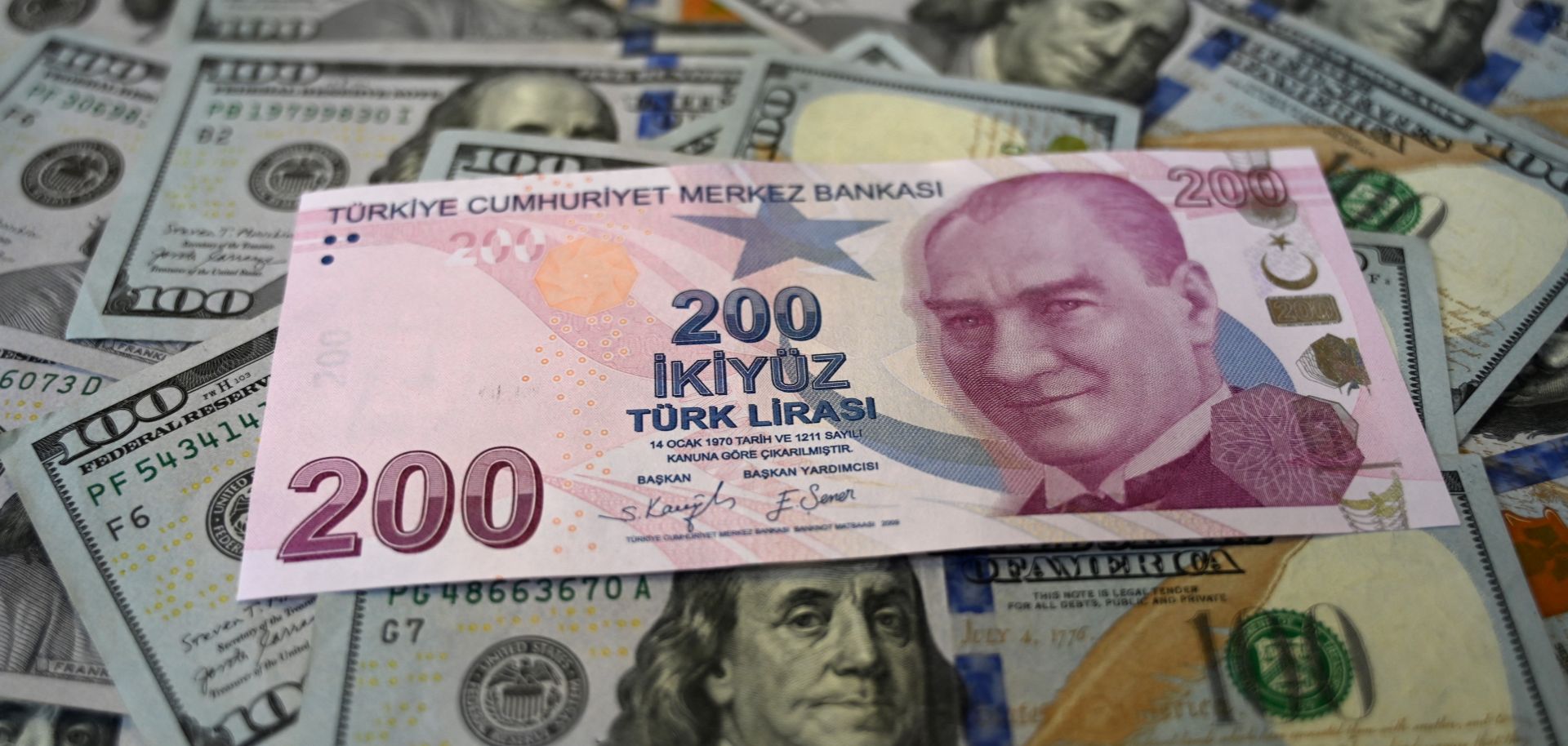
A Turkish lira banknote is seen on top of U.S. dollar banknotes in Istanbul, Turkey, on Dec. 7, 2021.
Turkey’s step toward capital controls to support the plunging lira will create additional uncertainty and presages further administrative efforts to preserve foreign exchange. On Jan. 3, the Central Bank of Turkey (CBRT) announced that exporters will now be required to convert 25% of their earnings in U.S. dollars, euros or British pounds to Turkish liras. The new surrender requirement on export revenue is a de facto capital control measure and marks Ankara’s latest effort to curb the increasing dollarization of Turkey’s economy amid the local currency’s free fall.
- On Dec. 20, the Turkish government offered to compensate holders of short-term lira time deposits for differences between the contractual interest rate and inflation. Less than 2% of foreign exchange deposits in Turkish banks were subsequently converted to lira. And with Turkish inflation reaching a 19-year high in December, the currency quickly resumed its depreciation against the U.S. dollar and euro.
- The latest CBRT data, as of Dec. 24, shows that in the week in which the lira deposit subsidies were announced, Turkish households moved only $100 million out of total foreign currency deposits of $239 billion into lira deposits, while businesses increased their foreign currency holdings by $1.6 billion.
Such surrender requirements are not unprecedented for Turkey, but the most recent measure indicates Ankara will maintain its politicized approach to monetary policy that rejects higher interest rates as an anti-inflation tool. The plan will not stop inflation and may worsen it as Treasury/CBRT losses are monetized and add liquidity to the economy, given the precipitous fall in the lira exchange rate and net negative foreign exchange reserves of the central bank, which points to further lira depreciation. Following the Dec. 20 announcement of the government’s new currency defense scheme, the lira reversed some of its losses against the dollar until Dec. 25, after which it resumed depreciation and lost 20% of its value in the last week of 2021. There is evidence that much of the lira’s gains may have been due to massive foreign exchange intervention by the CBRT and state-owned banks, although “official” intervention numbers show only about $5.2 billion in dollar sales in the first two weeks of December.
- Turkey had an 80% foreign currency surrender requirement in place from September 2018 to late 2019 during a previous iteration of a currency crisis and has also used other “soft” capital controls including changing fees charged on currency conversions and adjusting the requirements for currency hedging.
- The International Monetary Fund’s “Institutional View on Capital Flows in Practice” considers a surrender requirement that is designed to limit capital outflows in the case of a crisis or imminent crisis without a broad macroeconomic policy response to be inappropriate. In the case of a high inflation economy such as Turkey, that would include reversing economic overheating and reducing dependency on external financing. (Turkey’s external financing needs are projected to reach $210 billion, or 26% of GDP, in 2022.)
- The yield on 10-year government lira bonds hit 24.9% on Dec. 29, an increase of more than seven percentage points since the central bank began cutting its policy interest rate in September. Loan rates have jumped to as high as 35%, from a weighted average of 21%, according to central bank data and private sector financial participants.
The government’s efforts to try to stabilize the currency create added political risk by raising uncertainty, as well as fiscal risk in the Turkish economy if it is paid for through the budget. Whether it durably addresses the exchange rate problem depends on credibility, which actions by Turkish residents show is lacking. There have been no bids for forward swaps of foreign exchange, which were intended to get businesses to keep their funds in lira. Volatility has increased for both the Turkish currency, as well as Turkish assets such as stocks. Changes to the deposit guarantee program risk undermining it by creating new uncertainties as depositors and investors either delay the conversion of funds or demand higher risk premia and inflation accelerates. Currency volatility and high inflation have increased economic anxiety in Turkey, reflected in consumer confidence surveys and declining support for Turkish President Recep Tayyip Erdogan in some national polls.
- Turkish inflation rose to 36.1% (y-o-y) in December, the highest since September 2002. On a monthly basis, the price level was 13.6% higher in December than in November, an annualized increase of more than 460%.
- Since Dec. 20, the central bank has changed the schedule for forex and gold buying rates, increasing the frequency to six daily fixings from one. One of Erdogan’s financial advisors also said the government was weighing “inflation-indexed instruments” to guarantee investors against inflation losses.
- Turkish inflation rose to 36.1% (y-o-y) in December, the highest since September 2002. On a monthly basis, the price level was 13.6% higher in December than in November, an annualized increase of more than 460%.
- The volatility of lira-denominated assets has increased as interest rates no longer provide a credible anchor against inflation. The Turkish Treasury has assumed exchange rate risk on about $265 billion in retail banking accounts, which if realized, would require monetization and a further acceleration of inflation.
