
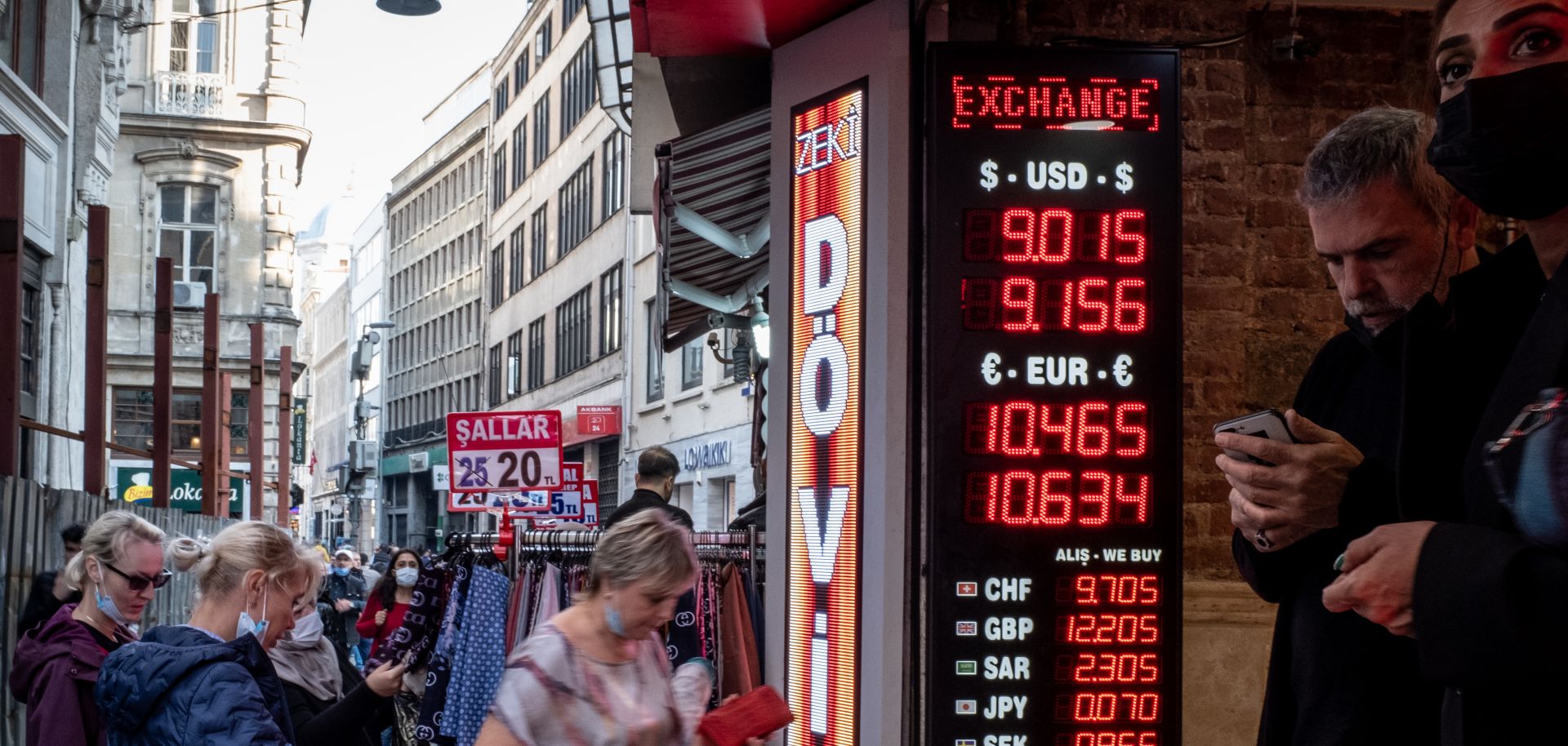
People line up at a currency exchange in Istanbul on Oct.14, 2021, after the firing of central bank officials caused the Turkish lira to drop to a new low against the U.S. dollar.
The Turkish central bank's policy of cutting interest rates amid rising inflation and a weakening currency will probably make both problems worse by spurring additional capital flight and deterring investment. The Central Bank of Turkey (CBRT) is widely expected to make its second consecutive monthly cut to interest rates during its Oct. 21 meeting, which follows last week’s purge of bank officials who had resisted such rate decreases. On Oct. 13, President Recep Tayyip Erdogan fired three members of the CBRT’s monetary policy committee who had pushed back against his calls to lower interest rates. The market’s reaction to the latest CBRT shake-up was almost instantaneous, with the Turkish lira’s exchange rate falling by 3% over the past week on top of the currency’s more than 20% depreciation previously this year.
- The lira’s value against the U.S. dollar has decreased by nearly 200% over the past five years, and by 400% over the past 10 years.
An interest rate cut and the further loosening of financial conditions risk increasing market volatility by further shaking investors’ confidence in Turkey’s economy, which is heavily dependent on short-term capital flows to finance a weak banking system and deeply indebted non-financial corporations. The Turkish economy has multiple vulnerabilities that the current CBRT policies could make worse, including:
- A low level of foreign exchange reserves. With advance commitments of nearly $140 billion, Turkey’s foreign exchange needs currently exceed its gross reserves, which were equivalent to $69.3 billion at the end of August. This leaves Turkey’s net reserves in the red at -$70.3 billion. The CBRT’s gold reserves currently total $40.6 billion, though these are typically illiquid in the short term. In addition, the International Monetary Fund (IMF) has said currencies used to value its issued reserve assets, known as Special Drawing Rights or SDRs (dollars, euros, sterling, yen and Chinese yuan), now account for less than half of CBRT gross assets, which increases volatility and hinders conversion to freely available and usable currencies.
- A high proportion of bank deposits in U.S. dollars or euros. According to IMF estimates, deposits in U.S. dollars and euros reached 60% of domestic bank deposits in the first half of 2021. A potential withdrawal of foreign currency deposits, especially if Turkish citizens lose faith in banks, could depreciate the lira at a potentially faster rate by increasing competition for foreign exchange, raising the risk of a currency “crash.”
- Highly leveraged corporations. Over the past 10 years, corporate debt as a share of equity has grown from 150% to 250% across all sectors in Turkey. The problem is particularly acute in the country’s transportation and food/accommodation sectors, where companies are nearing 500% leverage. About 20% of overall corporate debt is also foreign currency-denominated, leaving the balance sheets of Turkish firms exposed to currency risk in the absence of hedging.
- An annual gross external financing requirement in addition to projected current account deficits of about $200 billion per year through at least 2026. Rollover needs of short-term debt increase from $139 billion in 2021 to $165 billion in 2026.
Erdogan’s economic policy model prioritizes fast GDP growth at the expense of inflation and a depreciating exchange rate. The projected decline in Turkey’s economic growth next year indicates the current pace of expansion is not sustainable. The Turkish economy is underwritten by fast credit growth, which fuels consumption and construction, accelerates inflation, pumps up the current account deficit, and dries up international reserves as the government tries to defend a depreciating exchange rate.
- Turkey was one of the few large emerging markets with positive growth of 1.8% in 2020, which included a surge of 5.9% (y-o-y) in the fourth quarter of last year driven by an 8.2% increase in consumption and a 10.3% rise in construction. Growth remained relatively strong in the first half of 2021, and the IMF World Economic Outlook expects Turkey’s GDP to increase by a total of 9% this year before falling back to 3.3% in 2022. The resumption of some tourism in 2021, along with increased European demand for Turkish goods amid Asian exporters’ supply and logistical struggles, has also helped reduce Turkey’s current account deficit.
- Credit growth is a primary factor supporting domestic demand, with the amount of money in the Turkish economy increasing by one-third in 2020 and credit to the private sector rising by nearly 35%. The IMF estimates a positive credit “gap” with domestic credit increasing at a rate 25% greater than its long-term trend. Money growth in Turkey slowed slightly in H1-2021 as the CBRT temporarily pursued a more cautious policy, but that will change as interest rates fall and financial conditions loosen.
- In September, Turkey’s consumer price inflation reached a two-and-a-half-year high of 19.6% — nearly four times CBRT’s official target. Turks are becoming particularly angry over rising food prices, which increased 29% last month. Inflation in Turkey will, at best, fall only slowly as global food and energy prices remain high and there is a large pass-through to domestic inflation from a depreciating exchange rate.
Erdogan will continue to push for further interest rate cuts as the rest of the world moves toward monetary policy tightening, which will probably result in additional capital flight and weaker foreign direct investment. The CBRT’s policies are likely to produce lower real growth and higher inflation. This will, in turn, result in a sharp increase in the Turkish current account deficit and an even weaker exchange rate for the lira, as well as higher risk premia as markets react adversely to heightened political and financial risk. In the face of a rapidly depreciating lira, the CBRT may bow to market pressure on Oct. 21 by either maintaining its main policy rate at 18% or making a cut smaller than the expected 100 basis points. Any move to limit or defer an interest rate decrease, however, would likely prove temporary, as inflation in Turkey moves closer to 20% and interest rates become increasingly negative in real terms — increasing policy uncertainty and the risk of additional capital flight. As Turkey runs out of foreign exchange reserves and options to stabilize the lira, and as macroeconomic imbalances further undermine the economy, the CBRT’s next step could thus well be capital controls.
